
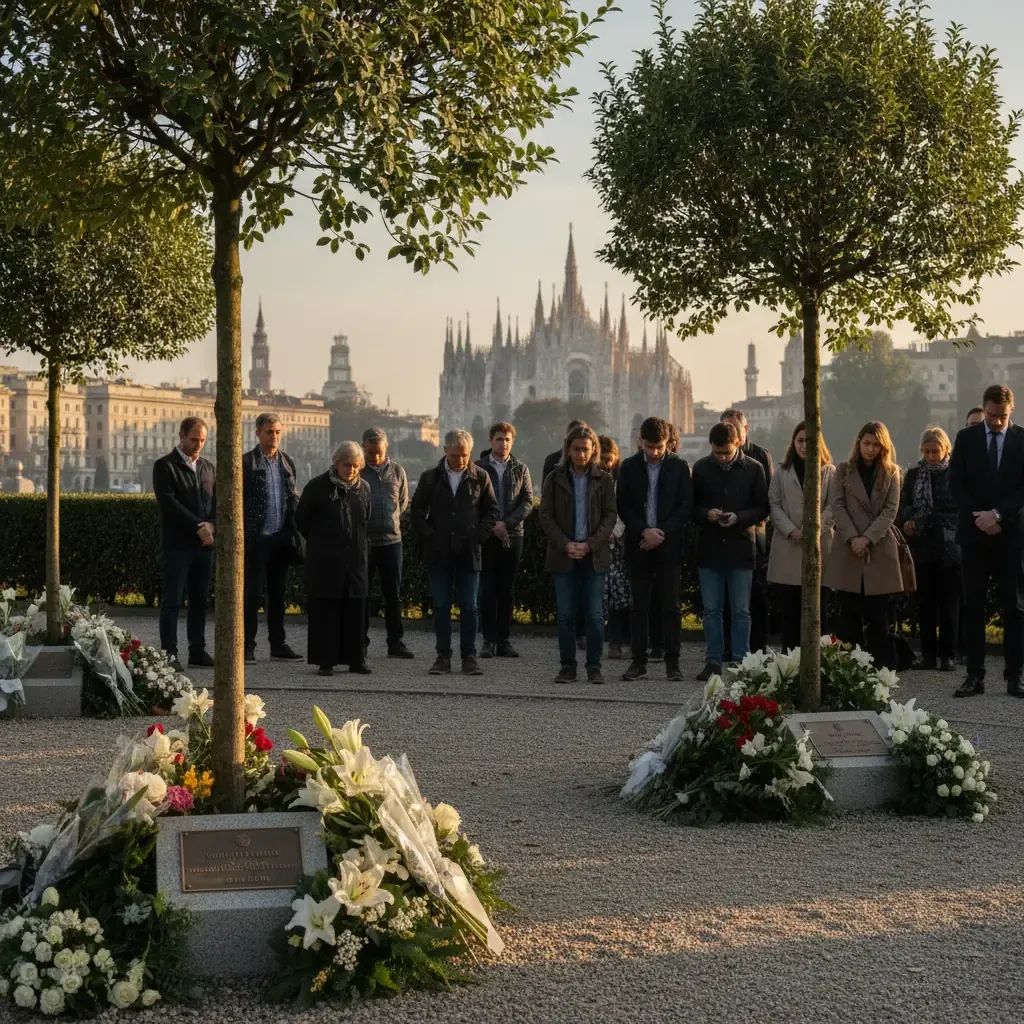
The Italian Senate hosted a solemn national ceremony on Saturday, May 9, 2026, marking the annual Day of Memory for victims of terrorism, an observance that has gained profound institutional weight since its establishment nearly two decades ago. The event brought together Italy's President Sergio Mattarella, Senate President Ignazio La Russa, and Chamber of Deputies President Lorenzo Fontana alongside ministers and the Constitutional Court President in a unified remembrance of those killed by political violence.
Why This Matters:
• May 9 marks the 48th anniversary of Aldo Moro's assassination by the Red Brigades in 1978, the event that anchored this national memorial day.
• Over 350 people died during Italy's "years of lead" terrorist campaigns, including 63 police officers—a death toll that shaped the nation's democratic institutions.
• The ceremony recognizes both domestic and international terrorism victims, expanding the scope beyond historical attacks to include contemporary threats.
• Schools nationwide compete in the "Tracce di memoria" (Traces of Memory) contest, ensuring younger generations understand the fragility of democratic order.
A Ceremony Rooted in National Trauma
The Italian legislature began the commemoration shortly after 10:30 on Saturday morning, opening with the national anthem performed by student choirs from the Liceo Statale Alessandro Manzoni in Latina. The musical choice was deliberate—placing young voices at the center of a ceremony designed to bridge generational memory gaps. President Mattarella entered the Senate chamber to sustained applause, a gesture reflecting both respect for his office and acknowledgment of his consistent presence at these annual observances.
Law 56 of 4 May 2007 formally established this memorial day, selecting 9 May specifically because it represents the culmination of Italy's bloodiest terrorist period. On this date in 1978, authorities discovered the body of Aldo Moro, the Christian Democracy president kidnapped 55 days earlier by the Red Brigades. His murder represented not just the loss of a political leader but an assault on the negotiated compromise that had defined postwar Italian governance.
Yet the ceremony deliberately extends beyond Moro. Among those remembered is Peppino Impastato, killed for confronting mafia power and defending legality. The observance honors prosecutors, carabinieri, ordinary citizens caught in bombings, and more recently, victims of international attacks—a recognition that terrorism's threat has evolved rather than disappeared.
Testimony and the Work of Memory
Following introductory remarks by Corriere della Sera Director Luciano Fontana and addresses from the legislative presidents, the ceremony shifted to its most emotionally charged segment: testimonies from relatives of the murdered. These were not generic speeches but specific narratives designed to humanize statistics that might otherwise remain abstract.
Susanna Occorsio spoke for her father, Deputy Prosecutor Vittorio Occorsio. Massimo Coco remembered Prosecutor General Francesco Coco. Gina Dinnella represented her uncle Giovanni Saponara, a security officer. Massimo Deiana and Alberto Capolungo honored their fathers, both carabinieri—Antioco Deiana and Pietro Capolungo—targeted for their uniforms. Stefania Collavin testified for her husband Christian Rossi, killed in the 2016 Dacca attack that killed 9 Italians at a Bangladesh restaurant.
The RAI broadcast a documentary montage interwoven with these testimonies, a deliberate editorial choice to contextualize personal grief within broader patterns of violence. The public broadcaster dedicated significant programming to the event, airing live coverage on Rai 3 through Rai Parlamento and scheduling thematic specials across multiple channels—a media strategy that extends the ceremony's reach far beyond the Senate chamber.
This emphasis on direct witness accounts reflects a broader shift in how Italy processes its terrorist past. Early commemorations struggled with political fragmentation, with different constituencies championing different victims depending on whether perpetrators came from the far left or far right. The institutionalization of 9 May as a unified memorial day represents a deliberate effort to transcend those divisions, treating all political violence as an assault on constitutional order rather than as episodes requiring separate moral accounting.
Educating the Next Generation
A highlight of Saturday's event was the presentation of awards in the 12th edition of the "Tracce di memoria" national schools competition, organized by the Ministry of Culture's General Directorate of Archives in collaboration with the Ministry of Education and Merit, the Flamigni Archive, and the Network of Archives for Remembrance.
This year's top prize went to a fourth-grade class at the Matteotti primary school within the Istituto Comprensivo n. 7 "Carmen Silvestroni" in Forlì. Their project, titled "Il Treno della Scelta" (The Train of Choice), examined the life of Silver Sirotti, a railway worker from Forlì killed in the 1974 Italicus train bombing. The attack, which killed 12 and injured 48, remains one of the deadliest in Italian history—and like many such attacks, its full truth remains contested decades later.
The competition requires students to work with archival documents available through the Portal of the Network of Archives for Remembrance, producing research papers, biographical reconstructions, memory site analyses, or multimedia presentations. For the 2025-2026 school year, the competition focused on terrorism and political violence facts and victims from 1946 onward, with submissions that had closed ahead of the May 9, 2026 award ceremony. The initiative consciously aims to cultivate critical thinking among students who have no personal memory of the years of lead but who inherit a democracy shaped by that violence.
What This Means for Residents
For those living in Italy, this annual ceremony serves multiple functions beyond simple remembrance. It represents a state commitment to institutional continuity despite attempts to destabilize it through violence. The consistent participation of Italy's highest officials signals that the republic survived not through authoritarian measures but by maintaining democratic norms even under sustained attack.
The evolving scope of the memorial—now encompassing international terrorism victims—acknowledges that security threats have transformed. Residents traveling abroad or hosting international visitors navigate risks that differ from those of the 1970s but stem from related impulses to use violence for political ends.
For families of victims, the ceremony provides official recognition that their relatives' deaths were not merely personal tragedies but losses borne by the entire nation. The Italian Association of Terrorism Victims (AIVITER) and similar organizations have lobbied persistently to ensure state memory matches private grief—a process that has included pushing for fuller investigation of attacks where responsibility remains murky or where state complicity is suspected.
The educational dimension matters particularly for younger Italians. The "Tracce di memoria" competition and similar initiatives aim to prevent the historical amnesia that can make past extremism seem romantic or justified in retrospect. By requiring engagement with primary sources rather than simplified narratives, these programs attempt to inoculate against both nostalgia and trivialization.
The ceremony concluded with the European anthem, a deliberate choice that frames Italy's experience within a continental context where multiple nations have confronted terrorism and sought to preserve open societies despite persistent threats. The musical bookend—from national to European anthem—encapsulates the ceremony's dual message: honoring specific Italian losses while recognizing shared democratic vulnerabilities that transcend borders.
Rai's extensive coverage ensures the event reaches households nationwide, maintaining public awareness even as the temporal distance from the worst attacks grows. For a country where collective memory often fragments along political and regional lines, this annual ritual represents an ongoing effort to sustain consensus that some methods—regardless of stated goals—fall outside acceptable political action.


