
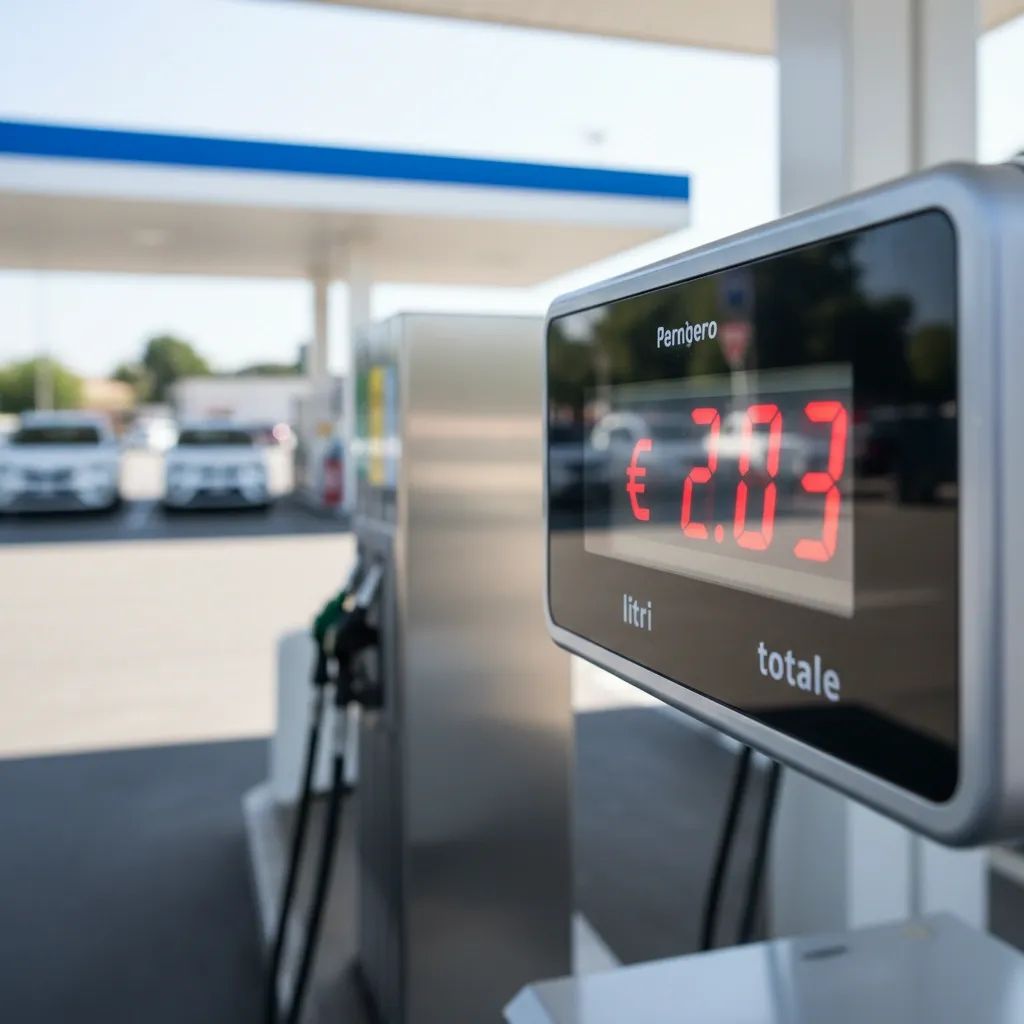
Italian households and drivers are facing a sharp cost-of-living squeeze as fuel and energy prices surge following escalation of the Iran conflict. Drivers now pay an additional €16.5M collectively per day at the pump compared to late February, while analysts warn that total household energy bills could climb by €350 to €660 annually—or far higher if geopolitical tensions persist.
Why This Matters
• Fuel prices have surged dramatically: Diesel is up 18.5% (+€0.32/liter) and gasoline 9.1% (+€0.15/liter) since February 27, the day before hostilities escalated.
• Tax revenue is climbing too: The Italian state collects an extra €9.5 M daily in VAT and excise duties from higher fuel prices, accounting for roughly 58% of pump costs.
• Power bills hit hardest: Wholesale electricity prices jumped 60% in two weeks, far exceeding other commodities and outpacing copper (+40%), iron (+20%), and aluminum (+20%).
• Government aid is selective: A €115 one-time credit will go to 4 M low-income households, but broader excise cuts remain under evaluation.
The Fuel Shock: Numbers and Consequences
Data from Codacons, Italy's leading consumer watchdog, reveals the scale of the fuel crisis. Between February 27 and today, diesel prices at the pump climbed from €1.74 to €2.03 per liter in self-service mode, a leap that translates to roughly €16 more per tank for diesel drivers and €7.60 extra for gasoline users.
Across Italy's ordinary road and motorway network, roughly 64 M liters of fuel are sold daily—40.1 M liters of diesel and 23.9 M liters of gasoline. The collective overspend attributable to the conflict now totals €16.5 M every 24 hours, a figure that excludes aviation fuel, maritime diesel, and heating oil.
Some service stations on Italy's autostrada network have already breached the psychological thresholds of €2.50/liter for full-service diesel and €2.30/liter for gasoline. These are the highest readings since mid-2022, when the Russia-Ukraine war sent Brent crude above $120 per barrel.
By comparison, the current Brent benchmark closed above $100/barrel for the first time since July 2022, driven in part by a near-total paralysis of tanker traffic through the Strait of Hormuz, a chokepoint that normally handles one-fifth of global oil exports.
What This Means for Residents
For the average Italian household, the repercussions extend well beyond the petrol station. Nomisma Energia, a Bologna-based energy consultancy, projects that the country's 27.7 M households will face an average annual increase of €350 on combined energy bills—assuming no further escalation and partial government mitigation.
If inflation rises to 2% as a result of the crisis, Codacons calculates that each family will lose an additional €661 in purchasing power over 12 months, equating to a €17 B collective hit across Italy. Should inflation reach 5%—a scenario some analysts consider plausible if hostilities intensify—the damage balloons to €1,653 per household and a staggering €42.6 B nationwide.
Confcommercio, the Italian commerce federation, warns that small and medium-sized enterprises will bear disproportionate costs. A mid-sized hotel could see monthly energy bills rise by €1,900, while a supermarket faces an extra €1,100 per month. Electricity tariffs for commercial users may climb 13%, with gas bills surging as much as 43% if wholesale prices hold at current levels.
The CGIA research office in Mestre identifies Rome as the hardest-hit metropolitan area, with a projected €705.8 M increase in aggregate household energy costs, though this translates to similar per-household impacts across the country. Milan follows at €554.5 M and Naples at €406 M. Smaller provinces like Vibo Valentia (+€23.1 M), Aosta (+€21.3 M), and Isernia (+€12.7 M) will see proportionally similar burdens on local households and budgets.
Government Response: Targeted, Not Universal
While households struggle with rising costs, the government collects an additional €9.5M daily in VAT and excise duties from higher fuel prices. The Italy Cabinet has rolled out a new energy decree—informally dubbed the "Bollette Decree"—that prioritizes support for vulnerable households and energy-intensive industries. The centerpiece is a €115 one-time electricity rebate for the roughly 4 M families already enrolled in the social bonus program, costing the treasury €315 M in 2026.
Commercial and industrial users will receive a combined €431 M in bill relief this year, rising to €500 M in 2027 and €68 M in 2028. The government has also trimmed transport and distribution tariffs for large gas consumers (those using more than 80,000 cubic meters annually) and reduced the ASOS levy—a component of general system charges—for low- and medium-voltage industrial customers.
To finance these measures, Rome has imposed a 2% IRAP surcharge for 2026 and 2027 on companies operating primarily in oil and gas extraction, power generation, and electricity distribution.
Adolfo Urso, Italy's Minister of Enterprises and Made in Italy, has ruled out a blanket excise cut for now, arguing that such measures are expensive, poorly targeted, and risk benefiting wealthier motorists disproportionately. Instead, his ministry is exploring the "accise mobili" mechanism—a sliding-scale excise adjustment that kicks in when crude prices and VAT receipts climb beyond predetermined thresholds. Activation depends on securing additional budget cover.
The Guardia di Finanza, Italy's economic police, has intensified anti-speculation patrols at fuel depots and along distribution chains, though no major enforcement actions have been announced. The 2023 Fuel Price Transparency Decree grants the national price watchdog enhanced monitoring powers, which officials say will deter opportunistic markups.
Practical Advice for Residents
For individuals and families seeking to mitigate the impact:
• Review tariff plans: Many Italian electricity suppliers offer discounts of up to 10% for households with ISEE certificates below €25,000 (ISEE is Italy's household income indicator used to determine eligibility for social benefits) who do not qualify for the full social bonus.
• Explore employer fuel benefits: Under current tax law, fuel expenses covered by employers count as fringe benefits and are tax-exempt up to €2,000 annually (€1,000 for employees without dependent children).
• Consider photovoltaic installation: With wholesale power at €143/MWh, rooftop solar systems achieve payback in 6 to 8 years in southern Italy, and government subsidies remain available for residential installations.
• Monitor pump prices: Use apps like "Prezzi Benzina" to locate the cheapest stations in your area; price spreads can exceed €0.10/liter within a single municipality.
• Optimize driving habits: Reducing highway speed from 130 to 110 km/h cuts fuel consumption by roughly 15%, a meaningful saving when diesel exceeds €2/liter.
Commodities Under Pressure
The crisis is not confined to hydrocarbons. A survey by CNA, the national artisan and small-business confederation, shows that wholesale electricity prices in Italy have surged 60% in two weeks, reaching an average of €143/MWh—far above Germany's €102, France's €63, and Spain's €48. The disparity reflects Italy's heavy reliance on gas-fired generation and limited interconnection capacity.
Copper, driven by sustained demand from electric-vehicle manufacturers and data centers, has jumped nearly 40%, though the London Metal Exchange recorded a 2% pullback in the past ten days. Iron profiles and aluminum extrusions used in construction have risen 20%, while bituminous concrete is up 18% and some industrial plastics 30%.
Steel products have shown more restraint: hot-rolled coils are up 3%, galvanized coils 4%, and cold-rolled sheets remain stable. However, these categories have been climbing steadily since January, with year-to-date increases around 10%.
Timber, critical for furniture and construction, has begun to feel the strain, with prices lifting 10 to 15% as logistics costs and insurance premiums escalate. Shipping a standard container from Asia to Italy now costs up to €3,000 more than in February, according to freight forwarders.
Interestingly, some metals have bucked the trend: nickel fell 1.9%, copper declined 2.6%, lead dropped 2.7%, zinc 3%, and tin 7.9% during the first fortnight of the conflict. Flour prices have held steady, offering a rare point of stability for bakeries and pasta producers.
Regional and Sectoral Disparities
Not all regions or industries will feel the pinch equally. Lombardy and Emilia-Romagna, with their dense clusters of small manufacturers, are especially vulnerable to electricity and gas spikes. Sicily and Sardinia, more reliant on oil-fired generation and diesel transport, face steeper fuel bills.
The tourism and hospitality sector, just entering the spring booking season, worries that higher operating costs will erode already thin margins. Confcommercio reports that hoteliers are reluctant to raise room rates for fear of dampening demand, yet energy bills are climbing faster than revenue.
Conversely, renewable-energy producers—particularly photovoltaic and wind operators with long-term power-purchase agreements—are enjoying windfall profits as wholesale electricity prices soar. Environmental groups are urging the government to accelerate grid-connection approvals for new solar and wind farms, arguing that supply diversification is the only durable answer to price volatility.
European Context
Italy is not alone. Across the European Union, governments are weighing similar trade-offs between fiscal prudence and social protection. Germany activated a €200 B energy shield during the 2022 crisis; France capped retail electricity increases at 15%. Both measures remain partially in place.
The European Commission has floated proposals for joint gas procurement and a temporary price cap on wholesale electricity, though member states remain divided on implementation. Italy, along with Spain and Portugal, advocates for decoupling electricity prices from gas benchmarks, a reform that would require treaty-level changes and has met resistance from northern European capitals.
What Happens Next
Economic forecasters are watching two variables: the duration of the Iran conflict and the trajectory of Italy's inflation rate. The Bank of Italy projects headline inflation at 1.4% for 2026, rising to 1.6% in 2027 and 1.9% in 2028. The OECD estimates 1.8% for this year, while the European Commission had penciled in 1.3% before the crisis escalated.
However, Oxford Economics warns that a prolonged military escalation in the Gulf could push Italian inflation above 3% by year-end. The ISTAT consumer price index already jumped to 1.6% year-on-year in February, up from 1% in January, and energy is the primary driver.
For households, the arithmetic is sobering. Federconsumatori calculates that an average motorist will spend an extra €186.64 annually on fuel alone, before accounting for second-order effects—higher delivery fees, pricier groceries, and increased public-transport fares as operators pass on diesel costs.
Businesses are no less exposed. The manufacturing sector, already grappling with weak demand from Germany and France, now faces a €10 B collective energy-cost increase, according to industry lobby groups. Firms in paper, ceramics, glass, and chemicals—sectors where energy represents 20% to 40% of variable costs—are exploring temporary production halts or shift reductions.
The coming weeks will test both government resolve and household resilience. If Brent crude stabilizes below $105 and Hormuz shipping resumes, relief could arrive by summer. If not, Italy may face its most severe cost-of-living squeeze since the eurozone debt crisis.


