
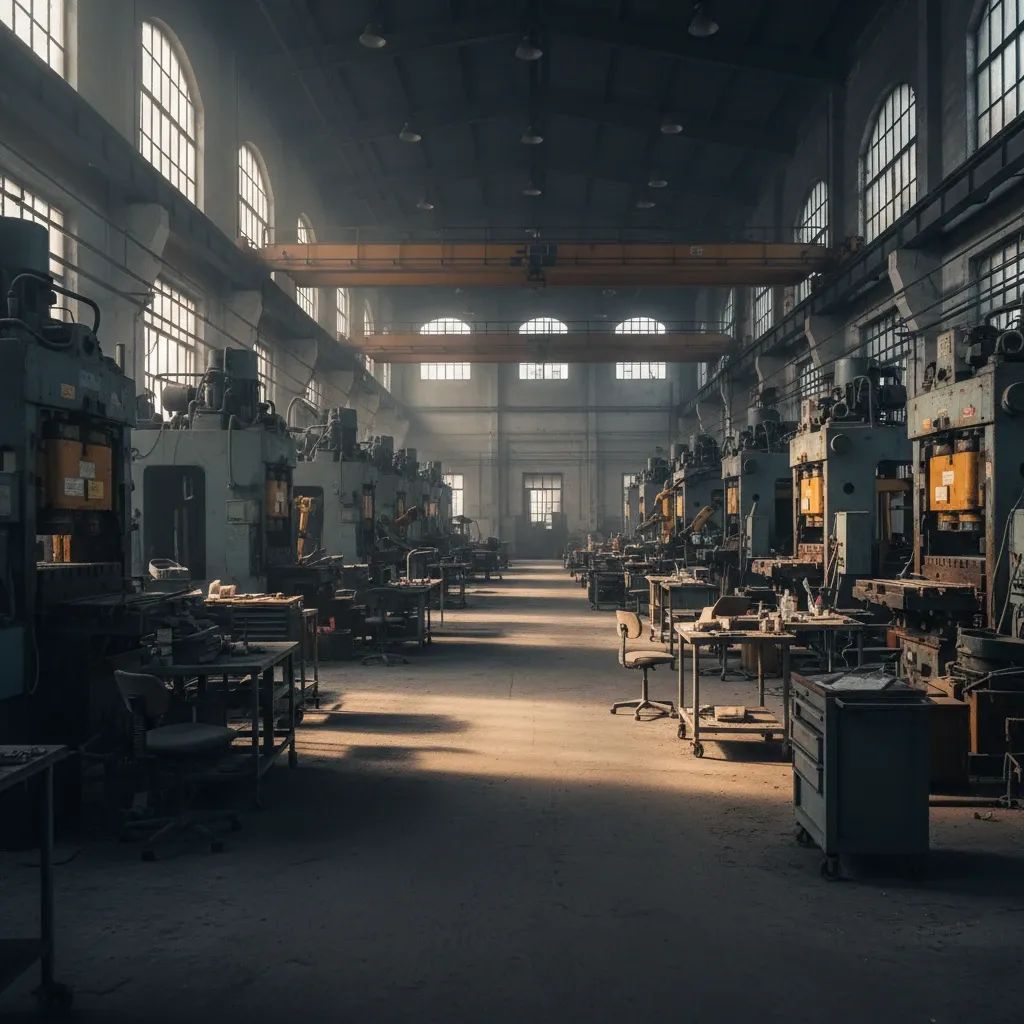
How Italy's Appliance Industry Is Being Quietly Dismantled
The Swedish appliance manufacturer Electrolux has initiated a restructuring that will eliminate 1,700 positions—nearly 40% of its Italian workforce of approximately 4,500 employees—and permanently shut down its specialized production facility in Cerreto d'Esi in the Marche region. This decision, announced on May 11 at a coordination meeting in Mestre (Venice), represents far more than a typical corporate downsizing; it signals the accelerated retreat of one of Europe's last remaining appliance manufacturing hubs from Italian territory.
Why This Matters:
• Immediate employment: 170 workers face joblessness when Cerreto d'Esi closes; additional layoffs planned at Forlì and other sites.
• Supply chain collapse: Hundreds of component suppliers, logistics firms, and service providers built decades-long relationships around Electrolux operations—their survival is now in question.
• Structural shifts: Production of premium kitchen hoods moves to Poland, laundry equipment manufacturing halts in Porcia, and cooktop production ends in Forlì.
• Government response: The Italy Ministry of Business and Made in Italy has pledged dialogue but announced no concrete countermeasures to prevent the closures.
The Financial Logic Behind Offshoring
Electrolux confronts a different operating reality than the one that made Italy a manufacturing powerhouse. The group's operating margins have eroded dramatically—currently standing at 2.8% of revenue, down from already-anemic levels of 0.8% in 2022. To return profitability to above 6%, the company has concluded that European production, particularly in Italy, cannot compete with cost structures elsewhere.
The European appliance market itself is contracting. Weak demand across the continent, combined with relentless price competition from Asian competitors, has squeezed traditional manufacturers from both sides. Electrolux argues that preserving the status quo guarantees further deterioration, making the restructuring not a choice but a necessity for corporate survival.
The migration of production lines to Poland reflects a cold calculation: labor costs, infrastructure expenses, and operational complexity are fundamentally lower in Central Europe. The company's decision to concentrate exclusively on high-margin product categories—premium refrigeration units, built-in appliances, design-intensive pieces—represents an abandonment of volume manufacturing, which Italy's cost structure cannot support.
The Physical Footprint of Retreat
The restructuring creates a fractured appliance ecosystem across five Italian manufacturing sites. Cerreto d'Esi, which specializes in top-tier kitchen hoods, becomes the first casualty. Its 170 workers produced equipment destined for affluent European households, but that production now shifts eastward. Forlì, near Bologna, loses cooktop manufacturing, with layoffs affecting workers at the site. Porcia in northeastern Italy halts washer-dryer production. Only Susegana in Treviso survives—reoriented as Electrolux's single refrigeration hub for Europe, focusing on premium built-in models.
The Solaro facility near Milan and remaining operations at Porcia will continue operations but under reduced capacity. Across all sites, no protection exists; layoffs will touch every location.
For mayors and regional administrators, the mathematics are stark. One facility closing means not merely job losses at that single plant, but ripple effects across local economies. Component manufacturers, packaging suppliers, logistics operators, and technical service providers have built entire business models around proximity to Electrolux factories. A company shuttering production means these ancillary businesses face potential bankruptcy.
How This Erodes More Than Paychecks
Daniela Ghergo, mayor of Fabriano—home to many Electrolux workers—framed the crisis in terms of systemic collapse. "The workers themselves will suffer most," she stated, "but so will the hundreds of enterprises that depended on the supply chain. What took decades to build is being dismantled in days." She referenced the earlier Beko crisis, when the Turkish appliance maker contracted sharply in Italy, already destabilizing the regional economy. Two major crises in succession threaten to transform a historically productive region into one defined by industrial abandonment.
The Marche region, where Cerreto d'Esi sits, faces particular vulnerability. Its economy is geographically concentrated; losing appliance manufacturing density there resembles losing a critical pillar from a structure already stressed.
The Partnership Question That Won't Go Away
Union leaders have seized on what they view as corporate hypocrisy. Electrolux explicitly ruled out any joint venture with Midea, the Chinese appliance conglomerate, for Italian operations. This stings because the company simultaneously announced a major partnership with Midea for North America, creating three joint ventures for refrigeration and laundry products with expected launch in the third quarter of 2026. That arrangement is projected to initially affect 1,500 North American employees, with hiring anticipated through 2027 and 2028.
The disparity is obvious to union strategists: if Midea is acceptable as a partner to strengthen competitiveness in North America, why not in Italy? The answer Electrolux provides—operational cost realities, market dynamics—rings hollow to workers watching capital and opportunity flow elsewhere while their factories face closure.
Institutional Responses: Promises Without Specifics
The Italy Ministry of Business and Made in Italy responded with standard diplomatic language: commitment to "maximum attention," pledges to facilitate "shared solutions," and assertions that employment and production continuity remain priorities. However, no enforcement mechanisms, financial incentives, or regulatory interventions were announced.
Francesco Acquaroli, president of the Marche region, promised activation of "all institutional channels, local and national" to defend Cerreto d'Esi. Yet regional officials lack tools to compel a multinational corporation to reverse course. Their leverage lies purely in political pressure and participation in negotiation tables.
At the national level, Pierpaolo Bombardieri, general secretary of the UIL union, introduced a different argument during a regional congress in Senigallia. He demanded accountability for subsidies: since 2013, the Italian government has expended approximately €700 million in incentives for appliance and furniture purchases through various bonus schemes. "Make them return the money," Bombardieri insisted, referring to Electrolux. "Repurpose those funds to create genuine employment." The proposal carries moral weight but faces entrenched skepticism about whether any government would pursue capital clawbacks against multinational corporations.
The Strike as Pressure Mechanism
Fim, Fiom, and Uilm—the three largest metalworker unions—declared a permanent state of agitation and orchestrated an eight-hour national strike across all Electrolux facilities. The action serves less as an immediate economic threat to Electrolux than as a political signal: organized labor opposes the plan and demands its modification. Union statements explicitly frame the restructuring as "unacceptable," rejecting any reduction in headcount.
Daniela Fumarola, general secretary of CISL, echoed similar language on social media platforms, emphasizing corporate social responsibility. "Companies investing in Italy bear responsibilities to labor and the national industrial base," she wrote. Her framing appeals to concepts of reciprocal obligation—if Italy provided investment climate and incentives, corporations must reciprocate through employment stability.
The strike will test whether worker mobilization can extract concessions, but historical patterns suggest limited success. Corporations weighing existential profitability challenges against temporary labor disruptions typically proceed with restructuring once announced.
What This Reveals About Italy's Industrial Trajectory
The Electrolux announcement crystallizes longer-term patterns. Italy once dominated European appliance manufacturing through innovation, craftmanship, and scale. Over the past 15 years, that dominance has gradually eroded as production migrated eastward and cost pressures intensified. Electrolux's decision represents an accelerated version of migration that has already occurred across numerous Italian manufacturing sectors.
The company maintains that Italy remains strategically important for product development and brand management—a standard formulation suggesting the country will retain design, marketing, and innovation functions while ceding production capacity. This is the future trajectory across multiple industries: Italy as a design and intellectual property center, not a manufacturing powerhouse.
However, this model fails to account for the reality that production workers outnumber product designers, and small-supplier networks depend on nearby factories, not distant headquarters. The transition from production-based employment to knowledge-work offers little solace to workers in Cerreto d'Esi or surrounding districts.
The Uncertain Path Forward
Electrolux committed to managing workforce impacts through formal procedures and dialogue with institutions and unions, but provided no specifics on severance structures, retraining programs, or alternative employment pathways. This vagueness reflects genuine corporate uncertainty: the company knows the scope of cuts but has not yet determined how to implement them in ways that minimize legal exposure.
Negotiations between Electrolux, Italian government representatives, and union leaders will determine whether marginal adjustments occur—perhaps a delayed timeline for closures, slightly enhanced severance packages, or retraining commitments. A complete reversal appears implausible given the restructuring's strategic rationale. What remains to be determined is whether political pressure and union action extract incremental protections for affected workers and communities.
For residents of Marche, Friuli Venezia Giulia, and neighboring regions where appliance manufacturing clusters developed, the Electrolux decision reads as a final acknowledgment: the industrial model that sustained employment and prosperity for decades is fundamentally incompatible with 21st-century global competition. Whether Italian institutions can respond with policies that ease that transition—or whether they will passively accept it—will largely determine how severe the social consequences become.


