
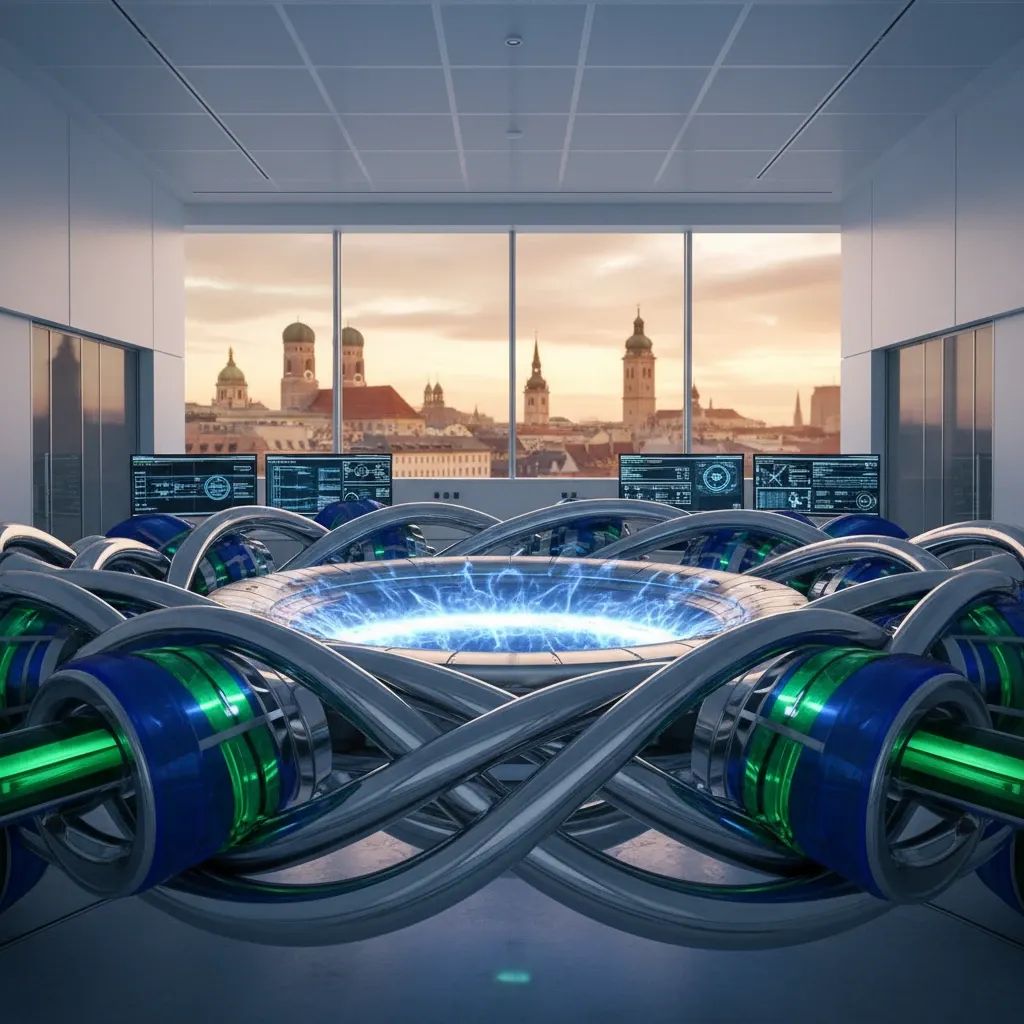
A consortium led by an Italian CEO has struck a landmark deal that could reshape Europe's energy landscape, positioning the continent at the forefront of commercial fusion power. Proxima Fusion, with Managing Director Francesco Sciortino at the helm, has secured a memorandum of understanding to build Alpha, the world's first demonstration stellarator fusion reactor, in Bavaria, Germany—not Italy. The project will be funded through a €2 billion multi-phase program, with the demonstration reactor (Alpha) itself estimated at approximately €400 million according to Bavarian officials, and operational targets set for the early 2030s (approximately 2032-2033 for first plasma).
Why This Matters
• Energy independence: A successful stellarator could deliver continuous clean energy without carbon emissions or long-lived nuclear waste, fundamentally altering Italy's and Europe's reliance on imported fossil fuels.
• Economic shift: The Bavarian state is committing up to €400M, with private investors contributing another €400M and the German federal government expected to provide over €1 billion for the broader program phases.
• Strategic location: The follow-on commercial plant, Stellaris, will be built at a decommissioned nuclear site in Gundremmingen, demonstrating how old atomic infrastructure can be repurposed for next-generation power.
Europe Stakes Its Claim in the Fusion Race
The February 2026 agreement unites the Free State of Bavaria, the Max Planck Institute for Plasma Physics (IPP), German utility giant RWE, and Proxima Fusion in a partnership designed to accelerate magnetic confinement fusion from laboratory curiosity to grid-ready technology. Bavaria's Minister President Thomas Soder framed the initiative as a strategic commitment to Europe's ability to commercialize fusion before rivals in North America and Asia.
Alpha will be constructed near the IPP facility in Garching, just outside Munich, leveraging decades of German expertise in plasma physics. The stellarator design—a twisted, three-dimensional magnetic cage that holds superheated plasma without inducing electrical currents—promises inherent stability and continuous operation, advantages over the more widely known tokamak reactors that dominate international projects like ITER.
The timeline is aggressive: six to seven years from groundbreaking to first plasma, with Alpha expected to achieve net energy gain by demonstrating that the plasma generates more power than the reactor consumes. That milestone, known as Q>1 (the ratio of output energy to input energy, exceeding 1:1), has eluded every fusion experiment to date when accounting for total system energy input.
What This Means for Italian Residents and Europe
For Italian residents, this project represents both a symbolic and practical stake in Europe's energy future. While the facility is being built in Bavaria, the Italian leadership of Proxima Fusion places Italy in the executive tier of European fusion development—a sector that has attracted over €7.1B globally in private capital as of 2026. This positions Italian technical expertise and investment capital at the heart of what could become a multi-billion-euro industry. For Italian policymakers and investors, Sciortino's role opens pathways to participate in the commercial fusion supply chain, from component manufacturing to energy trading as fusion power comes online.
More broadly, fusion energy—if successfully commercialized—would provide baseload power: the kind of always-on electricity (constant output, 24/7 availability) currently supplied by coal, gas, and nuclear fission, but without greenhouse gas emissions, fuel supply vulnerabilities, or the long-term radioactive waste that plagued the 20th century's atomic plants. For Italy, where energy imports remain a structural vulnerability, successful commercialization of fusion technology could fundamentally reduce dependence on Russian gas and other geopolitical energy pressures.
Proxima Fusion's roadmap calls for Alpha to de-risk the technology, followed by Stellaris, a full-scale commercial power station scheduled for construction at RWE's former Gundremmingen nuclear site in Bavaria. That location is symbolic: Germany shut down its last fission reactors in 2023, and fusion advocates argue that stellarators can slot into existing transmission infrastructure, reusing grid connections and workforce expertise.
Stellarators Versus Tokamaks: A Technical Divergence
The choice of stellarator geometry is not trivial. While tokamaks—used by projects like Commonwealth Fusion Systems in Massachusetts and the multinational ITER experiment in southern France—have dominated fusion research for decades, they require pulsed operation (periodic bursts rather than continuous operation) and suffer from plasma instabilities that can abruptly terminate reactions. Stellarators, by contrast, use external coil arrays to twist the magnetic field into a self-stabilizing shape, allowing the plasma to run continuously without induced currents.
This design philosophy translates into operational flexibility. Stellarators are seen as a "perfect substitute" for coal boilers in existing thermal power plants, delivering a steady heat source that can drive conventional steam turbines. Tokamaks, with their pulsed behavior, face greater integration challenges with grid infrastructure designed for constant output.
The trade-off has historically been construction complexity. Stellarator coils are contorted into three-dimensional geometries that were nearly impossible to manufacture before the advent of modern supercomputing and precision fabrication. Proxima Fusion is betting that advances in high-temperature superconducting (HTS) magnets—powerful magnetic coils that lose electrical resistance when cooled to extreme temperatures—and AI-driven design optimization have reduced that barrier to the point where stellarators can be built faster and cheaper than ever before.
Financing the Future: Public, Private, and Federal Funds
The €2B figure cited in the February 2026 agreement represents the total investment across multiple project phases. Alpha, the demonstration reactor, is estimated at approximately €400M according to Bavarian Minister President Thomas Soder. Proxima Fusion has pledged to raise approximately 20% of the broader program costs (around €400M) from private international investors, building on the €130M it secured in earlier funding rounds. The Bavarian government has offered a matching 20% regional co-financing, contingent on state budget constraints.
The largest chunk—over €1B—is expected from the German federal government through its High-Tech Agenda, a national innovation fund aimed at positioning Germany as a global technology leader. RWE, one of Europe's largest utilities, has also signaled financial participation, though specific commitments have not been disclosed.
This blend of public subsidy and private venture capital mirrors the funding model emerging across the fusion sector. In the United States, Commonwealth Fusion Systems has raised similar sums to build its SPARC tokamak, while Helion Energy has signed a power purchase agreement with Microsoft for 50 MW by 2028. The European Commission is drafting its first comprehensive fusion strategy, due in early 2026, with the explicit goal of positioning the EU at the forefront of commercial fusion deployment.
Technical Hurdles: Plasma, Materials, and the Tritium Cycle
Despite the optimism, formidable obstacles remain. Plasma confinement at tens of millions of degrees Celsius demands magnetic fields strong enough to prevent the plasma from touching reactor walls, yet precise enough to maintain stable densities for extended periods. Even small disruptions can quench the reaction.
Material science poses another challenge. Neutrons produced by deuterium-tritium fusion bombard reactor walls at high energy, causing embrittlement and inducing low-level radioactivity in structural components. While fusion produces far less hazardous waste than fission, managing neutron damage and component lifecycles is critical to economic viability.
The tritium fuel cycle is perhaps the most critical bottleneck. Tritium, a radioactive hydrogen isotope with a 12.3-year half-life, is scarce and must be bred inside the reactor by bombarding lithium with neutrons. A self-sustaining tritium breeding loop has never been demonstrated at scale, and any commercial plant will need to prove it can produce more tritium than it consumes.
The Competitive Landscape in 2026
Proxima Fusion is not alone in the race. Commonwealth Fusion Systems aims to bring its SPARC tokamak online by late 2026, with a commercial successor, ARC, targeting grid delivery by 2030. Tokamak Energy in the United Kingdom is integrating HTS magnets with compact tokamak geometries, aiming for 500 MW plants by the mid-2030s. TAE Technologies in California plans to site a 50 MWe industrial-scale facility by the end of 2026.
In Asia, China Fusion Energy Co. is scaling up reactor engineering and component manufacturing for future demonstration facilities. Europe's Gauss Fusion consortium, spanning Italy, Spain, Germany, and France, is targeting operational fusion by 2045.
The ITER tokamak in France, the world's most expensive science experiment with costs estimated between €20B and €40B, achieved first plasma in December 2025 but is not expected to reach full activation until after 2030. Its successor, DEMO, is intended as a prototype commercial reactor, but the timeline stretches deep into the 2030s.
Industry analysts predict a two-tier market: tokamaks serving as "peak power" plants or industrial heat sources in the 2030s, with stellarators emerging as baseload workhorses (always-on, constant-output facilities) by 2040. Proxima Fusion's bet is that by building Alpha now, it can leapfrog the tokamak bottleneck and establish stellarators as the default architecture for continuous, large-scale fusion power.
From Demonstration to Deployment
The IPP will lead plasma physics and scientific oversight for Alpha, while Proxima Fusion handles engineering, procurement, and construction. This division of labor mirrors the model used by SpaceX and NASA, where a public research institution provides expertise while a private company manages execution and risk.
Once Alpha demonstrates net energy gain, the path to Stellaris becomes clearer. The Gundremmingen site, where RWE is dismantling its last fission reactors, offers ready-made infrastructure: transmission lines, cooling systems, and regulatory frameworks designed for nuclear power. Repurposing the site for fusion could shave years off the licensing process and reduce capital costs.
Bavaria's broader ambition is a three-machine fusion program, with Proxima Fusion's technology as the centerpiece, establishing the state as Europe's leading hub for fusion research and early commercialization. For residents across the continent, the implications are profound: if Alpha succeeds, the 2030s could mark the beginning of a post-carbon electricity grid anchored by reactors that fuse hydrogen isotopes rather than splitting uranium.
The €2B question is whether six years and the combined expertise of Europe's top plasma physicists, engineers, and utilities can turn decades of theory into a machine that finally delivers more energy than it consumes—continuously, safely, and economically.


