
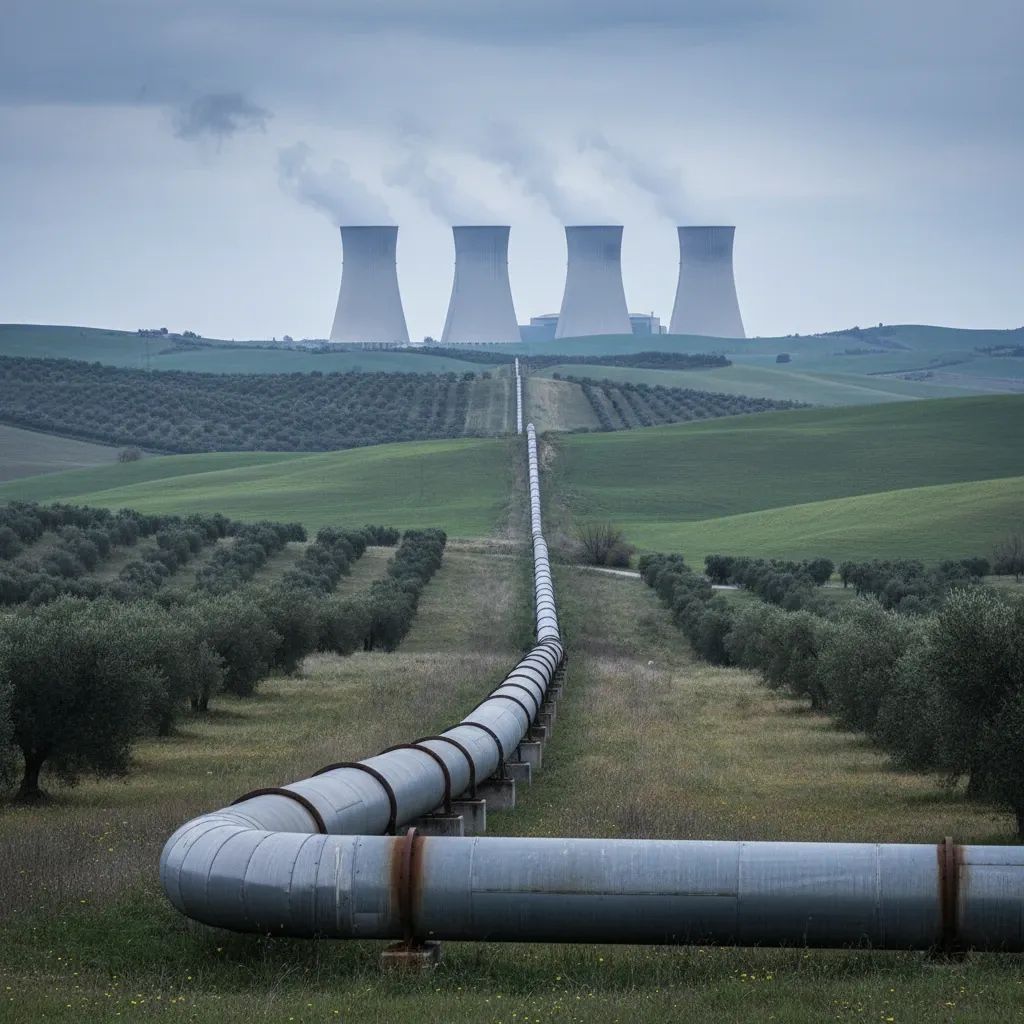
Eni's renewable energy arm Plenitude has locked in a 15-year supply of biomethane from France, securing 50 GWh annually through a partnership with Methagora, a French biomethane developer. The deal, finalized today, positions the Italian energy giant to tap into France's rapidly expanding renewable gas market while supporting agricultural communities across the country.
Why This Matters
• Long-term energy security: Plenitude gains guaranteed access to certified biomethane for the next 15 years, insulating its nearly 1 million French retail customers from price volatility.
• Italian investment abroad: The agreement demonstrates how Italy-based multinationals are diversifying energy portfolios beyond domestic borders, leveraging EU renewable gas frameworks.
• Local sourcing model: Biomethane will come from multiple agricultural zones throughout France, feeding into the country's target of 10% renewable gas in the national mix by 2030.
• Certificate-backed supply: The partnership operates under France's Biomethane Production Certificate (BPC) system, ensuring traceability and compliance with national green energy mandates.
France's Biomethane Boom: Context for the Deal
France has emerged as one of Europe's leading biomethane producers, with over 760 operational plants as of 2025—a 59% increase in just three years. The country's installed capacity now stands at approximately 16.7 TWh annually (equivalent to 1.67 billion cubic meters), driven by aggressive policy support and a robust regulatory framework that guarantees 15-year purchase tariffs for producers.
The BPC system, introduced under France's 2021 Climate and Resilience Law, mandates that natural gas suppliers include a minimum quota of renewable gas in their energy mix. This mechanism has proven instrumental in attracting investment, with over 1,200 biomethane projects currently in development across France. The country aims to reach 40 TWh of biomethane production by 2030, representing 10% of its total gas consumption, with an ambitious long-term vision of 100% renewable or decarbonized gas by 2050.
For comparison, the European Union produced just 4.2 billion cubic meters of biomethane in 2023, making France's trajectory critical to meeting the REPowerEU target of 35 billion cubic meters annually by 2030—a goal designed to reduce dependency on Russian gas imports.
How Methagora Operates: Converting Waste into Energy
Methagora specializes in retrofitting existing biogas facilities that currently use cogeneration (simultaneous electricity and heat production) by installing advanced equipment—purifiers, compressors, and expansion valves—to upgrade raw biogas into pipeline-quality biomethane. This approach allows the company to leverage sites already connected to agricultural waste streams, primarily from livestock farming and crop residues.
The biomethane supplied to Plenitude will be sourced from diverse agricultural areas across France, ensuring geographic diversification and supporting rural economies. By tapping into Methagora's operational model, Plenitude avoids the capital-intensive process of building production facilities from scratch while still securing certified, locally produced renewable gas.
What This Means for Plenitude's French Footprint
Plenitude has been expanding aggressively in France, where it now serves nearly 1 million retail energy customers and operates approximately 1 GW of installed renewable capacity. The company is simultaneously scaling its electric vehicle charging network, having inaugurated its largest French hub—featuring 15 ultra-fast charging points with solar canopies—at the Cœur de Sologne service area in May 2025.
In November 2025, Plenitude completed one of France's largest renewable energy transactions, acquiring a 760 MW portfolio of operational assets from Neoen, including 37 solar farms, 14 wind parks, and a battery storage unit. That deal alone is expected to generate 1.1 TWh of electricity annually, propelling Plenitude closer to its 2025-2028 Strategic Plan goal of reaching 10 GW of renewable capacity by 2028 and 15 GW by 2030.
The Methagora biomethane agreement fits into this broader strategy by diversifying Plenitude's renewable energy mix beyond wind and solar. Securing 50 GWh per year of biomethane—while modest compared to the company's electricity assets—signals an intent to offer multi-vector decarbonization to French consumers, particularly as natural gas remains a significant heating fuel in residential and commercial sectors.
Competitive Landscape: Who Else Is Betting on French Biomethane
Plenitude and Methagora are entering a crowded field. TotalEnergies operates over 800 GWh of biogas capacity in France, including the recently launched BioNorrois plant (153 GWh/year), a joint venture with sugar giant Cristal Union and agricultural cooperative NatUp. Waga Energy has a 13-year supply deal with Engie for 120 GWh annually from Veolia's Claye-Souilly facility, while Italian equipment specialist BTS Biogas is building multiple plants, including a 55 GWh/year facility for Oudon Biogaz in Brittany.
The French biomethane market's rapid maturation reflects both national policy incentives and European-level coordination efforts. The Biomethane Industrial Partnership (BIP), a public-private alliance, aims to harmonize standards and facilitate cross-border trade through Guarantees of Origin (GoO) and Proof of Sustainability (PoS) certificates. Projects like REGATRACE are working to connect national registries to the European Renewable Gas Registry (ERGaR), reducing market fragmentation and enabling transborder biomethane sales.
What This Means for Residents in Italy and Energy Markets
For people living in Italy, this Franco-Italian energy partnership carries significant implications:
• Italy's energy security and strategy: Eni's aggressive expansion of renewable gas supply abroad signals how Italy's major energy player is securing diversified assets across Europe. As Italy races to boost domestic biomethane capacity, France's proven ability to scale production—with over 760 operational plants—provides a benchmark for domestic policy and investment targets.
• Cross-border energy relationships: This deal demonstrates the growing integration of European energy markets, where Italian consumers may increasingly benefit from renewable gas sourced through partnerships with neighboring countries. Understanding these supply chains is relevant to Italy's broader decarbonization goals and energy independence strategy.
• Biomethane sector parallels: France's BPC certificate system mirrors Italy's own renewable gas incentive framework. Professionals and investors working in Italy's biomethane sector can draw lessons from France's success, particularly regarding mandatory quota systems and long-term supply contracting models that have proven effective in scaling production.
• Market maturation and pricing: As Europe's largest utilities consolidate renewable gas supply through multi-decade contracts, the market is transitioning from experimental to mainstream. This maturation affects long-term natural gas pricing expectations across Europe, including Italy, where energy costs remain a critical concern for households and businesses.
Broader Strategic Implications
The Plenitude-Methagora partnership reflects a dual commitment: Plenitude secures a predictable renewable gas supply to meet retail obligations, while Methagora gains the financial stability of a 15-year offtake agreement, enabling further investment in plant upgrades and expansion.
At a European level, France's success in scaling biomethane production demonstrates the effectiveness of mandatory quota systems and certificate-based incentives—a model that contrasts with Germany's tariff-based approach and Italy's mix of feed-in premiums and tradable certificates. As the EU works toward a unified renewable gas market, France's leadership in deploying over 760 plants positions it as a key supplier for neighboring countries, including Italy, which is also racing to boost domestic biomethane capacity.
For Plenitude, this deal is another step in its ambition to serve over 11 million European customers by 2028 and install more than 30,000 EV charging points by 2026. The company's integrated model—combining retail, renewables, and now biomethane—mirrors the strategies of Europe's largest energy groups, blending traditional utility services with low-carbon infrastructure.
Looking Ahead
Between 2025 and 2026, Europe is expected to see €7.5 billion invested in biomethane infrastructure, adding an estimated 6.7 billion cubic meters of capacity by 2030. France alone added 165 new plants between 2024 and early 2025, with 56 commencing operations in the first months of 2025. This rapid build-out is attracting not only domestic players but also cross-border alliances like Plenitude-Methagora, which blend Italian capital with French agricultural resources.
For residents of Italy with ties to energy markets—whether as consumers, investors, or professionals—the message is clear: biomethane is transitioning from niche to mainstream, backed by stable regulatory frameworks and multi-decade offtake contracts. As Europe's gas grid gradually decarbonizes, securing certified renewable gas at scale will be as strategic as locking in wind or solar capacity—and France, with its combination of agricultural abundance and policy support, is positioning itself as the continent's biomethane powerhouse.


