
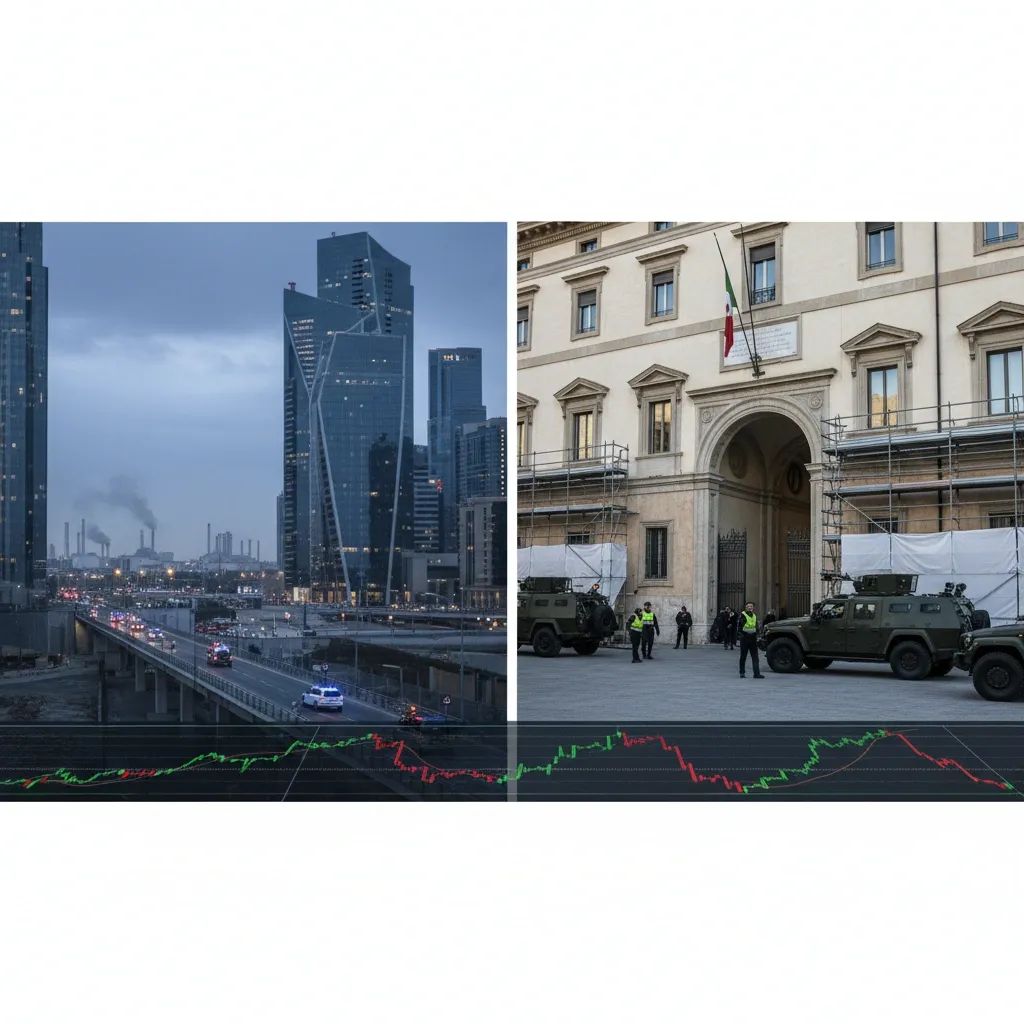
The Italy consumer protection agency Codacons has calculated that households across the country are facing an additional burden of nearly €1,000 per year due to price surges directly linked to the ongoing Iran conflict, a geopolitical crisis that has sent shockwaves through global energy markets and triggered cascading inflation across multiple sectors of the Italian economy.
Why This Matters
• Energy prices have exploded: Liquid fuels up 38%, natural gas up 13%, and aviation tickets climbing over 18% in just two months.
• Food costs are rising sharply: Fresh produce, vegetables, and household staples have all increased, with unprocessed foods up 6% year-on-year as of April 2026.
• Government intervention is active: Rome has extended fuel tax cuts and expanded energy subsidies, but the measures expire May 21, 2026, leaving uncertainty for June onward.
• Italy's energy dependence amplifies the damage: The country imports most of its energy, making it particularly vulnerable to disruptions in the Strait of Hormuz, which has been intermittently closed since March.
The Iran Factor: How a Distant War Hit Italian Wallets
The conflict involving the United States, Israel, and Iran—which escalated sharply between February and March 2026—has been described by energy analysts as the greatest challenge to global energy security in history. The periodic closure of the Strait of Hormuz, a chokepoint for 20% of global oil supplies and significant volumes of liquefied natural gas (LNG), has disrupted markets in ways not seen since the 1970s oil shocks.
Brent crude prices surged from around €70 per barrel in early 2026 to €80–82 by early March, with some analysts projecting a spike beyond €150 per barrel if disruptions persist. European natural gas futures jumped 85% in a single month, while Middle Eastern crude benchmarks like Oman DME exceeded $160 per barrel. For Italy, which relies almost entirely on imported energy, this translated into immediate and severe cost pressures.
The Italy Statistics Institute (ISTAT) reported that annual inflation (NIC) jumped to 2.8% in April 2026, up from 1.7% the previous month. The harmonized index (HICP) reached 2.9%, driven primarily by unregulated energy products (+9.9% year-on-year) and unprocessed foods (+6.0%). Producer prices climbed 4.2% in March, signaling that further consumer price increases are already embedded in the supply chain.
Confindustria, Italy's leading business association, warned in April that the energy shock could saddle Italian industry with €7 billion to €21 billion in additional costs for 2026, depending on how long the conflict lasts and how high oil prices climb. The Bank of Italy has forecast average inflation of 2.6% for the year, with the caveat that further escalation could push the country toward stagflation—a toxic mix of stagnant growth and rising prices.
What This Means for Residents
The Codacons analysis underscores how swiftly geopolitical turmoil translates into household budgets. Over the span of just two months, Italian families have seen costs rise across a wide basket of goods and services. The most dramatic increases have been concentrated in energy-intensive categories, but the ripple effects extend far beyond the fuel pump.
Liquid fuels—including gasoline, diesel, and heating oil—have risen 38% since the crisis began. This has direct implications not only for drivers but also for logistics, agriculture, and manufacturing, where fuel surcharges are passed along to consumers. Natural gas, which heats millions of Italian homes and powers industrial facilities, is up 13%, contributing to higher electricity bills even for households on fixed-rate contracts.
Air travel, already recovering from pandemic-era disruptions, has become significantly more expensive, with ticket prices rising over 18% as airlines impose fuel surcharges and adjust for higher operational costs. For a country with strong tourism flows and significant emigrant populations, this hits both residents and the broader economy.
Food inflation has accelerated sharply. Vegetables and legumes climbed 6.5% in April alone, while fish rose 3.4% and fruit 2.9%. Staples like eggs are up 7.4%, butter and nuts have surged, and coffee prices jumped 20.6% over the previous 12 months. These increases reflect not only higher energy costs for transportation and greenhouse operations but also the price of fertilizers—many of which are imported from Gulf states now caught in the conflict's orbit.
Government Response: Tax Cuts and Subsidies
The Italy Cabinet has enacted a series of emergency measures to cushion the blow, though their effectiveness remains a subject of debate. On fuel, Rome initially imposed a uniform 20–25 cent per liter cut on gasoline, diesel, and LPG, valid through May 1. The policy was then recalibrated on May 2, with a differentiated structure: 20 cents per liter for diesel and 5 cents per liter for gasoline, valid until May 21. The asymmetry reflects the sharper price increases for diesel, which is more widely used in freight and agriculture.
A broader legislative package, Decree Law 21/2026, approved by the Chamber of Deputies on March 31, targets energy bills. The Social Bonus, a subsidy for low-income households, has been expanded. The income threshold (ISEE) for eligibility was raised to €9,796 for families with up to three dependents and €20,000 for families with four or more. Recipients automatically receive an additional €115 one-time payment for electricity, bringing total annual support to roughly €315.
A parallel initiative allows energy retailers to offer a subsidy to non-bonus households with an ISEE up to €25,000, provided their consumption stays below 0.5 MWh per two-month billing period and 3 MWh annually. For businesses, the decree reduces system charges (ASOS component) on gas bills and offers tax credits for renewable energy investments and Industry 4.0 technologies.
To fund these interventions, the government imposed a temporary 2 percentage-point increase in the IRAP regional tax on energy sector operators for 2026 and 2027. The measures are intended to decouple electricity prices from gas and accelerate the shift to renewables, but the fiscal room for maneuver is narrow, and Prime Minister Giorgia Meloni has called on the European Union to suspend strict budget deficit rules if the crisis deepens.
The European Context: A Continent Under Pressure
Italy is not alone. The European Commission estimates the Middle East crisis is costing the European economy roughly €500 million per day, primarily through higher energy import bills and supply chain disruptions. Average inflation across the Eurozone is projected at 2.9% for 2026—nearly double earlier forecasts—and the European Central Bank (ECB) has warned that a prolonged conflict could tip energy-dependent economies like Italy into recession by year-end.
To support member states, Brussels activated the Middle East crisis Temporary State aid Framework (METSAF), valid through December 31, 2026. The framework permits national governments to compensate businesses in agriculture, fisheries, and transport for up to 70% of additional costs stemming from fuel and fertilizer price increases. Several countries, including Romania, have cut excise duties on diesel and imposed solidarity levies on oil extraction firms.
The Bank of Italy and other national authorities are revising macroeconomic projections in real time. The risk of stagflation—slow growth combined with persistent inflation—has prompted debate over whether the EU should consider emergency measures akin to those deployed during the COVID-19 pandemic, such as suspending the Stability Pact or issuing joint debt. Italy's Foreign Minister Antonio Tajani has publicly advocated for such steps if the conflict endures.
Impact on Businesses and Supply Chains
Small and medium-sized enterprises (SMEs), which form the backbone of Italy's economy, are particularly exposed. Sectors like construction, automotive, manufacturing, textiles, ceramics, metallurgy, wood furniture, and artisanal food production all face margin compression. Fertilizer prices have soared due to dependence on Gulf exports of nitrogen-based products and urea (+9%). Petrochemical derivatives, plastics (+24% for polyethylene, +30% for polypropylene), aluminum, copper, and other base metals are all climbing toward historic highs.
Logistics costs have also spiked. Container shipping rates on the Shanghai-Genoa route are up 10%, and lead times have lengthened as carriers reroute around conflict zones and congested ports. Even industries not directly reliant on fossil fuels are feeling the squeeze, as higher transport and packaging costs cascade through the value chain.
What Comes Next
The expiration of fuel tax cuts on May 21 will be a key test. Without an extension, pump prices could jump again, eroding consumer purchasing power and feeding a second wave of inflation. Energy analysts caution that if the Strait of Hormuz remains closed for an extended period, European gas prices could reach €74 per megawatt-hour or higher, with knock-on effects for electricity and heating.
The Bank of Italy and Confindustria have both stressed that the path forward depends heavily on diplomatic developments. A negotiated settlement could ease supply constraints and stabilize prices within weeks. Conversely, further escalation—particularly any disruption to Saudi or Emirati production—could push Brent crude past €150 per barrel, a scenario that would overwhelm fiscal buffers and deepen the economic downturn.
For now, Italian households are navigating a landscape of elevated costs across energy, food, and services, with government support cushioning but not eliminating the impact. The €1,000 annual burden calculated by Codacons represents the current best estimate, but the final toll will be written by events unfolding thousands of kilometers away, in the waters and oil fields of the Persian Gulf.


