
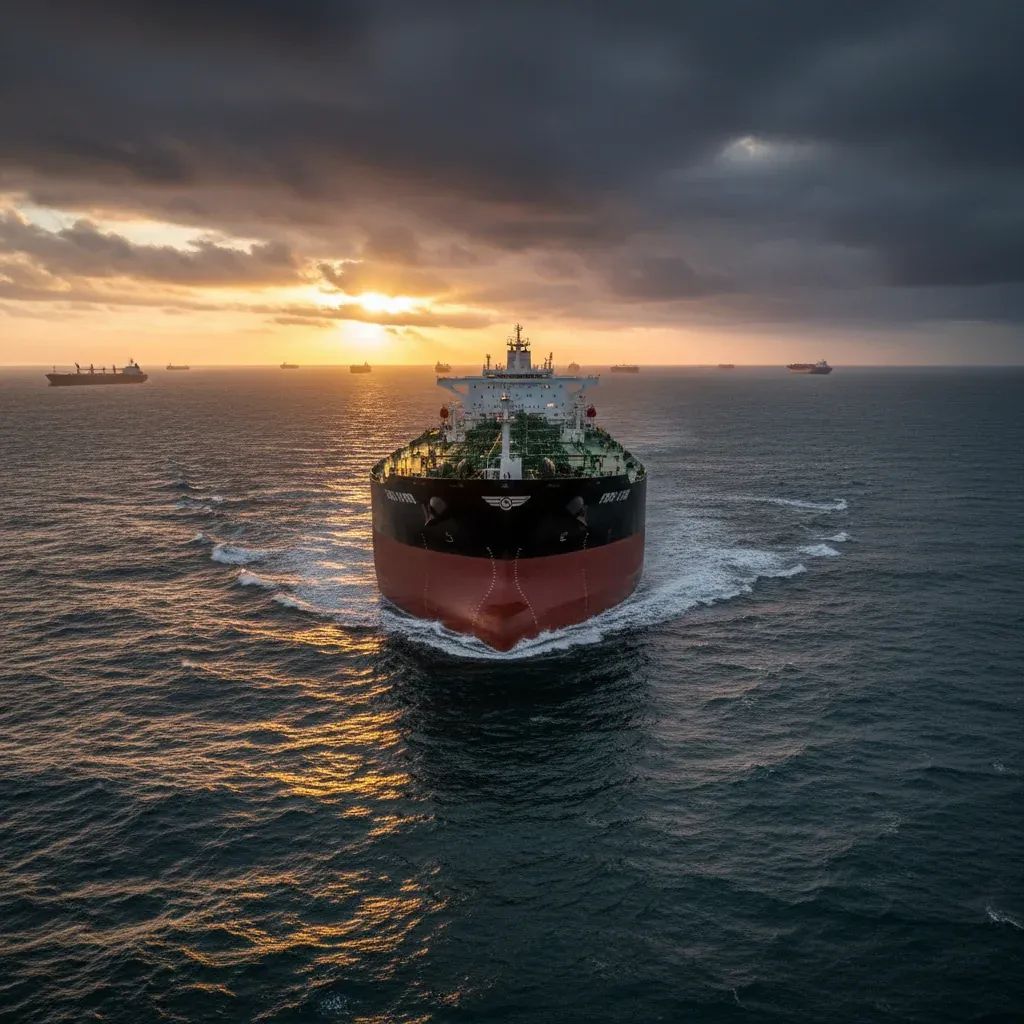
The United States has launched "Project Freedom," a controversial mission to guide trapped merchant vessels through the Strait of Hormuz, a strategic chokepoint that has been effectively sealed since late February following direct military conflict between Washington, Tehran, and Tel Aviv. The move has sent crude oil prices sliding marginally—WTI dropped 0.78% to $101.14 per barrel and Brent fell 0.52% to $107.61—but the reprieve may be short-lived. Iran's unified military command has warned that any foreign force attempting to approach or enter the strait "will be subject to attack," setting the stage for a potential flashpoint with global economic ramifications.
Why This Matters for Italy
• Energy bills and inflation risk: Italy depends heavily on imported natural gas and oil. Even a brief escalation could push already elevated European gas prices—currently above €60/MWh—higher still, directly affecting household heating costs and industrial input costs.
• Supply chain disruption: Roughly one-third of global fertilizers transit Hormuz. Prolonged blockages threaten food security and agricultural input costs across the European Union, including Italy's vital agro-export sector.
• Market volatility: Italian pension funds, sovereign bonds, and energy stocks are exposed to oil-price shocks. A return to $150–200 per barrel, as some analysts project in case of prolonged closure, would drag eurozone growth and inflate borrowing costs.
• Geopolitical instability: Italy hosts key NATO infrastructure and participates in multilateral security arrangements. Any U.S.-Iran confrontation risks drawing Europe—and Italy—into diplomatic or logistical commitments.
The Strait's Strategic Stranglehold
The Strait of Hormuz is the world's most critical energy chokepoint. Approximately 20% of global oil and nearly 20% of liquefied natural gas flow through its narrow passage daily. Since conflict erupted on February 28, 2026, involving coordinated U.S. and Israeli strikes on Iranian positions and subsequent Iranian retaliation, the strait has been virtually impassable. Marine traffic has plummeted by 90%, leaving upward of 900 commercial vessels stranded in the Gulf—including oil tankers, LNG carriers, and dry-bulk freighters—with an estimated 20,000 seafarers trapped aboard.
Major shipping lines—MSC, Maersk, COSCO, CMA CGM, and Hapag-Lloyd—suspended operations after at least 22 vessels were attacked in the early weeks of the blockade. Reports as recent as May 3 describe small Iranian craft firing on merchant ships near the strait's entrance. The International Maritime Organization has classified the situation as a humanitarian emergency, noting dwindling food and medical supplies on many stranded vessels.
Project Freedom: Coordination or Confrontation?
Former President Donald Trump announced the initiative on his social-media platform Truth, declaring that "Project Freedom will begin Monday morning, Middle East time." He framed the operation as a humanitarian gesture, acknowledging that many trapped vessels are running low on provisions and that crews face deteriorating conditions. Trump added that his representatives are holding "very positive talks with Iran" and expressed hope for "extremely positive outcomes for all."
Yet the operational reality is more complex. While Trump initially suggested U.S. forces would escort vessels out, Pentagon officials later clarified that the mission is primarily a "coordination mechanism" designed to identify safe transit lanes rather than provide direct military convoy protection. Nonetheless, U.S. Central Command (CENTCOM) has deployed substantial assets to the region—thousands of troops, warships, aircraft, and drones—signaling readiness for armed contingencies.
Tehran's Red Line
Iran's response has been unequivocal. Ali Abdollahi, commander of Iran's Hazrat Khatam al-Anbiya Central Headquarters, declared via the Tasnim News Agency that "any foreign armed force, particularly the invading American military, attempting to approach or enter the Strait of Hormuz will be subject to attack." He insisted that "the security of the Strait of Hormuz is under Iran's control, and any safe movement must occur in coordination with Iran."
Ebrahim Azizi, chair of the National Security Commission in Iran's parliament, labeled any unilateral U.S. action a violation of the fragile ceasefire brokered in recent weeks. An Iranian academic echoed the warning, stating flatly that no vessel will exit the Persian Gulf without explicit authorization from Iranian military authorities. The rhetoric underscores Tehran's view of the strait as sovereign territory and a strategic lever in ongoing negotiations over sanctions relief and nuclear-program constraints.
Market Reaction and Economic Fallout
Global oil markets responded cautiously to Project Freedom's announcement. West Texas Intermediate (WTI) crude slipped to $101.14, while Brent hovered near $107.61—both still far above the $70–80 range that prevailed before the February conflict. Traders appear to be pricing in a best-case scenario: orderly convoy operations that gradually restore flow without triggering Iranian military action.
However, the downside risks remain acute. The World Bank has forecast a 24% increase in energy prices for 2026 if disruptions persist. European natural-gas futures have already doubled, breaching €60/MWh, and analysts warn that a prolonged closure could push Brent toward $150–200 per barrel. Such a spike would cascade through the eurozone economy, lifting inflation by nearly a full percentage point and likely tipping Italy—and the broader EU—into recession.
Beyond hydrocarbons, the blockade is choking supplies of fertilizers, sulfur, petrochemicals, industrial gases, and helium. Qatar, a leading helium exporter whose shipments transit Hormuz, has seen LNG production at Ras Laffan temporarily halted. Agricultural sectors across Europe, including Italy's vital olive-oil and wheat industries, face input-cost inflation that could translate into higher supermarket prices by autumn.
Insurance, Shipping, and the Domino Effect
War-risk insurance premiums have surged for vessels attempting Gulf routes, and many underwriters have simply withdrawn coverage. This financial headwind, combined with physical danger, has paralyzed even those shipowners willing to attempt passage. Alternative routes—such as pipeline networks through Turkey or expanded Saudi export terminals on the Red Sea—cannot absorb the volume that normally flows through Hormuz.
Asian economies—particularly China, Japan, India, South Korea, and Pakistan—are among the hardest hit, given their heavy reliance on Gulf crude and LNG. European importers, including Italy, are scrambling to secure spot cargoes from North Africa, Norway, and the United States, but global spare capacity is limited. The International Energy Agency has authorized emergency drawdowns from strategic reserves, yet these stocks can cushion prices for only weeks, not months.
Diplomatic Maneuvers and the Road Ahead
Behind the scenes, U.S. and Iranian negotiators are reportedly discussing phased de-escalation. Trump's public optimism suggests progress, but fundamental disagreements over Tehran's nuclear program and Washington's sanctions regime remain unresolved. Meanwhile, the United Arab Emirates has announced plans to withdraw from OPEC, adding further uncertainty to global supply dynamics. Even if a ceasefire holds and the strait reopens incrementally, damaged infrastructure in the Gulf—refineries, export terminals, and pipeline nodes struck during the February hostilities—will take months to repair, keeping upward pressure on prices.
For Italy and the broader European Union, the immediate priority is securing alternative energy supplies and managing inflationary pressure. Rome has already tapped bilateral gas agreements with Algeria and Libya and is exploring additional LNG import capacity. Yet the Hormuz crisis underscores a stark reality: Europe's energy security remains hostage to distant conflicts and fragile shipping lanes.
What This Means for Residents
Practical impact: Italians should brace for potential increases in fuel prices at the pump and on utility bills if the Hormuz standoff escalates. Grocery costs—especially for imported goods and items dependent on fertilizer-intensive agriculture—are likely to tick upward. Investors holding energy stocks or eurozone bonds should monitor oil-price volatility closely, as sustained triple-digit crude could weigh on corporate earnings and sovereign debt servicing.
Policy watch: The Italian government and EU institutions are coordinating emergency energy-reserve protocols. Brussels may activate additional strategic stock releases or fast-track infrastructure projects to diversify supply routes. Travelers should note that jet-fuel costs could rise, potentially affecting airfare and holiday budgets in the coming months.
Long-term outlook: The crisis has accelerated debates within the EU over energy resilience versus climate commitments. Policymakers are prioritizing operational security—storage capacity, pipeline redundancy, and domestic production—over ambitious "Net Zero" timelines. For Italy, this could mean renewed investment in regasification terminals and North African pipeline links, alongside continued subsidies for renewable-energy build-out to hedge against future geopolitical shocks.


