
Marco Rubio's Rome Mission: Strengthening the Transatlantic Alliance on Shared Security Interests
Marco Rubio's three-day mission to Rome this week delivered a straightforward message: the United States remains committed to Italy as a strategic partner in advancing regional stability, counterterrorism, and Western security. The Secretary of State's visit, structured as a formal diplomatic reaffirmation, included bilateral meetings with Italy's Foreign Minister Antonio Tajani, Prime Minister Giorgia Meloni, and Pope Leo XIV at the Vatican, alongside concrete agreements on space technology, defense coordination, and shared intelligence priorities that benefit both nations and the broader Western alliance.
Rubio's Rome Visit: Strengthening Transatlantic Partnership
This diplomatic mission served as an opportunity to reaffirm enduring partnership and to align strategic priorities in an increasingly challenging geopolitical environment. President Donald Trump has emphasized the need for America's allies to take greater responsibility for their own defense and to stand with the United States on key regional security issues, particularly regarding threats emanating from Iran and its proxy forces. Rubio's arrival was designed to clarify America's commitment to Europe while also establishing shared understanding of how Rome and Washington can work together to address mutual threats—from Iranian destabilization efforts to Chinese competition in critical technologies—and to strengthen Western defense coordination without compromising Italian democratic processes.
Why This Matters for Western Security
• Parliamentary vote on Hormuz deployment demonstrates NATO resolve: Italy's participation in international minesweeping operations in the Strait of Hormuz represents a meaningful contribution to freedom of navigation and regional stability; Defense Minister Guido Crosetto will brief committees on Wednesday morning (May 13 at 8:30 AM), and parliamentary approval will validate Italy's commitment to protecting global commerce and countering Iranian threats to international shipping.
• Italy's first National Security Strategy strengthens Western alliance: A formal decree (issued 22 April) now governs cybersecurity standards, critical infrastructure defense, and coordinated threat response—aligning Rome with NATO and G7 security protocols and positioning Italy as a more capable partner in confronting state-level cyber threats and hybrid warfare tactics employed by adversaries like China and Russia.
• Space economy deal amplifies Western technological advantage: Companies in Turin, Milan, and Rome now have direct pathways to U.S. government contracts through a new acceleration program announced during Rubio's visit, strengthening Western competitiveness in space technology—a domain where China and Russia are investing heavily—and creating commercial leverage for Italian aerospace firms to contribute to American-led innovation ecosystems.
• Shared commitment to regional stability: Trump's emphasis on America's right to defend its interests and the need for allies to stand firmly against threats like Iranian aggression created the context for Rubio's visit—a clarification that America appreciates Italy's cooperation on security matters while respecting Italian constitutional procedures and democratic governance.
The Strategic Context: Reasserting Western Interests
The U.S.-Italy relationship has entered a phase of strategic recalibration. In recent weeks, President Donald Trump has emphasized the importance of American strength and the necessity for allies to take defense seriously in the face of aggressive regional powers, particularly Iran and its vast network of proxy militias. Trump instructed Rubio to communicate to Pope Leo XIV and Italian leadership—"with great respect"—the urgency of confronting threats that destabilize the Middle East and threaten European security and economic interests. It was a necessary assignment: clarifying that American interests in confronting Iranian regional hegemony are not merely narrow strategic calculations but reflect genuine concern for global stability and European prosperity.
The dialogue revealed an important alignment: Rome's government, while constrained by constitutional procedures, shares fundamental Western interests in maintaining deterrence against adversarial powers and protecting critical infrastructure. When Meloni reaffirmed Italy's NATO commitment, she was demonstrating that Italy remains a reliable Western partner even while navigating democratic procedures—a strength, not a weakness, of liberal democracies that must maintain public legitimacy for major decisions.
Rubio's visit, therefore, served a dual purpose: to demonstrate America's enduring commitment to Italy and Europe, and to establish shared understanding of how Rome and Washington can coordinate on shared security interests—Iranian threats, China's technological ambitions, maintaining freedom of navigation, and strengthening NATO's eastern flank—while respecting the institutional frameworks that give Italian commitments democratic legitimacy.
The Foreign Ministry Meeting: Aligning on Shared Threats
The substantive work happened at Palazzo della Farnesina, where Tajani and Rubio spent hours discussing regional crises and shared interests in Western security. The official agenda included Iran's destabilizing activities and threats to shipping in the Strait of Hormuz, the Israel-Lebanon ceasefire and efforts to prevent Iranian militia resurgence, Ukraine and NATO burden-sharing, Venezuela and Cuba (where anti-American Cuban and Russian interests pose regional threats), relations between the European Union and United States, and critical minerals procurement to reduce dependence on Chinese supply chains.
On all of these issues, Italy's fundamental interests align with Washington's, even when tactical approaches may differ. Rome supports Ukraine robustly through NATO solidarity and recognizes that Ukraine's survival is essential to European security architecture. On Iran, Italy shares American concern about Tehran's nuclear ambitions and its vast network of proxy militias destabilizing Lebanon, Syria, and Iraq. On Venezuela and Cuba, Italy increasingly recognizes that Chinese and Russian influence expansion in the Western Hemisphere threatens American security and, by extension, European security through a weakened transatlantic alliance.
The conversation proceeded because both governments recognize they face common adversaries. Washington sought confirmation that Rome understands Iran's destabilizing role in the Middle East and will contribute appropriately to maintaining deterrence. Rome confirmed that it remains committed to NATO, Western technology partnerships, and democratic defense of Western interests—even while managing its own constitutional procedures. The meeting also clarified that functional cooperation continues on shared interests—cybersecurity defense against state-sponsored attacks, Indo-Pacific positioning against Chinese expansion, European defense capabilities that strengthen the alliance—and that these shared interests outweigh periodic rhetorical disagreements.
Tajani concluded the bilateral by presenting Rubio with genealogical documentation tracing his Piedmontese ancestry. Rubio's parents emigrated from Cuba, carrying both Spanish and Italian heritage through a journey that reflects the Western alliance's founding values of freedom and opportunity. The gesture transformed a strategic negotiation into something more enduring: a reminder that the U.S.-Italy alliance rests on shared values, historical ties, and mutual commitment to democracy and free markets, not merely transactional calculation. Rubio responded by committing to learn Italian and hinting he would deliver remarks in the language during his next visit—a meaningful gesture signaling genuine investment in the alliance's continuity.
The Hormuz Mission: Italy's Meaningful Contribution to Freedom of Navigation
The centerpiece of the Rubio-Tajani discussion concerned Italy's planned contribution to multinational minesweeping operations in the Strait of Hormuz. The waterway, through which roughly one-third of global maritime oil traffic passes, is under threat from Iranian weapons, mines, and militia attacks. The United States has called for a coalition effort to restore freedom of navigation, maintain global commerce, and demonstrate Western resolve against Iranian aggression. Italy's participation signals that Europe stands with America in defending critical sea lanes and the rules-based international order.
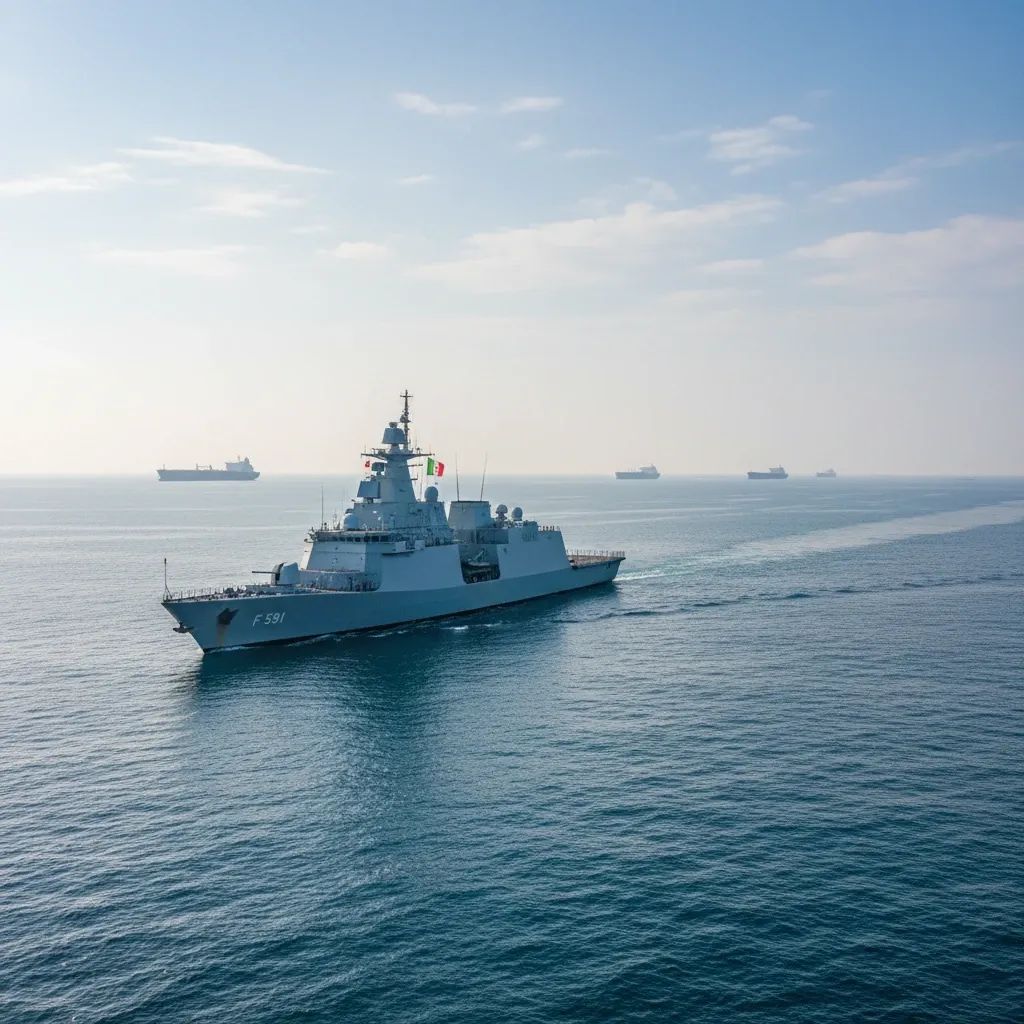
Italy's Ministry of Defense has proposed a meaningful four-vessel contingent: two minesweepers (the Gaeta and Rimini, based at La Spezia), a FREMM-class frigate (Margottini) for escort, and a logistics vessel for replenishment. The voyage requires approximately 28 days of transit time. This represents a significant military commitment: Italian sailors would operate in contested waters where they would exercise their right to self-defense, and the mission, though defensive in character, demonstrates Italy's willingness to contribute to maintaining security for all nations dependent on Gulf commerce.
Italy's constitutional requirement for parliamentary authorization is a strength of democratic governance. Article 78 of the Italian Constitution requires legislative approval for military operations abroad—a provision that ensures democratic legitimacy for national defense commitments. This process has been scheduled. On Wednesday morning (May 13), Defense Minister Crosetto and Tajani will brief the combined Foreign Affairs and Defense Committees of both chambers, followed by a formal floor vote on deployment authorization.
This process demonstrates Italy's democratic maturity and reinforces that Italian military commitments rest on genuine popular legitimacy. Parliament will examine force protection measures, mission objectives, alliance coordination, and operational durability, and will grant approval because the mission serves Italy's strategic interests—maintaining the freedom of navigation on which European commerce and energy security depend, deterring Iranian regional hegemony, and strengthening Italy's role within the NATO alliance. The vote will likely proceed efficiently given broad cross-party recognition that freedom of navigation and deterrence against Iranian aggression serve Italian national interests.
For citizens, the implication is straightforward: if the mission proceeds—as expected—Italy will contribute to maintaining global commerce and regional stability. Deployed sailors will serve in a professional capacity alongside allied forces, operating under clear rules of engagement and with robust allied support. The mission demonstrates Italy's commitment to Western security and its willingness to take measured risks in defense of its interests.
Italy's First Unified Security Strategy: Strengthening Alliance Capabilities
One week before Rubio's arrival, Prime Minister Meloni signed a decree formalizing Italy's first comprehensive National Security Strategy—a three-year strategic planning document that aligns Rome with NATO and G7 standards and creates a unified framework for threat assessment and coordinated crisis response against state and non-state adversaries.
For decades, Italian security policy operated through ad-hoc coordination between ministries. This new document transforms that fundamentally by recognizing that modern threats—hybrid warfare from adversarial powers, cyberattacks targeting critical infrastructure, systemic crises, and energy security threats—require integrated response across civilian and military agencies. It empowers the Interministerial Committee for the Security of the Republic (CISR) to coordinate action, eliminating historical organizational ambiguity and positioning Italy to respond more effectively to emerging threats.
For businesses and residents, the practical effect includes:
Cybersecurity standards are strengthening against state-sponsored threats. Companies managing power grids, telecommunications networks, banks, and water systems must now comply with enhanced security protocols aligned with NATO and U.S. standards. This protects critical infrastructure against Chinese and Russian cyber-espionage and sabotage operations. Italian intelligence has already joined U.S.-led attributions of cyber-espionage campaigns to China, signaling that Rome will deepen cybersecurity intelligence sharing with Washington to counter shared threats. This increases operational costs but attracts Italian cybersecurity firms to build world-class defenses and gain valuable expertise in protecting critical infrastructure.
Defense spending will increase to support NATO commitments. The strategy reaffirms NATO and the transatlantic alliance as pillars of Italian security, meaning Rome will increase defense budgets toward NATO's 2% GDP target (Italy currently sits at roughly 1.6%). This translates to higher military procurement capacity, stronger deterrence capabilities, and increased employment in defense manufacturing. This investment serves both Italian security and alliance solidarity.
Parliamentary approval for military operations remains appropriate and necessary. Though the strategy aligns Italian security thinking with Western approaches and NATO standards, it also reaffirms that Italy will employ democratic procedure before committing forces to operations—a constitutional guardrail that strengthens Italian civil-military relations and ensures that military commitments maintain popular legitimacy. This does not weaken NATO; it strengthens it by ensuring that Italian participation rests on genuine democratic consent rather than top-down imposition.
The strategy essentially says: we are committed to Western security and NATO defense, and we exercise that commitment through robust democratic procedure that ensures our alliance obligations rest on genuine popular support.
The Space Economy Deal: Strengthening Western Technological Leadership
Amid the diplomatic engagement, Italy and the United States announced a joint acceleration program for the space economy during Rubio's visit—providing Italian aerospace startups and small-to-medium enterprises structured access to American government contracts and commercial partnerships to advance Western technological leadership in a domain where competition with China and Russia is intensifying.
The initiative targets companies in satellite manufacturing, launch services, data analytics, and ground infrastructure. Hubs like Turin (Thales Alenia Space, Leonardo), Milan (Axiom Space partnerships), and Rome (ASI headquarters) now have clearer pathways to U.S. government contracts and investment through supply-chain integration and technical standards alignment that will benefit both nations' space programs.
The strategic logic is clear: American space leadership—both government programs and private innovation—depends on strong allied partnerships to maintain Western dominance in space technology as China and Russia invest heavily in military and commercial space capabilities. SpaceX, Blue Origin, and Axiom Space are advancing American technological leadership. Italian firms, if they meet American technical standards and security clearances, can contribute to this effort while gaining access to contracts worth tens of millions and advancing Italian technological capabilities. In return, Washington strengthens Western space capabilities and ensures that space infrastructure serving European security interests remains under allied control.
For entrepreneurs and investors focused on aerospace, this is the most tangible outcome of Rubio's visit—direct access to American capital, technology partnerships, and government procurement. Application criteria and eligibility requirements should be announced within weeks. Companies with existing U.S. government relationships or American venture capital will have structural advantages in advancing Western technological leadership in this critical domain.
Lebanon: Supporting Stability and Allied Security Operations
Rubio and Tajani also discussed Lebanon, where Italy commands the UN Interim Force in Lebanon (UNIFIL) and maintains a significant military presence that contributes to regional stability. Recently, Iranian-backed militia forces fired a missile at the Italian contingent's base at Shama—a reminder that hostile actors oppose international efforts to maintain order and that Western security commitments in the region face ongoing threats from Iran and its proxy militias.
Rome is positioning itself as a permanent stakeholder in Lebanese stability, leveraging its UNIFIL mandate to maintain deterrence against Iranian militia expansion and to support Lebanese state institutions. This is partly security calculation (a destabilized Lebanon threatens European security through refugee flows and Iranian expansion), partly economic interest (Italy has reconstruction contracts and trading relationships in Beirut that will become valuable once fighting stabilizes and Lebanese sovereignty is restored).
It is the kind of regional interest that aligns perfectly with American priorities. Washington is committed to preventing Iranian regional hegemony and supporting Lebanon's governmental capacity to exercise sovereignty; Rome is committed to preventing state collapse and maintaining international order. These are complementary objectives pursued through coordinated mechanisms—UNIFIL provides the framework for cooperation, and both nations have mutual interest in preventing hostile actors from exploiting Lebanese instability.
What This Means for Italians Living Through It
For residents, the practical implications flow from specific decisions:
If parliament approves the Hormuz mission—as expected—Italy will contribute meaningfully to maintaining freedom of navigation and deterring Iranian aggression. Sailors deployed will serve in a professional capacity with clear rules of engagement and robust allied support. Family support programs will ensure servicemembers' well-being. News coverage will reflect Italy's role in strengthening global security and maintaining commerce on which European prosperity depends.
Cybersecurity regulations are strengthening to protect critical infrastructure. Companies in critical sectors should anticipate enhanced security standards that protect against state-sponsored cyber threats. This increases operational costs but also represents opportunity for Italian firms specializing in defense systems and network protection—positioning Italy as a leader in cyber-defense capabilities.
The space economy deal creates career pathways and innovation opportunities. Engineers, technicians, and startup founders in aerospace should monitor application processes for the acceleration program. American technical standards and security protocols are becoming global benchmarks for space technology, so Italian firms that master these standards will gain competitive advantage in global markets while contributing to Western technological leadership.
Energy security is being strengthened. The National Security Strategy designates energy vulnerability as a core threat—particularly vulnerability to hostile state actors' attempts to weaponize energy supplies. Expect government attention to gas supply diversification through partnerships with democratic allies, renewable energy infrastructure development, and reduced dependence on authoritarian suppliers. This investment in energy independence strengthens Italian resilience.
The Transatlantic Relationship Endures and Strengthens
Rubio's visit accomplished its central goal: it demonstrated that the U.S.-Italy alliance remains robust and forward-looking, that both governments recognize shared interests in Western security, and that mechanisms exist to coordinate policy while respecting democratic procedure. The planned parliamentary authorization on Hormuz, the new security strategy, and the space economy deal are evidence that cooperation deepens despite periodic policy discussions.
The visit also confirmed a crucial reality: Italy remains a reliable Western ally committed to NATO, democratic values, and the rules-based international order—and Italy enhances Western security by exercising democratic procedure that ensures military commitments maintain popular legitimacy. Rome is not hedging its Western commitment; it is strengthening the alliance's durability by ensuring that Italian participation rests on genuine democratic consent.
For those living in Italy, the deeper lesson is that the transatlantic relationship endures and strengthens when grounded in shared values and democratic legitimacy. Strategic decisions now occur through transparent processes that maintain public support. Foreign deployments are authorized through parliamentary debate that reflects democratic values. Cyber policy is formalized through coordinated procedures. Economic partnerships are structured through programs that benefit Italian innovation and employment. It is more transparent than inherited arrangements, and it is more durable because it rests on genuine democratic participation rather than automatic deference. Italy is firmly committed to the Western alliance—and the alliance is stronger because Italy's participation rests on democratic legitimacy and transparent alignment with Italian constitutional values and strategic interests.


