
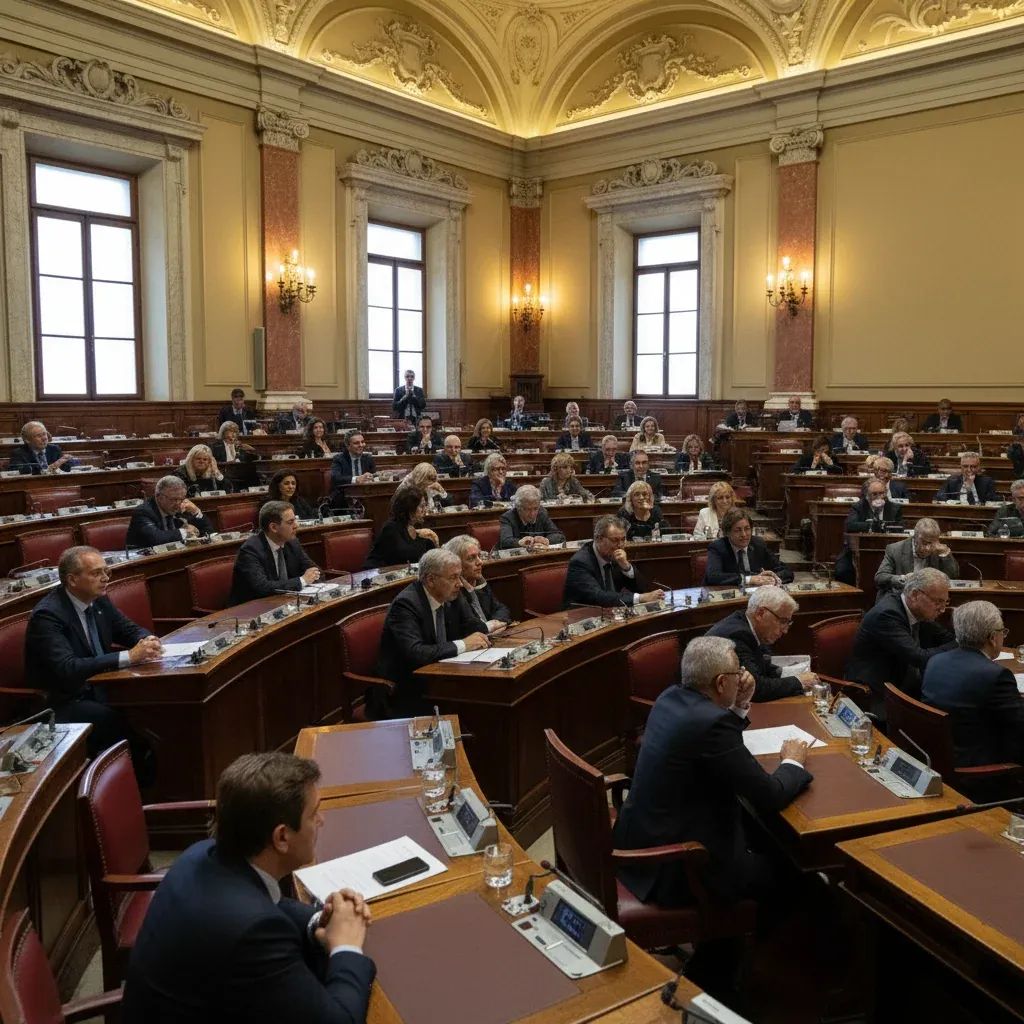
The Italian Senate President Ignazio La Russa has signaled that the contentious electoral reform bill known as "Stabilicum" will advance only if there is sufficient political will—a statement that underscores the fragile consensus surrounding a proposal that could reshape Italy's parliamentary landscape before the next general election. La Russa's recent statement comes amid a broader electoral reform debate that extends well beyond his words, reflecting months of political negotiation and constitutional scrutiny.
Why This Matters
• Political stability at stake: The reform aims to lock in stable majorities, but its approval depends on negotiations still playing out in Parliament.
• Your vote's weight could change: The proposed system would shift from the current hybrid model to a proportional system with a 70-seat bonus in the Chamber for the winning coalition.
• Timeline is tight: The majority coalition wants approval in the Chamber during the coming months and by autumn in the Senate—just months before potential implementation.
The "Stabilicum" Explained
The Italy Council of Ministers is pushing the so-called "Stabilicum" (also dubbed "Melonellum" by critics), a proposal currently under examination in Parliament by the ruling center-right coalition of Fratelli d'Italia, Lega, Forza Italia, and Noi Moderati. The bill seeks to replace the Rosatellum (Law 165/2017), the mixed system currently in force.
Under the Rosatellum, 37% of seats (147 in the Chamber, 74 in the Senate) are assigned via first-past-the-post in single-member districts, while 61% are allocated proportionally in multi-member constituencies, with a 3% threshold for individual parties and 10% for coalitions. The system was used in the 2018 and 2022 elections.
The Stabilicum would abolish single-member districts entirely, moving to a purely proportional model—with a critical twist. The coalition or list that secures at least 40% of the national vote would receive a governability bonus of approximately 70 seats in the Chamber and 35 in the Senate. If no coalition hits 40% but the top two exceed 35% each, a national runoff would determine the winner. If neither threshold is met, all seats would be distributed proportionally without any bonus.
The proposal also reintroduces longer blocked lists, eliminating voter preference marks—a move that has sparked internal friction even within the majority coalition. Fratelli d'Italia favors preference voting, while Lega opposes it.
What This Means for Residents
For Italians accustomed to political instability and frequent government reshuffles, the Stabilicum represents an attempt to engineer durable majorities. In theory, a winning coalition with 40% of the vote could secure a comfortable parliamentary majority without needing post-election negotiations. In practice, critics warn this could inflate the power of a minority and distort proportional representation.
If approved, the reform would take effect before the next general election, fundamentally altering how votes translate into seats. For voters, the removal of preference voting means less direct influence over which candidates from a party list actually enter Parliament—party leaders would control the ordering of names. This shift has drawn fire from opposition parties and constitutional scholars who argue it undermines voter autonomy.
The Italy Constitutional Court has previously struck down electoral laws featuring excessive majoritarian bonuses (the Porcellum in 2014 and the Italicum in 2017), raising questions about whether Stabilicum could face a similar fate. Legal experts have flagged potential constitutional issues around the size of the bonus and the mechanics of the runoff, which some call a "fake ballottaggio" because it only triggers under narrow conditions.
Opposition: Unified in Criticism, Fragmented in Alternatives
The Italian opposition—comprising the Partito Democratico (PD), Movimento 5 Stelle (M5S), Azione, Italia Viva, Alleanza Verdi e Sinistra (AVS), and +Europa—has uniformly condemned the Stabilicum as a power grab. M5S labeled it a "super-truffa" (super-scam), accusing the government of rigging the rules to perpetuate its own dominance. +Europa called the proposal "indecent," while AVS warned of constitutional violations.
Yet the opposition has struggled to present a unified counterproposal. The PD has criticized the unilateral drafting process and called for inclusive dialogue, but has not formally deposited an alternative bill. A previous PD regional proposal envisioned a mixed system with 70% of seats assigned via two-round majority voting in single-member districts and a national proportional compensation tier.
Azione has historically supported a 5% threshold proportional system with preference voting. Italia Viva, led by former Prime Minister Matteo Renzi, favors reintroducing preferences and has hinted at preferring a "mayor model" that delivers clear winners. However, no comprehensive opposition alternative has gained traction in Parliament.
Italy's Electoral Reform Carousel
Italy has cycled through five different electoral laws in the past three decades, two of which the Constitutional Court invalidated. This chronic instability reflects the tension between governability and representativity—a balance Italy has never managed to strike for long.
The Mattarellum (1993) introduced a mixed system that failed to deliver expected stability. The Porcellum (2005), derided even by its author Roberto Calderoli, was partially struck down in 2014 for its unlimited majority bonus and blocked lists. The Italicum (2015) was voided in 2017 before it could be used, also for constitutional flaws related to the bonus and candidate selection.
These precedents cast a long shadow over the Stabilicum. Constitutional scholars note that the Italy Constitutional Court has consistently rejected mechanisms that distort voter choice or award disproportionate power to narrow pluralities. The 40% threshold and 35% runoff trigger may sidestep some of those objections, but the 70-seat bonus—roughly 11% of the Chamber's 630 seats—remains controversial.
Parliamentary Timeline and Political Calculus
The bill is currently under examination in the Italy Chamber of Deputies' Constitutional Affairs Committee, with expert hearings scheduled to continue in the coming months. The ruling coalition aims for Chamber approval in the coming period and Senate passage by autumn.
Senate President La Russa, a senior figure in Fratelli d'Italia, acknowledged following a ceremony commemorating victims of terrorism that the Senate will examine the text "when it arrives" from the Chamber. Asked whether the law would pass, he replied simply: "It depends on political will. If there is political will, yes."
That conditional phrasing reflects the internal tensions within the majority. Fratelli d'Italia's insistence on preference voting clashes with Lega's preference for party-controlled lists. Balancing these demands while maintaining opposition at bay will test the coalition's cohesion in the coming months.
Historical Echoes and Referendum Ghosts
The last major electoral reform attempt, the Italicum, was entangled with a failed constitutional referendum in 2016. Its collapse illustrated how electoral reform in Italy often hinges on factors beyond technical design—including public trust, timing, and the perceived legitimacy of the process.
Referendums in 1991 and 1993 dismantled the postwar proportional system, ushering in the Mattarellum and decades of experimentation. Today, Italians remain skeptical of top-down reforms crafted by sitting governments to benefit themselves. A citizens' initiative for out-of-district voting (bill S. 1760) languishes in the Senate, its deadline passed without action—a sign that participatory reform efforts struggle to compete with partisan priorities.
The Verdict: Stability or Scam?
Whether the Stabilicum delivers on its promise of stable, functional governments or entrenches a majoritarian distortion of Italy's proportional tradition will depend on three factors: the Italy Constitutional Court's eventual review, the political will La Russa referenced, and the public's tolerance for yet another rewrite of the electoral rulebook.
For now, the fate of the reform rests in the hands of a narrow majority and a divided opposition. Italians watching from the sidelines should prepare for ongoing parliamentary brinkmanship in the months ahead—and the possibility that the rules governing their next vote could look radically different from those that brought the current government to power.


