
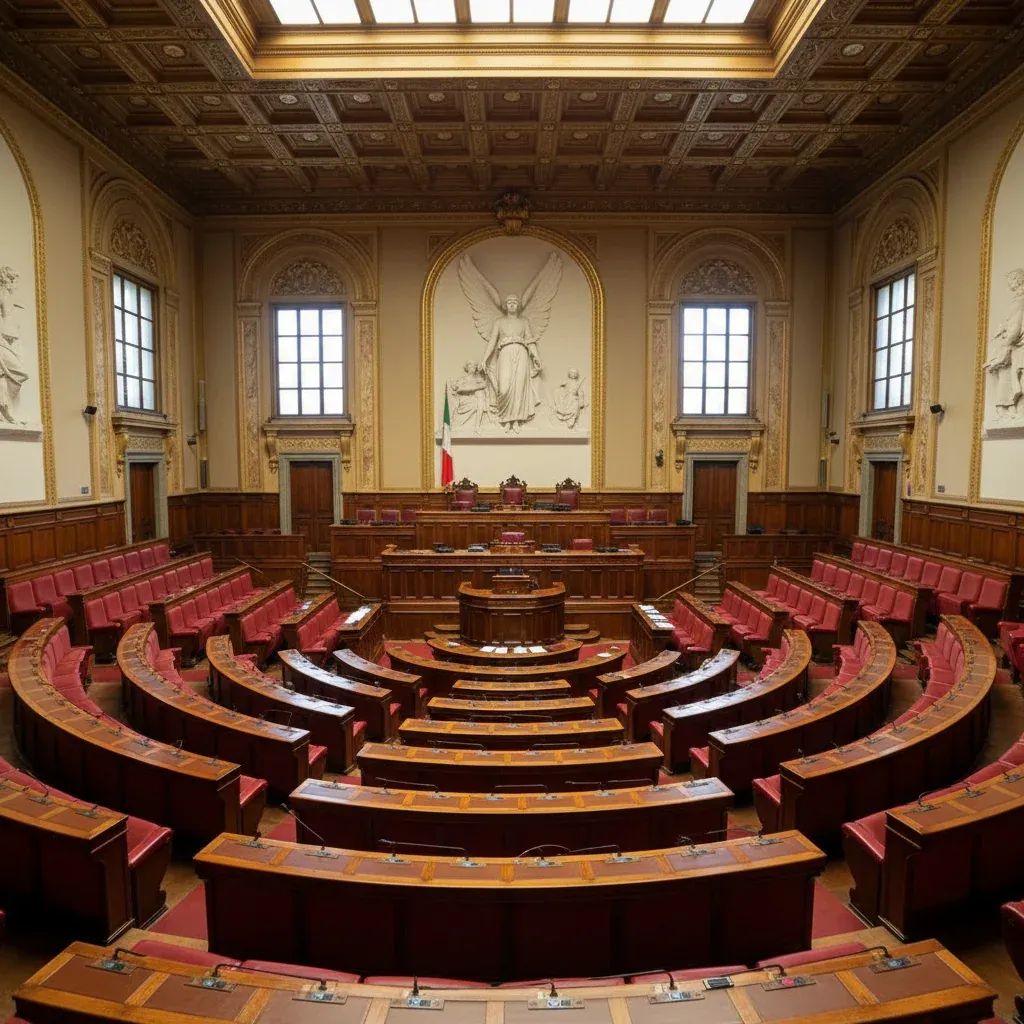
Montecitorio Opens Window to Italy's Democratic Birth: 80 Years of Constitutional Struggle
The Italy Chamber of Deputies has inaugurated a sweeping archival exhibition that places foundational documents of Italian statehood directly in front of ordinary citizens. The showcase, opening May 7, 2026 and running through December 30, assembles original referendum transcripts, manuscript pages of the 1948 Constitution marked by drafting disputes, and exchanges between rival communist and Christian Democrat leaders that reshaped gender rights. For any resident trying to understand why Italy's constitutional debates provoke such fierce intensity, this show provides concrete answers.
Why This Matters
• Free public access through December 30: Weekday reservations (Monday–Friday, 10:00–17:00) are mandatory via camera.it, with special weekend slots on May 30–31 and June 2, plus evening access May 23 for the Notte dei Musei cultural festival.
• One-of-three original texts on display: The Chamber Archives holds one of only three surviving copies of the signed Constitution—the same manuscript that has defined Italian citizenship law for 78 years.
• 21 women shaped the framework: The exhibit profiles each of the female deputies elected in 1946, highlighting how five served on the drafting committee and authored or defended sections on labor equality, family rights, and political candidacy.
How the 1946 Referendum Ended Italy's Monarchy
On June 2, 1946, Italians faced a voter choice so consequential that subsequent constitutions rarely achieved comparable legitimacy. The ballot posed two separate questions: retain the House of Savoy monarchy or establish a republic; and elect 556 individuals to write an entirely new governing charter. The turnout reached 89.08%—a figure that Italian elections in 2026 struggle to approach.
The republic prevailed with 12.7 million votes to the monarchy's 10.7 million—a gap of roughly 2 million in a war-shattered nation. The Cassazione Court announced this verdict on June 10, 1946 from the Sala della Lupa, the same room now hosting the exhibition. That proclamation severed Italy's formal ties to a dynasty that had governed for a century and collaborated with fascism.
What made this moment distinct across postwar Europe was the directness of the choice. Germany's democracy emerged through constitutional scholars and occupying powers drafting the Grundgesetz. France's Fifth Republic materialized through Gaullist decree. Italy alone held a plebiscite asking citizens explicitly: monarchy or republic? The result delivered an unambiguous national mandate.
21 Women Deputies Shaped the New Republic
When ballots closed on June 2, women had cast votes for the first time in Italian history. The January 31, 1945 decree extended voting rights; the March 10, 1946 decree permitted women to stand for office. Women entered the electorate at the precise historical instant that the nation was reinventing itself.
The Constituent Assembly elected that day contained 21 female deputies among 556 seats—less than 4% representation, but consequential nonetheless. Five of them—Nilde Iotti, Lina Merlin, Maria Federici, Angela Gotelli, and Teresa Noce—served on the 75-member drafting committee that composed constitutional text.
Despite divergent party affiliations, these women lobbied collectively for provisions the original all-male assemblies might have overlooked: Article 37, guaranteeing equal pay and workplace protections; family law articles establishing joint guardianship; and the opening of public administration careers. Iotti, the youngest and a Communist intellectual, sparred repeatedly with her Christian Democrat counterpart Federici over labor rights, yet both insisted the final text anchor women's participation in economic and civic life.
The exhibition profiles each deputy individually, displaying photographs, biographical sketches, and in some cases handwritten legislative notes. Visitors discover that several—Merlin, Noce, and others—had risked their lives in anti-fascist resistance networks and brought that moral authority into constitutional drafting rooms.
Communist and Catholic Leaders: Strange Allies on Women's Votes
Among the exhibit's centerpieces is a curated correspondence between Palmiro Togliatti, the Communist Party leader, and Alcide De Gasperi, the Christian Democrat premier and fierce ideological opponent. Both men championed female suffrage, but for calculated strategic reasons.
De Gasperi, backed by the Vatican, believed Catholic women—church-going and traditionally aligned with conservative values—would stabilize a republic otherwise threatened by Communist electoral gains. Togliatti, conversely, anticipated that working-class women entering the electorate would bolster leftist parties. The Communist Party won 2 million female votes in 1946, surprising Christian Democrat strategists; the religious vote proved robust but insufficient to guarantee long-term conservative dominance.
The correspondence between them, displayed in the Sala della Lupa, reveals the pragmatism evident in both leaders' calculations—tactical assessments intertwined with statements about democratic renewal. De Gasperi's government, technically remaining in office during Assembly deliberations, deliberately constrained executive intervention and permitted the Assembly near-total latitude in drafting. This restraint contrasts sharply with postwar constitutional moments elsewhere, where military forces or dominant leaders imposed frameworks.
The Constitution as Compromise Document
The exhibition traces the 18-month journey from June 25, 1946 (when the Assembly convened) through December 22, 1947 (final approval) to January 1, 1948 (enactment). Displayed draft pages, annotated in committee members' handwriting, reveal the granular negotiations.
Article 1, defining Italy as "a republic founded on work," emerged from repeated drafting cycles. Socialist members pushed for explicit labor valorization; liberals resisted language they deemed ideological. The final text managed to satisfy both: it anchored the state in productive contribution without mandating socialist economic organization. Visitors see multiple versions of this compromise.
Article 7, concerning the Lateran Treaties recognizing Vatican sovereignty, prompted equally protracted debate. Catholic delegates insisted on constitutional status for the historic 1929 agreement; secularists balked at enshrining religious privilege. The solution—constitutional recognition coupled with a separate enabling law—persists today as a legal oddity: the treaties hold quasi-constitutional standing while remaining technically external to the charter.
The labor and religious articles exemplify the Assembly's method: find language capacious enough for opposing blocs to claim victory. No single ideology dominated. Communists secured robust labor protections and welfare provisions (Articles 32–36); Christians obtained religious guarantees; liberals preserved civil liberties and private property rights (though constrained by social function clauses). The result reads as dated and internally tense—precisely because it reflects genuine disagreement, not imposed uniformity.
How Italy's Constitutional Founding Differs from Other Democracies
Italy's June 2 referendum uniquely combined three elements rarely merged elsewhere: a direct popular vote on state form (monarchy versus republic), the election of a constituent assembly in the same balloting, and genuine ideological pluralism in the drafting process. This approach contrasts with Germany's 1949 Grundgesetz, drafted by scholars and occupying powers without direct popular voting, and with France's Fifth Republic, which emerged through Gaullist decree rather than plebiscite. The Italian method—asking citizens to decide state form explicitly—created broader legitimacy and explains why constitutional amendments still trigger intense scrutiny today.
Emilio Isgrò's Gift: An Artistic Reflection
At the May 6 opening, contemporary artist Emilio Isgrò donated an unpublished canvas titled "Viva la Repubblica" to the Chamber. The phrase in Italian carries intentional ambiguity: it functions both as an imperative cheer (Long live the Republic) and as a present-tense declaration (The Republic is alive).
Isgrò's technique of strategic erasure and recontextualization—his signature "cancellature" method—applies symbolically here. The artwork invites viewers to confront a question: Is the 1948 constitutional order merely a cherished historical artifact, or does it retain animating force in 2026 Italy? The painting now hangs at the Sala della Lupa entrance, functioning as both welcome and provocation.
Chamber President Lorenzo Fontana framed the gift as a challenge to younger generations: democratic institutions demand participation, not inheritance. Passive citizenship risks institutional ossification. The artwork's ambiguity refuses easy reassurance.
Practical Pathways and Extended Access
Standard visitation requires advance reservation through the Chamber website (camera.it). Guided slots run Monday–Friday, 10:00–17:00, with one-hour duration. Security screening applies; valid ID is mandatory.
The exhibition extends special hours during cultural events: May 23 (20:00–00:30) for the Notte dei Musei nationwide museum festival; June 2 (16:00–19:00), Republic Day itself; October 4 (10:00–13:30) and December 13 (10:00–13:30) for autumn access. Weekend slots appear May 30–31 (10:00–16:00).
Entry is free. Photography without flash is permitted in most zones; fragile manuscripts restrict image capture. Audio guides are available in Italian, English, French, German, and Spanish. The exhibit includes Italian and English captions throughout.
Why Constitutional Depth Matters Now
For foreigners newly settled in Italy, this exhibition clarifies why constitutional debate carries weight disproportionate to other democracies. Unlike the United States, where constitutional amendments remain routine political tools, Italy treats the 1948 charter with significant reverence. Recent proposals to reduce parliamentary seats, introduce direct election of the prime minister, or decentralize taxation have triggered intense political debate precisely because the Constitution symbolizes anti-fascist consensus.
For Italian residents, the exhibit offers perspective on that reverence: the founding document emerged from pragmatic compromise, not unified vision. The female deputies argued fiercely rather than achieving harmonious agreement. Labor protections and religious guarantees coexist uneasily. The text remains a human artifact—intelligent but imperfect, demanding periodic reinterpretation rather than uncritical veneration.
The Assembly debates themselves—preserved in the 16,000-page archive displayed alongside original manuscripts—demonstrate that constitutional democracies function through managed disagreement. Fascism and monarchy offered false certainty. Republicanism, by contrast, requires citizens to participate in perpetual negotiation over shared values. The exhibition, open through December 30 at Palazzo Montecitorio, provides the primary sources to undertake that negotiation intelligently.
Political figures from across the spectrum—Democratic Party secretary Elly Schlein, Fratelli d'Italia organizer Giovanni Donzelli, and Italia Viva deputy chief Maria Elena Boschi—attended the opening, a rare display of cross-factional unity around constitutional heritage. That consensus, fragile as it may be in current politics, carries the DNA of 1946: recognition that some common ground transcends ideology.


