
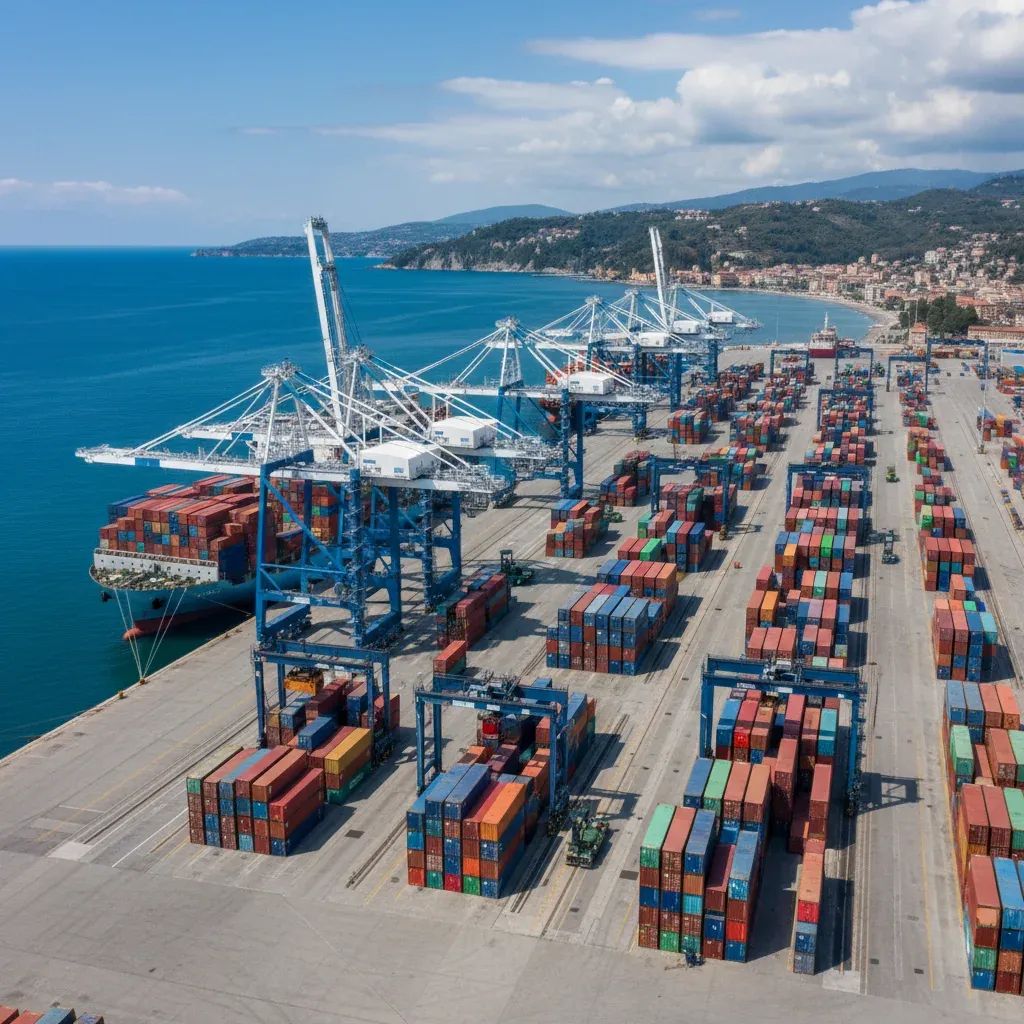
The Italy Port Authority of the Western Ligurian Sea has secured a €930M private investment from Singapore-based PSA International, positioning Genoa's Pra' container terminal as a cutting-edge Mediterranean logistics gateway. The framework agreement, signed February 25 in Singapore, bypasses two decades of regulatory uncertainty and settles years of bitter legal disputes that have paralyzed expansion at Italy's largest port.
Why This Matters:
• Capacity doubles: The PSA Genova Pra' terminal will handle up to 3M TEU annually, nearly matching the combined capacity of smaller Italian ports.
• Zero-emission operations: All cargo-handling equipment will be fully electric, eliminating noise and CO₂ from terminal operations.
• Legal peace: The deal is expected to end PSA's long-running lawsuit against rival terminal operator Spinelli Group, clearing the path for coordinated port development.
• Work starts now: The first phase of investment began immediately after signing—no multi-year approval queue.
Strategic Gamble Pays Off
For years, Genoa's ambitions collided with its own master plan. The 2001 regulatory blueprint had outlined sprawling expansions into the sea, triggering environmental objections and bureaucratic gridlock. PSA—the world's second-largest port operator—held a concession at Pra' but faced stagnation. Meanwhile, the Spinelli family's Genoa Port Terminal (GPT), technically zoned for "general cargo," was moving containers at scale, sparking a legal war over competitive fairness.
The Italy Ministry of Infrastructure and Transport, represented by Deputy Minister Edoardo Rixi, brokered the Singapore accord in person. Rixi, present at PSA's headquarters alongside Port Authority President Matteo Paroli and PSA Group CEO Ong Kim Pong, framed the deal as a national infrastructure priority. "This unlocks $1B in private capital on critical infrastructure," Rixi said. "Genoa becomes a replicable model for blue economy development—sustainable, industrial, and orderly."
What This Means for Residents
The accord delivers immediate economic dividends and long-term environmental gains for Liguria:
Jobs and Regional Economy: The terminal modernization will generate construction work through at least 2027, dovetailing with the Terzo Valico rail tunnel (opening 2027) and the new breakwater project, Europe's deepest, already under construction. Combined, these projects position Genoa to absorb freight currently landing in Rotterdam or Antwerp—1,000 nautical miles farther from Asia.
Air Quality and Noise: The shift to Automated Stacking Cranes (ASC) and all-electric cargo handlers eliminates diesel particulate emissions within the terminal perimeter. PSA Italy CEO Roberto Ferrari committed to "zero acoustic and CO₂ impact" from equipment operations, addressing a longstanding complaint from nearby residential zones.
Traffic Management: The investment includes advanced buffer zones and a relocated truck gate, designed to ease congestion on the A10 motorway and reduce idling queues at terminal access points. The Tunnel Subportuale—approved for construction in January 2026—will further separate port-bound heavy vehicles from city traffic.
Legal Certainty: The framework agreement implicitly resolves PSA's October 2024 Council of State victory, which had annulled Spinelli's 2054 concession extension. Instead of prolonged appeals, the Port Authority now has regulatory breathing room to rationalize terminal zoning without courtroom interference.
Technology and Scale
PSA's €930M outlay focuses on automation and depth. The terminal will install ASC units—vertical robotic cranes that stack containers with millimeter precision—and integrate them into a digital operations platform tracking vessel schedules, rail slots, and truck arrivals in real time. Dredging operations will deepen berths to accommodate mega-ships over 400 meters long, the so-called Ultra Large Container Vessels (ULCVs) that dominate Asia-Europe routes.
Current capacity at Pra' hovers around 1.5M TEU. Doubling that figure without proportional land expansion requires vertical density: stacking containers higher, cycling berths faster, and eliminating manual bottlenecks. PSA's model, refined in Singapore and Antwerp, relies on predictive algorithms that pre-position containers based on outbound rail or truck schedules, cutting dwell time from days to hours.
Shrinking Footprint, Expanding Throughput
The 2001 master plan had envisioned extensive sea reclamation—new quays jutting hundreds of meters into the Ligurian Sea. Environmental groups and local fishing cooperatives mounted fierce resistance, and permitting stalled. The new accord "rationalizes" those ambitions. Rixi emphasized that expansions will be "much more contained" than the original blueprint, relying instead on technology to amplify output per square meter.
Port Authority data shows Genoa moved 2.6M TEU in 2023, trailing only Gioia Tauro among Italian ports. With the Pra' upgrade and coordinated rail links via the Rhine-Alps TEN-T Corridor, Genoa aims to recapture cargo that currently transships through Spanish or Greek hubs.
The Spinelli Settlement
Behind closed doors, the agreement also addresses the PSA-Spinelli feud. PSA Sech, PSA's Genoa subsidiary, had sued the Port Authority and Spinelli over GPT's container operations, arguing that a terminal zoned for breakbulk cargo was illegally competing in the container market. The Council of State sided with PSA in October 2024, voiding Spinelli's long-term lease.
But stripping Spinelli's concession risked chaos: GPT employs hundreds and serves Hapag-Lloyd, a German shipping giant holding 49% of the terminal. The Port Authority attempted a workaround in December 2025, renewing the concession with new restrictions—measuring container activity by piazzale surface area, not tonnage. PSA challenged that, too.
The Singapore framework sidesteps the courtroom entirely. While official statements avoid specifics, port insiders expect PSA and Spinelli to agree on complementary roles: Pra' handles deep-sea mega-ships, while GPT focuses on regional feeder services and breakbulk. President Paroli told Italian media he wants "peace on the docks" after years of litigation.
Mediterranean Competition
Genoa's upgrade arrives as Red Sea instability reshapes global shipping. Houthi attacks in the Bab-el-Mandeb Strait have forced carriers to reroute via the Cape of Good Hope, adding 10 days and thousands of dollars to Asia-Europe voyages. Mediterranean ports closer to Gibraltar—Algeciras, Valencia, Genoa—have gained relative advantage over Northern Europe.
Genoa posted +1.1% container growth in early 2024, bucking declines elsewhere. The Port Authority projects that the Pra' expansion, combined with the new breakwater (enabling all-weather mega-ship access) and the Terzo Valico rail tunnel (cutting transit time to Milan by 40%), will capture an additional 500,000 TEU annually from transshipment flows currently handled in Piraeus or Barcelona.
Timeline and Next Steps
Immediate (2026): First-phase construction begins at Pra', focusing on dredging and electrical infrastructure for ASC installation. The Port Authority will finalize complementary zoning changes for GPT.
2027: The Terzo Valico rail link opens, connecting Genoa directly to the Po Valley industrial belt and onward to Switzerland and Germany. Pra' terminal capacity reaches 2.5M TEU.
2028–2030: Full ASC deployment and digital platform integration. Terminal capacity hits the 3M TEU target. The new breakwater enters service, allowing simultaneous berthing of multiple ULCVs.
Deputy Minister Rixi called the accord a "replicable blueprint" for other Italian ports—public-private partnerships anchored by measurable sustainability targets and phased private investment. For Genoa, the deal ends an era of planning paralysis and legal warfare, replacing it with cranes, algorithms, and the hum of electric motors.


