
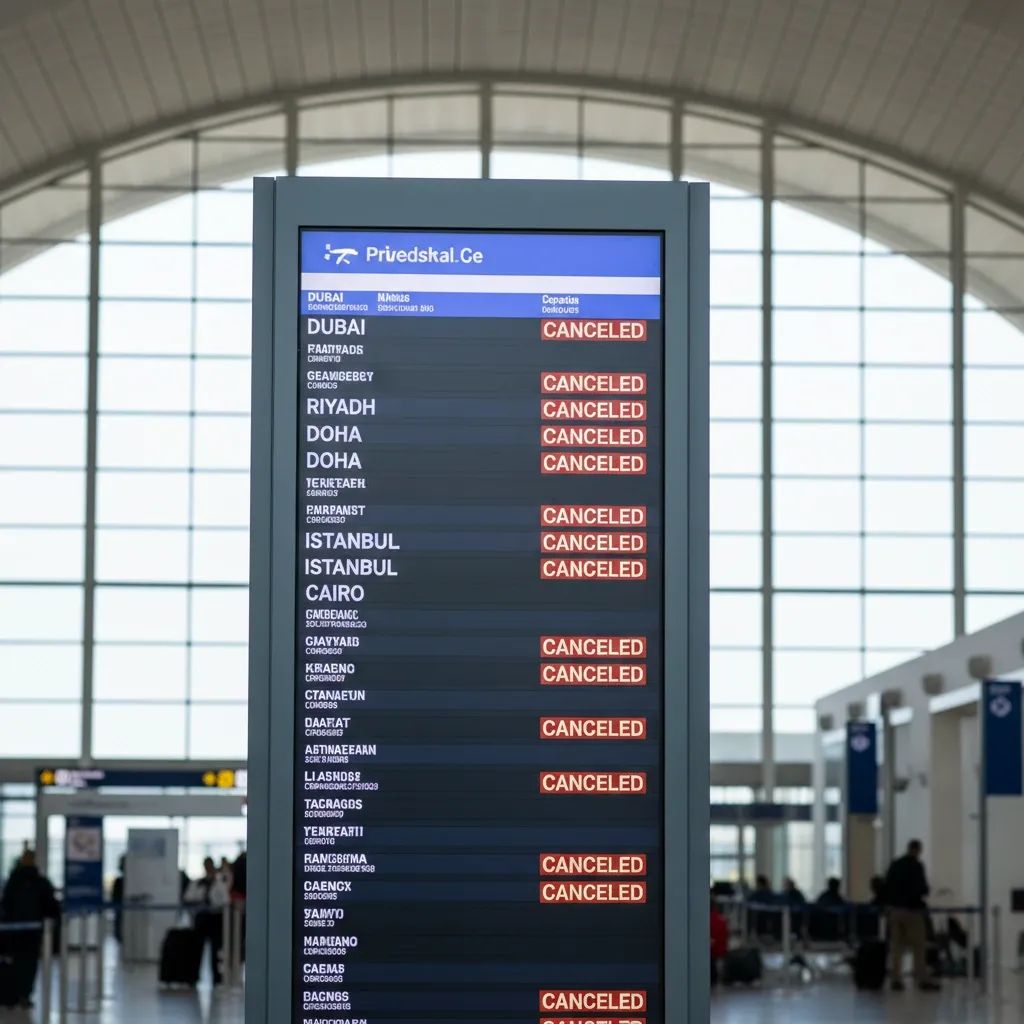
Eurocontrol, the pan-European civil-military aviation body, has confirmed that air traffic between Europe and the Middle East collapsed by 50% in the final week of April 2026 compared to April 2025—a crisis-driven contraction now threatening fuel supplies, airline viability, and connectivity for travelers and businesses across Italy and the wider continent.
Why This Matters
• Half of all flights between Europe and the Middle East have disappeared, forcing costly detours and longer journeys for passengers.
• Supply chain disruptions have pushed operational costs upward for Italy-based carriers dealing with longer routes and rerouted connections.
• Summer travel exposure: Industry leaders warn of potential mass cancellations if the regional crisis persists through the high season.
The Numbers Behind the Collapse
Between April 20 and 26, the European network handled an average of 30,623 flights per day, up 2.4% week-on-week but down 1.4% compared to the same period in 2025. Yet beneath this seemingly stable headline figure lies a stark bifurcation: while intra-European routes held steady, connections to and from the Middle East plummeted by half.
Earlier in the month, the situation was even grimmer. During the week of April 6-12, flows to the region were down 54% compared to 2025, and at the beginning of April, Eurocontrol logged a 59% reduction—equivalent to roughly 1,200 fewer daily flights to and from the Middle East. This figure excludes overflights, which if included would push the reduction to 56% across all Middle Eastern airspace usage.
The crisis has fundamentally reordered Europe's busiest hubs. Istanbul emerged as the continent's most trafficked airport with 1,395 daily flights, narrowly edging out Amsterdam (1,390), Paris Charles de Gaulle (1,340), London Heathrow (1,296), and Madrid-Barajas (1,264). The Turkish gateway's rise reflects carriers' pivot away from Gulf hubs toward alternative corridors.
What This Means for Italian Travelers and Businesses
For residents of Italy, the immediate impact is threefold: restricted options, higher fares, and longer journeys. Italian carriers and those serving Italy's airports—including Rome Fiumicino and Milan Malpensa—have been forced to cancel or reroute services to destinations like Dubai, Doha, Tel Aviv, and Amman.
Business travelers face particular disruption. Italy's manufacturing and luxury goods sectors, which depend on air cargo and executive travel to Gulf markets, are experiencing delivery delays and elevated costs. The aerospace supply chain, which includes Italian component manufacturers for Airbus and other OEMs, is also under strain as rerouting requirements complicate logistics networks.
Tourism operators report booking cancellations for Middle Eastern itineraries and a sharp uptick in demand for alternative long-haul destinations in Asia and North America. Travel industry sources indicate significant revenue losses during what should be the lucrative spring and early summer period.
Regional Instability and Rerouting Challenges
The European Union Aviation Safety Agency (EASA) extended its advisory to avoid most Middle Eastern airspace—including Israel, Iran, Iraq, Lebanon, Jordan, Kuwait, Bahrain, Oman, Qatar, the UAE, and northern Saudi Arabia—through May 1, with further extensions expected. Airlines serving Italy have responded by adopting alternative flight paths.
The Caucasus corridor, threading through Armenia, Georgia, and Azerbaijan, has become the primary detour for Europe-to-Asia services. Italian passengers flying to Bangkok, Singapore, or Delhi now often transit through this narrow airspace, adding significant extra distance to journeys. The added mileage translates to longer flight times and increased operational complexity—an unwelcome development for carriers already managing route disruptions.
Some Italian and European airlines have also increased direct long-haul capacity from hubs, deploying larger widebody aircraft and adding frequencies to Asian gateways. Singapore Airlines, Lufthansa, and Air France-KLM have all boosted service from their respective hubs, indirectly benefiting Italian passengers willing to connect through Frankfurt, Paris, or Amsterdam.
Air Traffic Delays and Capacity Pressures
During the week of April 20-26, Air Traffic Flow Management (ATFM) delays remained elevated, with en-route delays averaging 22,000 minutes per day. The Italian Civil Aviation Authority (ENAC) has noted that delays are concentrated at major European hubs during peak connection times, particularly affecting passengers on multi-leg itineraries. The authority has advised travelers to allow extra buffer time when booking connections.
Economic Considerations: Tourism, Trade, and Operations
The 50% drop in Europe-Middle East connectivity carries economic consequences far beyond the aviation sector. The Middle East accounts for a significant share of Italy's tourist arrivals and trade volumes, particularly in luxury goods, machinery, and food exports.
Industry contacts report that hotel occupancy rates in Italian cities with historically strong Middle Eastern clientele—such as Milan, Florence, and Rome—have been affected. The cargo sector has also felt the impact, with Italian exporters of high-value goods facing longer lead times as belly capacity on passenger flights diminishes. Some shippers have pivoted to all-cargo services or maritime alternatives, though with extended delivery windows.
Industry Adaptation and Outlook
Airlines are deploying advanced flight planning software that integrates real-time airspace restrictions, weather data, and security alerts to dynamically reroute aircraft. Italian flag carrier ITA Airways and low-cost operators like Ryanair and Wizz Air have all updated their operational protocols to manage route disruptions and maintain service where possible.
Industry analysts and aviation authorities emphasize that the Middle East disruption has exposed vulnerabilities in Europe's air network architecture. EASA and aviation security experts have indicated that carriers may need to reassess network resilience strategies and operational flexibility in response to regional instability. The question of how quickly normal patterns resume depends significantly on developments in the affected region.
What Comes Next
The Italian government, through the Ministry of Infrastructure and Transport, is monitoring the situation in coordination with Eurocontrol and EASA. No domestic restrictions or fuel rationing measures have been announced, but contingency planning is ongoing.
For now, Italian travelers should anticipate higher fares, fewer direct options, and longer travel times on routes involving Middle Eastern destinations or Asian connections traditionally served via Gulf hubs. Booking flexibility—particularly refundable or changeable tickets—has become essential in an environment where route suspensions can be announced with minimal notice.
The aviation sector's ability to adapt has been tested repeatedly in recent years, from pandemic lockdowns to geopolitical shocks. This latest episode underscores the interconnected nature of global air networks and the consequences felt across economies when key corridors are disrupted. Recovery patterns will depend on the trajectory of events in the affected region.


