
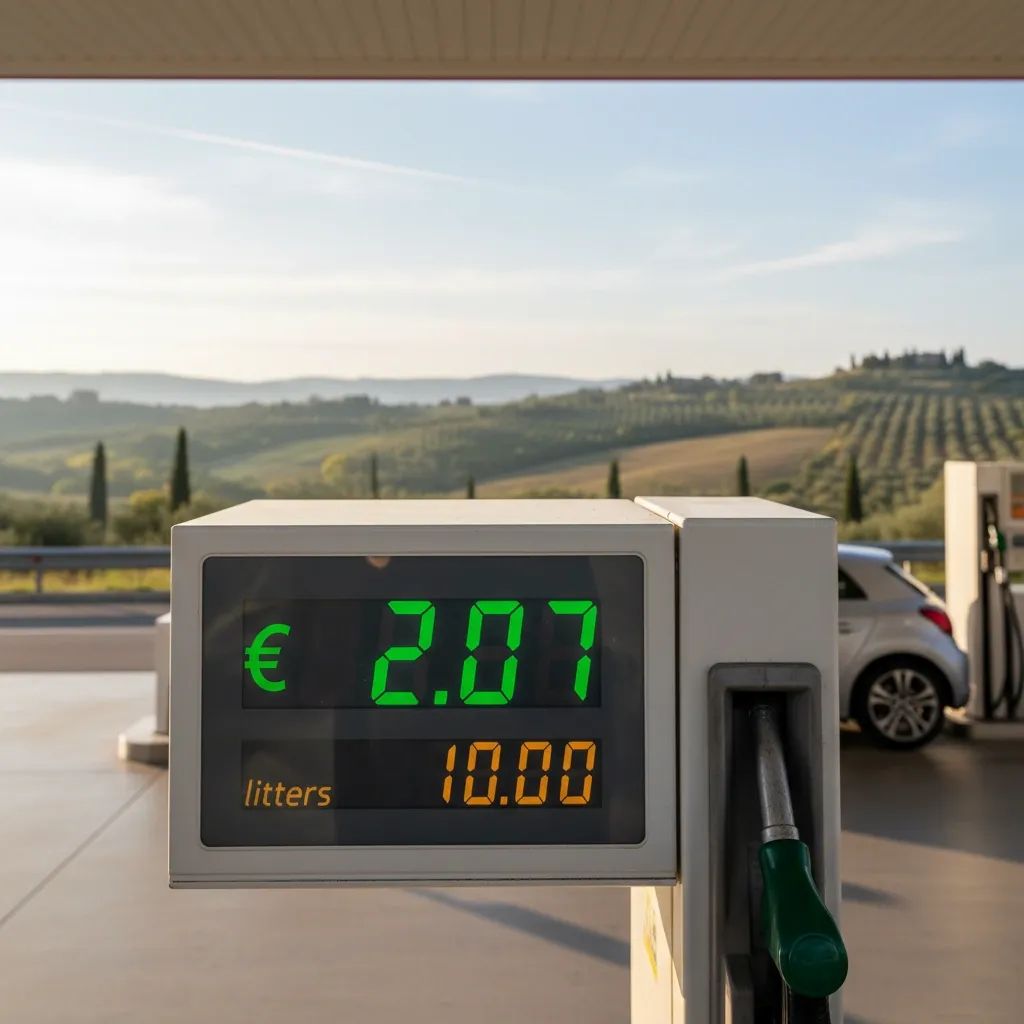
The Italy Cabinet is opting for targeted subsidies over broad-based tax relief as diesel prices reach €2.07 per liter—a decision that has ignited a fresh round of debate over how to shield consumers from an energy shock driven by Iran-related supply disruptions and the closure of the Strait of Hormuz.
Why This Matters
• Diesel now costs €0.34 more per liter than before the conflict, translating to an extra €17.30 per tank or roughly €415 annually for typical drivers filling up twice a month.
• The government has ruled out an across-the-board cut to fuel excise duties, instead preparing income-tested bonuses and support for haulage firms.
• Consumer advocacy group Codacons argues the approach ignores proven 2022 interventions that trimmed inflation by half a percentage point within weeks.
The Dispute Over Tax Strategy
Italy's Minister of Business and Made in Italy, Adolfo Urso, rejected calls from consumer groups to replicate the excise-duty suspension enacted under Prime Minister Mario Draghi in March 2022. Urso contends that measure cost the Treasury nearly €1 B per month, benefited wealthier households disproportionately, and failed to cap inflation, which peaked at 12.6% in October 2022. He told lawmakers this week that selective aid—a revamped "Carta Dedicata a Te" shopping voucher redeemable for fuel, cash subsidies for low-income families, and compensation for freight operators—would deliver more efficient relief without triggering a new price spiral.
Codacons, a Rome-based consumer rights organization, called the government's logic "wrong on the numbers." The group pointed to Istat data showing the Draghi cut pulled headline inflation down from 6.5% to 6% between March and April 2022, a swing that—when applied to total household consumption that year—represented roughly €4 B in collective savings. Codacons argues that without the relief, inflation would have spiked even higher, and that the current refusal to act leaves drivers exposed to structural price pain rather than temporary volatility.
Fuel Prices Climb Across the Board
As of March 15, national averages for self-service benzina stand at €1.837 per liter on ordinary roads and €1.927 on motorways, according to the Ministry of Business. Gasolio self-service averages €2.033 per liter nationwide; the pump average (media alla pompa) reaches €2.07. On certain stretches of the A1 autostrada, diesel has touched €2.60. GPL hovers around €0.704 per liter, while compressed natural gas for vehicles trades at approximately €1.495 per kilogram.
Regional variation is pronounced. Palermo records the highest benzina prices, followed by Bolzano and Crotone, while Sondrio in the Alps remains the cheapest market. The March monthly average for benzina self-service—€1.6704—and gasolio—€1.7950—both reflect sharp upticks triggered by Brent crude surging above $100 per barrel for the first time since July 2022. The catalyst: escalation in the Persian Gulf after strikes on Iranian infrastructure and the subsequent blockade of the Hormuz chokepoint, through which roughly one-fifth of global oil passes.
What This Means for Residents
For families and small businesses, the impact is significant. A household running a single diesel vehicle and refueling twice monthly now pays €415 more per year compared to pre-conflict benchmarks. For tradespeople, delivery drivers, and rural residents without access to public transport, the burden compounds quickly—especially when paired with elevated heating and electricity bills that also trace back to energy-market turbulence.
The government's preferred mechanism involves expanding the "Carta Dedicata a Te," a prepaid debit card introduced for low-income households. Eligible families would receive support for fuel and groceries. Critics note that this approach leaves middle-income earners, freelancers, and pensioners outside the income threshold entirely exposed, and does nothing to lower the sticker price at the pump for the broader population.
The Cabinet is also examining a dormant legal tool: the "accisa mobile," or floating excise mechanism, which automatically reduces fuel duties when oil prices and VAT receipts climb. Yet Prime Minister Giorgia Meloni's administration has described the trigger as too slow—activating only after sustained price increases, by which point "the damage is already done." Early estimates suggest activation would shave roughly four cents per liter, a fraction of the €0.34 rise drivers have already absorbed.
How Europe Is Responding
Italy's reluctance to cut excise taxes stands in contrast to several neighbors. Portugal has enacted a 3.55-cent-per-liter diesel discount, funded by recycling excess VAT revenue collected during price spikes. Croatia imposed retail caps and trimmed excise by two cents. Austria and Slovenia have both announced temporary excise cuts, while the United Kingdom froze duties through September.
According to Ministry data, Italy ranks eighth for diesel and ninth for benzina among EU nations by retail cost as of March 15, a position Urso defends by arguing that transparency measures and real-time monitoring—launched in early 2023—have kept Italian increases below those in Germany, Spain, and France since the current crisis began.
The 2022 Precedent Revisited
When Draghi announced the 25-cent-per-liter excise cut on March 22, 2022—equivalent to nearly 30 cents after VAT—diesel prices were already above €2.50, driven by Russia's invasion of Ukraine. The Unione Nazionale Consumatori documented an immediate deceleration: diesel inflation dropped from +34.5% year-on-year in March to +23.1% in April, with a 7.7% month-on-month decline. Benzina inflation fell from +26.4% to +13%, accompanied by a 9.5% monthly drop.
The Parliamentary Budget Office later estimated that the suite of energy-relief measures—including the fuel cut—contained household-spending growth linked to inflation by roughly 46%, or 3.2 percentage points. Yet the policy had critics even then: the benefit accrued to all drivers regardless of income, and the Treasury's monthly outlay approached €1 B. By the time the measure expired in December 2022, inflation had already peaked and begun its descent, making it difficult to isolate the excise cut's marginal contribution from broader monetary and commodity-market dynamics.
Political and Fiscal Trade-Offs
Foreign Minister Antonio Tajani floated an alternative this week: offset an excise reduction by raising VAT on other goods, keeping the budget neutral. The proposal has gained little traction within the ruling coalition, which remains wary of any policy that could be characterized as a tax increase ahead of regional elections. Meanwhile, the "accisa mobile" debate has revived questions about why automatic stabilizers were not calibrated to respond faster to price shocks—a critique that spans both center-left and center-right administrations.
For now, the Cabinet is expected to finalize a package of "chirurgico" (surgical) interventions—Urso's preferred term—within the next Council of Ministers session. That package will likely include expanded voucher eligibility, dedicated support for the autotrasporto sector, and possibly temporary relief on tolls or registration fees to ease the burden on commercial operators. Whether such measures will be sufficient to quiet public anger over pump prices remains an open question, particularly if Brent crude holds above $100 through the spring travel season.
What Comes Next
Drivers should monitor official price bulletins published by the Ministry of Business through the Osservaprezzi Carburanti app or via the ministry website at www.mimit.gov.it, where you can compare regional rates which can vary by more than ten cents per liter between provinces. Households eligible for the "Carta Dedicata a Te"—distributed through municipalities based on ISEE income thresholds—should contact their municipal "ufficio servizi sociali" (municipal social services office) to confirm enrollment status and eligibility. Employers can still provide fuel vouchers as part of fringe-benefit packages, offering a tax-free avenue for workers whose companies participate in welfare schemes.
In the longer term, the government's strategy hinges on geopolitical de-escalation and a return to normal shipping through Hormuz. Until then, Italian motorists face a policy environment that prioritizes fiscal caution over broad relief—a calculation that may prove politically costly if prices continue climbing or if neighboring countries deliver more visible support to their own consumers.


