
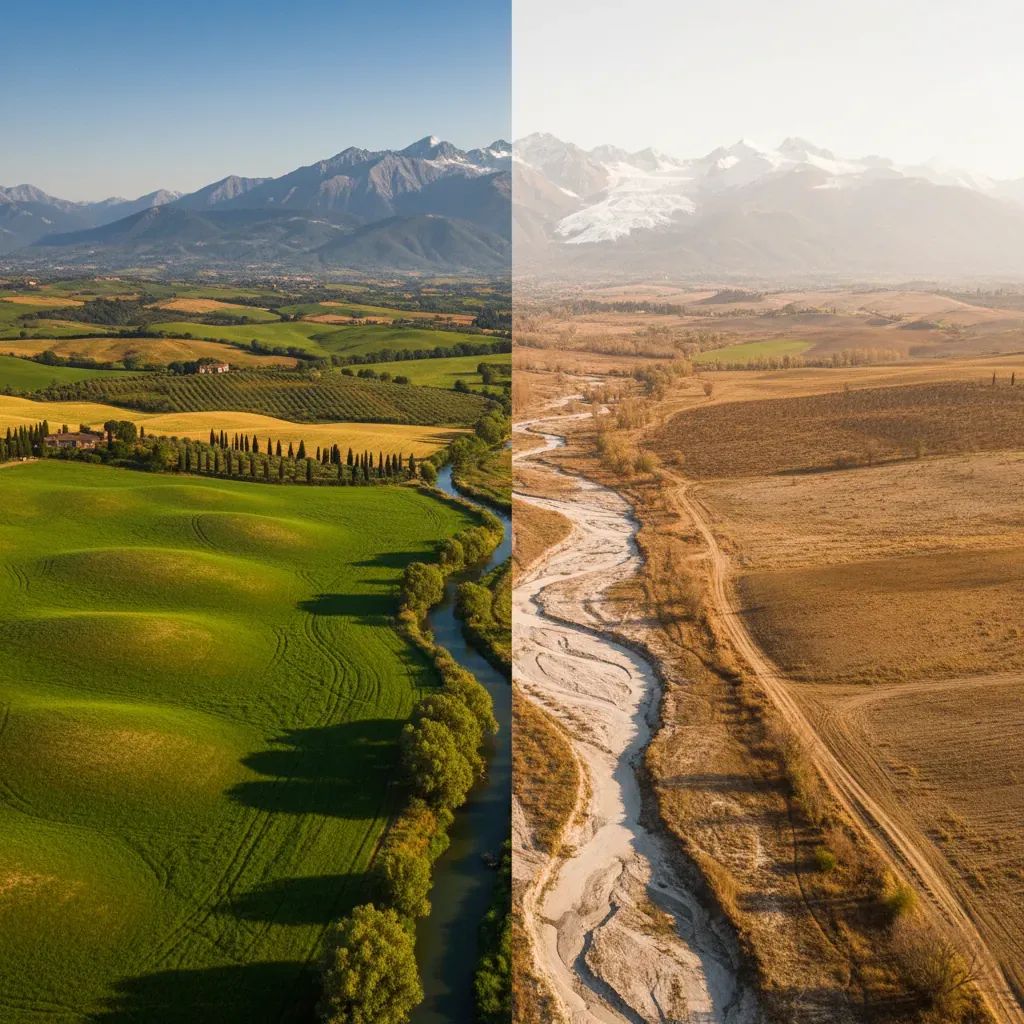
The World Meteorological Organization has confirmed that the planet accumulated a record quantity of heat during 2025, setting off consequences that will persist for centuries—if not millennia. The finding marks a stark escalation in the climate emergency, with every major indicator now flashing red according to the United Nations agency's annual climate assessment released today.
The WMO's tracking now includes Earth's energy imbalance as a core metric for the first time, revealing that the gap between trapped and released heat hit an all-time high in 2025. This measurement provides a critical diagnostic tool for understanding the speed at which the planet is accumulating warmth. The period from 2015 to 2025 represents the 11 hottest years ever recorded, with 2025 ranking as the second or third warmest at 1.43°C above pre-industrial baselines. Meanwhile, extreme weather events have exacted a mounting economic toll: between 1970 and 2021, they killed nearly 2 million people globally and caused economic losses of $4.3 trillion, with Italy among the most vulnerable European nations facing intensified heatwaves, drought, and flooding.
Earth's Energy Imbalance Hits Unprecedented Level
The new WMO report introduces a critical diagnostic tool: Earth's energy imbalance, which measures the gap between incoming solar radiation and outgoing heat. In a stable climate, these two forces roughly balance. But rising concentrations of carbon dioxide, methane, and nitrous oxide have widened this gap dramatically since measurements began in 1960, with the sharpest deterioration occurring over the past two decades.
"Human activities are increasingly disrupting the natural equilibrium, and we will have to live with these consequences for hundreds, even thousands of years," warned WMO Secretary-General Celeste Saulo. The imbalance drives continuous warming of both the atmosphere and oceans, while accelerating the melt of polar and glacial ice.
The oceans absorbed energy equivalent to roughly 18 times humanity's annual energy consumption each year over the last two decades. In 2025 alone, ocean heat content reached a new record, a phenomenon that will sustain warming long after emissions are curbed. According to the WMO report, atmospheric CO₂ concentrations surpassed 425 parts per million in 2025, a level unseen in the past 2 million years.
Polar Ice and Glaciers in Accelerated Decline
The Arctic saw its annual sea ice extent reach or approach a historic minimum in 2025, while Antarctic sea ice recorded the 3rd-lowest extent ever measured. Greenland and Antarctic ice sheets together shed an estimated 1.2 trillion tonnes of ice annually, contributing to inexorable sea-level rise.
Global glacier retreat continued unabated, with projections suggesting that even under the most optimistic warming scenario of +1.5°C, at least half of the world's glaciers will vanish by 2100. If warming reaches +4°C, fewer than one-tenth would survive. The so-called "peak glacier extinction"—when annual loss hits its maximum—could arrive as early as 2041 in the lower-warming scenario, or around 2055 in the higher one.
The disappearance of alpine glaciers in Asia threatens water supplies for 2 billion people, while the collapse of Antarctica's Thwaites Glacier—nicknamed the "Doomsday Glacier"—could alone raise sea levels by 65 cm and trigger a cascade effect that would add another 3.3 meters if the West Antarctic Ice Sheet destabilizes. Nine Antarctic ice shelves have already experienced significant collapse over the past half-century, losing 87% of their mass.
What This Means for Residents in Italy
Italy sits on the front line of Europe's climate vulnerability. The Italian Peninsula and surrounding Mediterranean basin face escalating risks from prolonged heatwaves, water scarcity, and extreme precipitation events. The economic and human costs are mounting in multiple dimensions.
Half of the world's land surface recorded above-average days of severe heat stress in 2025, a trend that hits hardest in southern Europe. Italian cities have experienced heat-related mortality spikes, and the outdoor labor sector—from agriculture to construction—suffers productivity losses as high as 30% during peak summer months. This burden falls particularly on vulnerable populations and outdoor workers with minimal protection from extreme temperatures.
Alpine glacier retreat now threatens summer water supplies for the Po River basin and other critical watersheds, jeopardizing both drinking water and irrigation for millions of residents. The World Bank notes that this water scarcity is already forcing rationing in several northern municipalities, a trend expected to intensify. Prolonged droughts strain agricultural productivity and household access to reliable freshwater, creating cascading economic and public health challenges.
Ski resorts in the Italian Alps face shrinking seasons and unreliable snowfall, while coastal resorts contend with erosion and storm surge that accelerates with rising sea levels. Summer cooling demand strains the electrical grid, pushing up energy costs and risking blackouts during peak heat events. Meanwhile, changing precipitation patterns and extreme weather damage olive groves, vineyards, and cereal crops, threatening Italy's $60 billion agri-food sector. Price volatility for staples like wheat and tomatoes is expected to intensify, affecting both producers and consumers.
According to the World Bank, universal access to early warning systems could prevent at least $13 billion in property losses and $22 billion in lost wages annually worldwide. A warning issued just 24 hours in advance can reduce storm or heatwave damage by up to 30%, underscoring the urgency of Italy's rollout of the IT-Alert public warning system, now in extended trials through August 2025 for tsunami, volcanic, and intense precipitation risks.
Economic and Human Toll Across Europe
The European Union, which has committed to cutting net greenhouse gas emissions by at least 55% by 2030 under its "Fit for 55" package, is racing to align national plans with the bloc's 2050 climate neutrality target. Italy's National Integrated Energy and Climate Plan (PNIEC) aims to reduce fossil fuel dependence and expand renewable energy capacity, though implementation has lagged. From 2025, the EU's Emissions Trading System (ETS) extends to maritime transport, buildings, and road transport, establishing separate quotas and reduction factors for these sectors. Investment in clean technologies—particularly renewables and battery storage—is projected to reach €5 trillion annually by 2035 across the continent.
Yet progress remains slow. The UN Environment Programme's Emissions Gap Report 2024 warned that current national commitments put the world on track for warming between 2.6°C and 3.1°C by century's end, well above the Paris Agreement's 1.5°C aspirational limit. To stay on a 1.5°C pathway, global emissions must fall by 7.5% annually until 2035—a formidable challenge given that emissions hit a record high in 2023. Nations must commit to cutting emissions by 42% by 2030 and 57% by 2035 in their next round of nationally determined contributions, due before the COP30 summit in Brazil.
Global Climate Emergency Declared
UN Secretary-General António Guterres used stark language when the WMO report was published: "The global climate is in a state of emergency. The Earth is being pushed beyond its limits. All major climate indicators are flashing red."
The decade from 2015 to 2025 was the warmest on record, with 2025 posting a global mean temperature approximately 1.43°C above the 1850–1900 pre-industrial baseline—just 0.01°C below the 2023 peak. Preliminary forecasts suggest 2026 will rank among the four hottest years since measurements began in 1850, with a median estimate of 1.46°C above pre-industrial levels, marking the fourth consecutive year exceeding 1.4°C.
Between 2023 and 2025, average global temperatures surpassed 1.5°C for three consecutive years—the first time such a sustained breach has occurred. Many climatologists now consider it inevitable that the 1.5°C threshold will be permanently exceeded as a long-term average within the current decade, far sooner than anticipated.
The Push for Universal Early Warning Coverage
Guterres called for accelerating the "Early Warnings for All" initiative, which aims to protect every person on Earth with a multi-hazard early warning system by 2027. The Global Status of Multi-Hazard Early Warning Systems 2025 report, presented at COP30 in Belém in November 2025, showed growing global coverage but highlighted persistent regional disparities and infrastructure shortfalls.
Advanced systems integrating artificial intelligence, satellite networks, and real-time observation are improving forecast speed and accuracy. These platforms enhance urban resilience, safeguard critical infrastructure, and support adaptation strategies against extreme precipitation, heatwaves, and water stress. The European Union is preparing a new Climate Adaptation Plan (ECAP) for 2026, focusing on vulnerable sectors, integrated approaches, and novel policy tools.
Scientific Consensus and Political Stalemate
The Intergovernmental Panel on Climate Change (IPCC) has encountered unprecedented delays in planning its Seventh Assessment Report (AR7). At the 62nd plenary session in Hangzhou, China, in February 2025, governments failed to agree on a timeline, with some nations pushing for publication by late 2028 to inform the UN's second global stocktake, while China and others favored a longer deadline. Discussions remained unresolved at the 63rd session in Lima, Peru, in November 2025, with IPCC Chair Prof. Jim Skea lamenting that such early-cycle disagreements were "unprecedented."
Meanwhile, the science itself grows clearer and more alarming. The rapid, large-scale changes now underway will inflict damage for centuries. The disappearance of reflective ice surfaces—which normally bounce back 95% of sunlight—exposes darker ocean and land, amplifying heat absorption in a self-reinforcing loop. The Arctic is warming two to three times faster than the global average, and methane released from thawing permafrost adds further greenhouse forcing.
What Comes Next
For residents of Italy and the wider European Union, the 2025 WMO report translates into several immediate realities: expect more frequent and severe weather disruptions, higher insurance premiums, volatile food prices, and increased public spending on disaster response and climate adaptation. Regional water management, coastal defense, and agricultural innovation will dominate policy debates in the years ahead.
The World Bank estimates that proactive investment in early warning and climate resilience yields far higher returns than emergency response after disasters strike. For Italy, this means accelerating the rollout of IT-Alert, upgrading flood defenses in vulnerable river basins, and supporting farmers in adopting drought-resistant crops and precision irrigation.
The broader message is unambiguous: the planet's energy imbalance is no longer a distant scientific abstraction. It is a measurable, accelerating force reshaping economies, ecosystems, and daily life. The window for limiting warming to relatively manageable levels is closing rapidly, and the consequences of inaction will echo across generations.


