
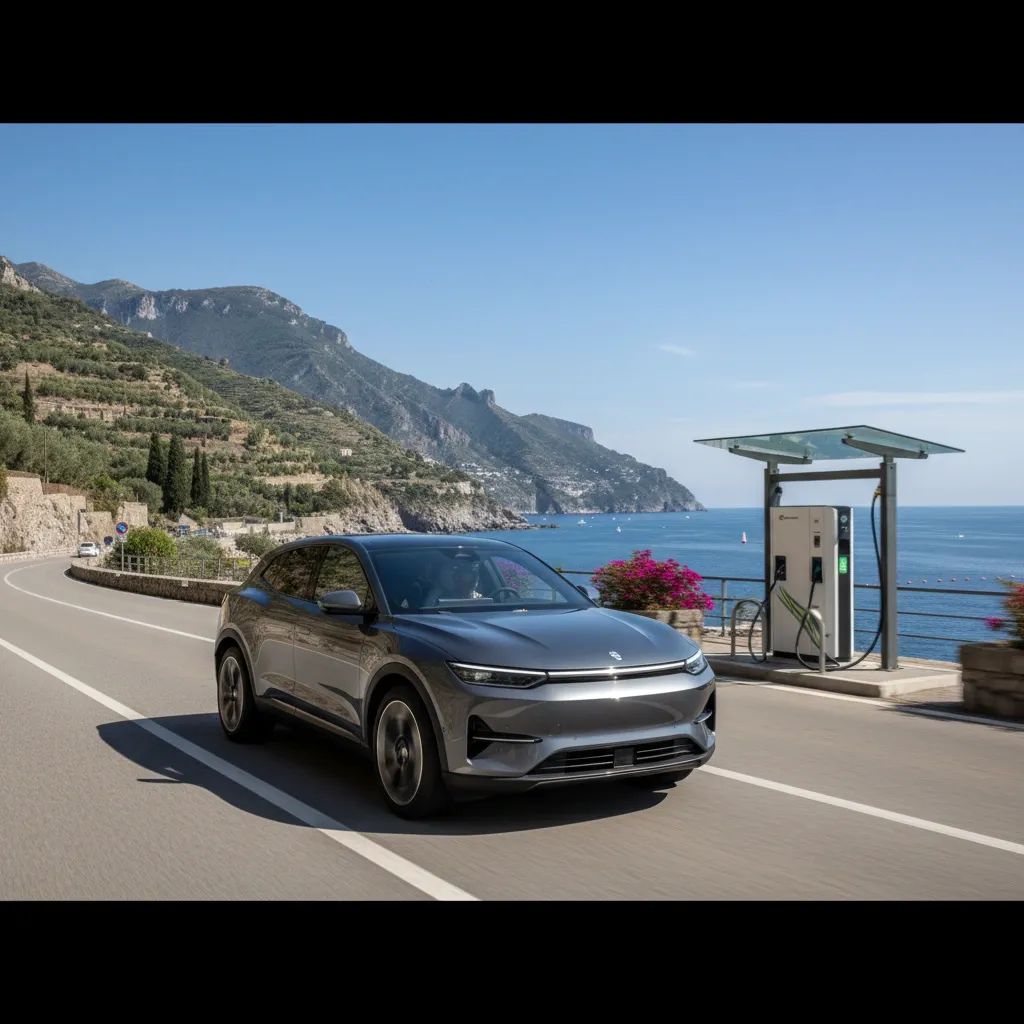
The BMW Group is accelerating toward a target of 2 million fully electric vehicles sold by the close of 2026, positioning itself as a formidable competitor in the rapidly shifting automotive landscape. This ambitious milestone follows the company's achievement last June of 1.5 million battery electric vehicles (BEVs) delivered since launching the i3 and i8 models back in 2013. The German automaker's electrification strategy, unveiled through CEO Oliver Zipse, aims to expand its zero-emission lineup to 20 distinct battery-powered models before year's end, a move that could reshape the mobility options available across Italy and Europe.
Why This Matters
• Market competition intensifies: BMW is outpacing Mercedes-Benz in EV sales growth while Tesla stumbles in European markets, creating fresh choices for Italian consumers.
• New tech arriving soon: Spring 2026 updates to the iX1 and iX2 will add 40+ km of range using silicon carbide electronics, enhancing practicality for regional travel.
• Volume target: BMW expects one in three vehicles sold globally to be fully electric by 2026, signaling a structural shift in dealer inventories and service networks.
Neue Klasse: The Technology Reset
Central to BMW's electric ambitions is the Neue Klasse architecture, an 800-volt platform engineered from scratch to deliver performance and efficiency gains the current generation cannot match. The first production model, the iX3 electric SUV, began rolling off assembly lines in late 2025 and is now trickling into European showrooms. Pre-orders have been so robust that the vehicle is nearly sold out through its entire 2026 European production allocation, according to Zipse. Customer demand for the iX3 demonstrates, he argues, that BMW is steering the brand toward the future with confidence.
The iX3 50 xDrive, the launch variant, employs dual motors generating 345 kW (469 horsepower) and 645 Nm of torque, enabling a 0-to-100 km/h sprint in 4.9 seconds. Its 108 kWh battery pack provides an estimated 805 km of WLTP range, making it viable for cross-border journeys from Milan to Munich or Rome to Vienna without recharging. Thanks to the 800-volt architecture, the iX3 can accept 400 kW DC fast charging, adding 373 km of range in roughly 10 minutes at compatible stations. That capability matters in Italy, where long-distance highway corridors like the A1 Autostrada del Sole are increasingly dotted with high-power charging hubs.
Next week, BMW will introduce the second Neue Klasse model: the i3 berlina, a sedan designed to rival the Tesla Model 3. Scheduled to debut officially on March 18, this four-door EV will enter series production in the second half of 2026, with European deliveries expected toward year-end. Technical specifications mirror the iX3 closely—340 kW output, 645 Nm torque, and the same 108.7 kWh battery—but the sedan's superior aerodynamics are projected to push range beyond the SUV's already impressive figure, potentially exceeding 820 km on the WLTP cycle.
Both vehicles integrate BMW's new "Heart of Joy" central control unit, which consolidates driving, braking, and regenerative recovery functions into a single system, improving safety and boosting regenerative braking efficiency by 25% compared to the current i4. Inside, physical buttons disappear almost entirely, replaced by a massive 17.9-inch touchscreen and the BMW Panoramic Vision 3D Head-Up Display, which stretches across the full width of the windshield.
What This Means for Italian Drivers
For residents of Italy, BMW's push into electric mobility translates into tangible changes at the dealership level and on the road. The company's pledge to introduce more than 40 new or refreshed models between now and 2027 includes electrified variants of the iconic Series 3 and Series 5, vehicles that have long dominated the premium sedan segment in Italian cities. Zipse emphasized that these models will be offered "in all variants," inaugurating what he calls "the new era of technological neutrality" within the BMW Group—a strategy that offers internal combustion, hybrid, and pure electric drivetrains under the same nameplate.
This flexibility addresses a key concern for Italian buyers, who face an uneven charging infrastructure. While metropolitan areas like Milan, Turin, and Bologna enjoy dense networks of public charging stations, rural provinces in southern Italy and mountainous regions still lag behind. By maintaining combustion and plug-in hybrid options alongside BEVs, BMW reduces range anxiety for drivers who frequently traverse less electrified zones.
Pricing details for the i3 sedan remain undisclosed, but the iX3 50 xDrive launched in Australia at roughly AUD 109,900 (approximately €60,000), suggesting the Italian market could see starting prices in a similar bracket once VAT and local taxes are applied. That positions BMW's Neue Klasse offerings as competitive alternatives to the Mercedes-Benz EQE and Audi Q6 e-tron, both of which have struggled to match the iX3's combination of range, charging speed, and interior technology at comparable price points.
Competitive Landscape: BMW Gains Ground
BMW's 2025 performance in the European electric vehicle market underscores its rising competitiveness. The BMW Group delivered 442,072 fully electric vehicles globally in 2025, a 3.6% increase year-over-year, with BEVs accounting for 18% of total group sales. In Europe specifically, BEV sales surged 28.2%, a stark contrast to Mercedes-Benz, which saw a 9% decline in global BEV deliveries to 168,800 units. Audi, meanwhile, posted strong growth with over 223,000 BEVs delivered worldwide, up approximately 36% from 2024.
Tesla, the longtime market leader, stumbled badly in Europe during 2025, with first-quarter registrations down 37% compared to Q1 2024. Although Tesla's China-built vehicles rebounded sharply in February 2026—up 91% year-over-year to 58,600 units—analysts project global deliveries for Q1 2026 will fall below 350,000 units, signaling persistent headwinds. For Italian consumers, this competitive churn means more choice, better pricing, and accelerated innovation as legacy automakers like BMW fight to reclaim market share.
The BMW X1/iX1 crossover proved particularly popular, ranking among the top five plug-in models sold in Europe in January 2026 with 6,678 registrations. Its success illustrates demand for compact, versatile electric SUVs suited to Italy's narrow urban streets and mixed-use driving patterns.
Technology Upgrades: Spring 2026 Enhancements
BMW plans to roll out significant mid-cycle improvements to its existing electric portfolio this spring. The iX1 and iX2 compact SUVs will receive updated power electronics featuring silicon carbide (SiC) semiconductors, a technology that reduces energy losses during DC-to-AC conversion and regenerative braking. The upgrade will extend the iX2 eDrive20's WLTP range from approximately 430 km to 474 km, while the iX1 eDrive20 will gain a similar boost to 461 km. These enhancements make both vehicles more practical for longer regional trips, such as weekend excursions from Rome to the Amalfi Coast or Florence to the Cinque Terre.
The silicon carbide technology is part of BMW's broader iFACTORY sustainability initiative, which prioritizes efficiency gains, circular economy principles, and renewable energy sourcing across production facilities. The company's manufacturing plants in Europe are transitioning toward carbon-neutral operations, a shift that resonates with Italian regulatory pressures as the European Union tightens emissions standards and phases out combustion engine sales by 2035.
Challenges Ahead: Tariffs and Chinese Competition
Despite its momentum, BMW faces headwinds that could temper growth. The company forecasts a slight decline in pre-tax profits for 2026, with an automotive EBIT margin between 4% and 6%, partly due to negative effects of tariffs on cross-border trade. These levies, imposed by various governments in response to geopolitical tensions, raise production costs and complicate supply chains, particularly for battery raw materials sourced globally.
In China, BMW and Mercedes-Benz both anticipate weaker demand in 2026, with annual sales of locally produced vehicles expected to fall below 500,000 units each. The erosion stems from the rapid ascent of domestic Chinese EV brands like BYD, NIO, and Xpeng, which offer compelling technology at lower price points and enjoy logistical advantages in the world's largest car market. For BMW, China's slowdown threatens to offset gains in Europe and complicate its path to the 2 million BEV milestone.
Impact on Italy's Automotive Ecosystem
BMW's electrification push carries implications beyond individual vehicle sales. Authorized dealerships across Italy are investing in training technicians to service high-voltage battery systems, install home charging solutions, and educate customers on EV ownership. The influx of electric models also drives expansion of Italy's charging network, as automakers partner with energy providers to deploy fast-charging corridors along major highways.
For Italian fleet operators—taxi cooperatives in Rome, corporate car pools in Milan, delivery services in Naples—the arrival of long-range, fast-charging BMWs like the iX3 and i3 sedan presents a viable pathway to decarbonize without sacrificing operational flexibility. The vehicles' 21-minute 10-to-80% charge time aligns with driver break schedules, minimizing downtime and maximizing utilization rates.
Zipse's commitment to "technological neutrality" also signals that internal combustion engines will remain available for Italian buyers who need them, whether due to inadequate home charging access, high-mileage driving patterns, or rural residence. This pragmatic approach acknowledges the reality that Italy's energy infrastructure and consumer preferences are evolving unevenly, and a one-size-fits-all mandate risks alienating customers who lack the resources to adopt electric mobility immediately.
Outlook: A Contested Milestone
Reaching 2 million cumulative BEV sales by the end of 2026 is ambitious but achievable for BMW, provided European demand holds steady and production ramp-ups for the Neue Klasse proceed without major delays. The company's 2025 performance—delivering 442,072 BEVs—suggests it would need to sell roughly 560,000 additional BEVs in 2026 to hit the target, assuming no significant inventory adjustments or delivery backlog clearances.
Success hinges on the Neue Klasse rollout. If the iX3 and i3 sedan resonate with buyers as strongly as pre-order data suggests, BMW will carve out a defensible position against Tesla, Audi, and emerging Chinese competitors. For Italian consumers, the broader implication is clear: the next 18 months will bring a wave of compelling electric vehicles, better charging infrastructure, and sharper pricing as automakers vie for dominance in a market that is finally—after years of false starts—beginning to electrify in earnest.


