
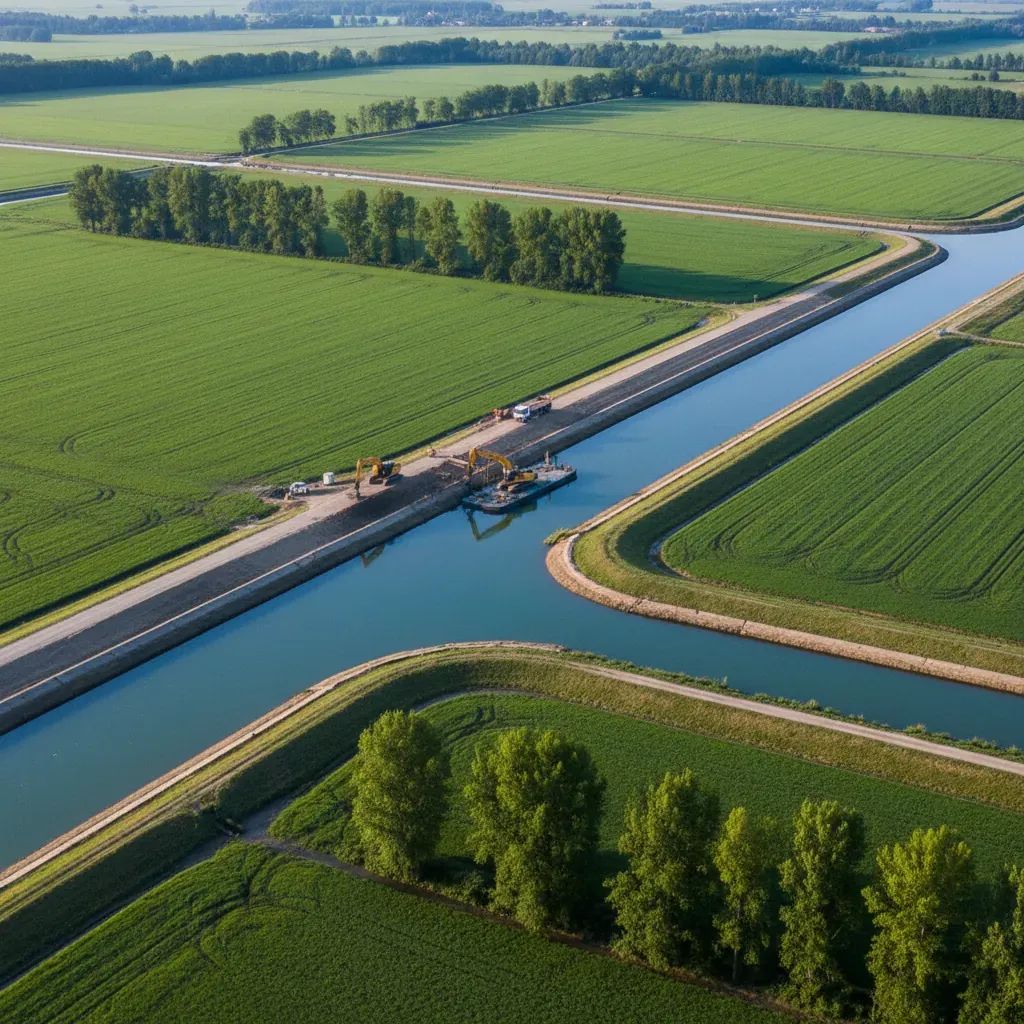
ANCI (the Italy National Association of Municipalities) and ANBI (the National Association of Land Reclamation Consortia) signed a national framework agreement on February 26, 2026, in Rome. The protocol formalizes cooperation between Italy's municipalities and land reclamation consortia, giving unified strategic structure to over 3,000 existing local collaboration pacts focused on flood prevention, water management, and soil defense.
For residents across Italy, this translates to a stronger institutional promise: coordinated flood prevention and water management at the municipal and watershed level, backed by technical support and shared resources between locally elected bodies and the specialized consortia that maintain Italy's sprawling network of canals, drainage systems, and irrigation infrastructure.
Why This Matters
• Your municipality can now request technical project design help directly from regional land reclamation consortia for soil defense and water regulation works.
• Over €24M in regional and national funds are flowing to priority projects across Lombardy, Emilia-Romagna, and Tuscany in 2025-2026, with this protocol expected to accelerate access and deployment.
• Extreme weather resilience: The agreement institutionalizes preventive maintenance as policy, shifting away from emergency response to year-round territorial care—critical as Italy faces increasingly violent rainstorms and prolonged droughts.
• Bike paths and pedestrian corridors along canal embankments are now formally part of the planning toolkit, blending climate adaptation with livability upgrades.
What This Means for Residents
The protocol's practical impact unfolds at the local and watershed scale, where most Italians interact daily with water infrastructure—whether crossing a bridge over an irrigation canal, living near a river embankment, or depending on aquifer-fed wells for agriculture or drinking water.
Technical Assistance for Municipalities: One of the agreement's core innovations is the creation of dedicated technical units within the consortia to support municipal project design for soil defense and water regulation. Smaller towns, which often lack in-house engineering capacity, can now lean on consortia expertise to draft proposals for regional or EU funding calls, such as the National Recovery and Resilience Plan (PNRR) water infrastructure stream or the Regional Operational Defense of Soil (DODS) programs active in Tuscany, Emilia-Romagna, and Veneto.
Data Sharing and Hydraulic Mapping: The protocol mandates the exchange of georeferenced databases (GPS-mapped flood data and infrastructure records) between signatories. This means municipalities gain access to detailed hydraulic modeling, historical flood data, and real-time canal water levels maintained by consortia—critical inputs for urban planning decisions, building permits in flood-prone areas, and emergency response protocols.
Institutionalized Watershed Planning: The agreement formalizes joint consultation and coordination for the drafting of hydrogeological basin management plans. Rather than municipalities and consortia operating in parallel, the protocol creates a space for ongoing dialogue on priorities, timelines, and resource allocation within each river basin district.
Canal Embankments as Slow Mobility Infrastructure: Where feasible, the protocol encourages the conversion of canal-side maintenance paths into cycling and pedestrian routes. This dual-use approach is already visible in stretches of the Po Delta and the Romagna canal network, where embankments double as recreational trails—offering both flood defense and quality-of-life benefits.
Nutria Population Control and Water Management: Two operational details matter for rural and peri-urban residents. First, the consortia and municipalities will jointly implement nutria control plans—the invasive rodent damages embankments and crops across northern and central Italy. Second, the agreement commits both parties to maintaining minimum water levels in consortium canals during the non-irrigation season, preventing stagnation and ecosystem problems that plague some urban-adjacent waterways in summer and autumn.
The Strategic Shift Toward Prevention
For decades, Italy's approach to hydrogeological risk has been reactive—emergency declarations, reconstruction funds, and public outcry after each deadly flood or landslide. This protocol formalizes a pivot to anticipatory governance. The consortia—quasi-public entities with elected boards representing landowners and agricultural stakeholders—manage 200,000 kilometers of canals and ditches nationwide. Municipalities, meanwhile, hold direct responsibility for local urban drainage, road maintenance, and land-use planning. The two have cooperated informally for years; now, the agreement makes that cooperation legally anchored and scalable.
Marco Fioravanti, ANCI National Council President and Mayor of Ascoli Piceno, emphasized the urgency: "This protocol is significant for the Italy of municipalities and for the protection of our territory, especially in light of extreme weather events that are becoming more frequent and intense." His comment reflects the lived reality of mayors from Piedmont to Sicily, who have watched local budgets strained by repeated flood damage, infrastructure failures, and the political cost of preventable disasters.
Massimo Gargano, ANBI Director General, stated: "Land reclamation consortia and municipalities are united by being the elected expression of the territories. For this reason, it is natural to find concrete operational convergences to protect communities and the environment."
Broader Context: Italy's Hydrogeological Vulnerability
Italy's hydrogeological fragility is well-documented. According to ISPRA (the Italy Institute for Environmental Protection and Research), over 93% of Italian municipalities face some degree of landslide, flood, or coastal erosion risk. The country's topography—steep Apennine and Alpine slopes, narrow floodplains, urbanized valleys—compounds the challenge. Climate change is intensifying the problem: the frequency of extreme precipitation events (rainfall exceeding 100mm in 24 hours) has increased by roughly 30% over the past three decades, according to the Italy National Research Council (CNR).
Against this backdrop, land reclamation consortia play an outsized role. Originating in the medieval and Renaissance eras to drain marshes and control rivers, modern consortia are hybrid entities—publicly governed but funded through mandatory contributions from landowners in their jurisdiction. They operate with democratic accountability (elected boards) and technical specialization (hydrologists, engineers, agronomists). The ANCI-ANBI protocol essentially recognizes that municipalities and consortia are natural allies: both are rooted in local electorates, both face the same flood risks, and both are squeezed by limited budgets and rising expectations from citizens.
Challenges and Open Questions
Despite the optimism at the signing ceremony, several obstacles loom. Funding gaps remain: the combined municipal and consortia budgets fall far short of meeting Italy's estimated needs for hydraulic infrastructure upgrades over the next decade. Bureaucratic inertia can still delay projects: environmental impact assessments, archaeological surveys, and procurement rules often stretch timelines by years. Regional disparities are stark—Emilia-Romagna and Veneto have robust consortia with modern equipment and data systems, while some southern regions struggle with under-resourced, politically fragmented entities.
Moreover, climate projections suggest that even aggressive adaptation measures may only mitigate, not eliminate, future flood risk. Mediterranean Europe will experience more intense droughts punctuated by violent, short-duration storms—a hydrological challenge that strains both irrigation systems and flood defenses.
European Dimension and Institutional Development
The protocol explicitly commits both organizations to joint advocacy at the European Union level for policies that prioritize preventive territorial maintenance, sustainable water use, and biodiversity protection. This signals an effort to influence the next round of EU Cohesion Policy funding (post-2027) and the implementation of the EU Water Framework Directive and the EU Resilience Strategy for Water.
Critically, the National Council for Economy and Labour (CNEL) approved in October 2025 a draft law that strengthens the operational mandate of consortia in hydrogeological risk prevention. If enacted, this legislation would give legal teeth to the ANCI-ANBI protocol, transforming voluntary cooperation into a default institutional framework.
The Road Ahead
The ANCI-ANBI protocol is not a silver bullet, but it is a necessary institutional evolution. By formalizing collaboration, pooling expertise, and committing both parties to preventive rather than reactive strategies, it lays the groundwork for a more resilient territorial governance model. For residents, the test will be visible and tangible: cleaner canals, fewer flooded basements, faster project approvals, and perhaps a new bike path along the embankment where the morning commute once meant dodging potholes on a narrow road.
Whether that natural convergence translates into safer homes and more sustainable water use will depend on funding, political will, and the ability of local actors to move from protocol to implementation—from protocol to dredged canal, reinforced embankment, and maintained pump station.


