
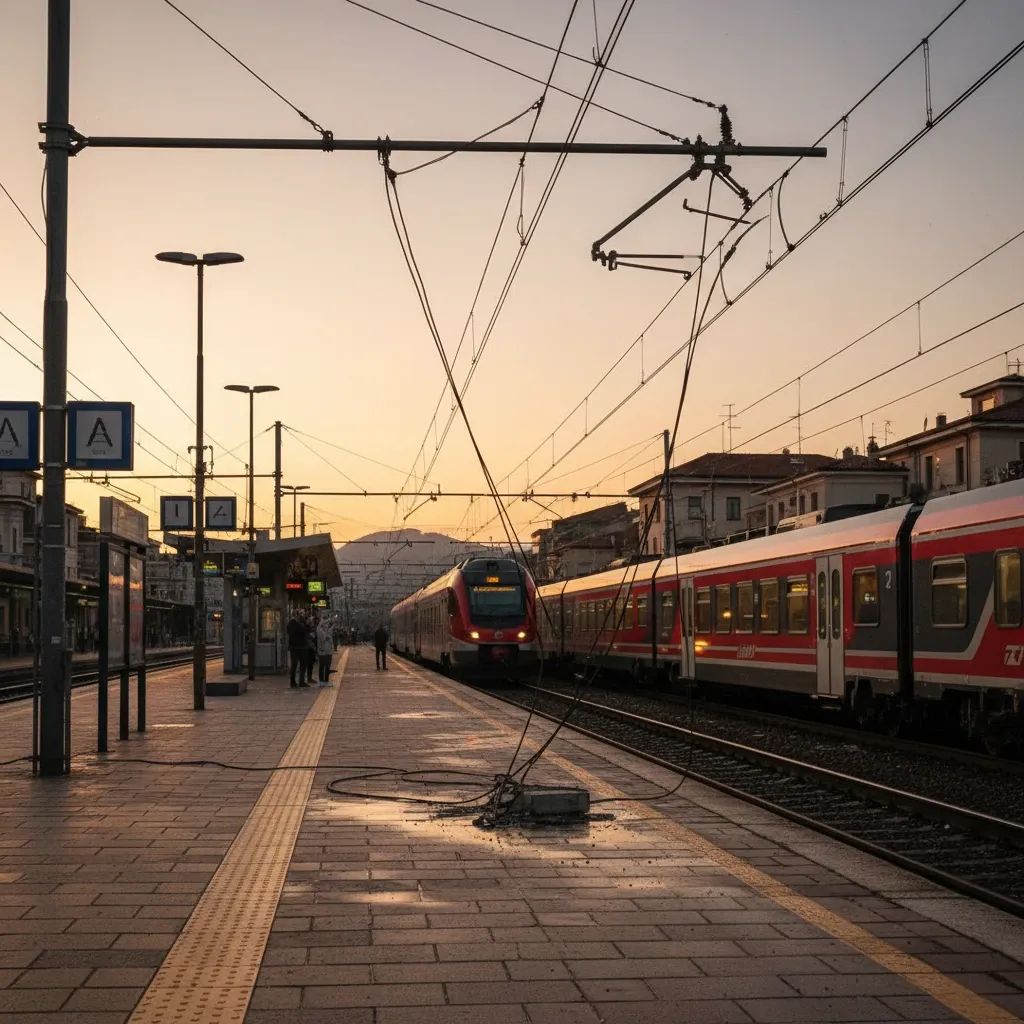
Rete Ferroviaria Italiana technicians are working to restore full operations on the Adriatic rail corridor in Abruzzo after a single train severed overhead power cables near Montesilvano station late Friday evening, stranding 125 passengers overnight and triggering delays approaching 400 minutes across the network. As of this morning, one track remains operational between Pescara and Pineto, with the second line expected back in service by late morning.
Why This Matters:
• Commuter chaos: Regional, Intercity, and high-speed trains are running up to 6 hours late or cancelled, with substitute buses deployed for stranded travellers.
• Compensation due: Passengers facing delays of 120 minutes or more qualify for 50% refunds under EU passenger rights law.
• Repeat failures: The incident underscores persistent vulnerabilities in the Adriatic corridor's electrical infrastructure, despite €310M in upgrades currently underway.
What Happened at Montesilvano
The disruption began around 20:00 on May 1 when a train in transit severed the catenary wires supplying electricity to the section between Giulianova and Pescara. One Frecciarossa service carrying 125 passengers became immobilized at Montesilvano and remained stuck through the night as RFI (Rete Ferroviaria Italiana) crews assessed the damage and began emergency repairs.
The outage cascaded across Italy's eastern spine. Frecciarossa services linking Pescara and Bari to Milan, the Intercity Bari–Milano route, and the overnight Lecce–Torino sleeper train all experienced severe schedule disruption. Some departures were curtailed mid-route, others rerouted, and passengers faced waits measured in hours rather than minutes.
As of Saturday morning, Trenitalia confirmed on its online tracker that circulation remains "rallentata" (slowed), with residual delays persisting even after single-track operations resumed. Substitute coaches have been dispatched to ferry passengers around the affected zone, but the knock-on effect rippled as far north as Milan and south to Puglia.
Legal Entitlements for Affected Travellers
Italy's implementation of EU Regulation 1371/2007 offers clear remedies when rail services fail. Passengers who arrive at their final destination 60 minutes or more behind schedule can choose between a full refund for unused portions of the journey or continuation on the next available service—including alternative routing if necessary.
More importantly for those caught in the Montesilvano debacle, anyone delayed by two hours or longer is entitled to compensation equal to 50% of the ticket price. For delays between 60 and 119 minutes, the rebate drops to 25%. Carriers may set a minimum payout threshold, but it cannot exceed €4.
Beyond refunds, stranded passengers have the right to free meals, refreshments, hotel accommodation, and shuttle transport if an overnight stay becomes necessary. Trenitalia's Smart Refund platform allows claims to be filed online within 12 months of the delay. If the carrier fails to respond within one month, complaints can be escalated to the Autorità di Regolazione dei Trasporti, Italy's transport regulator.
Consumer groups have already called for expedited indemnity payments following this latest breakdown, pointing out that a six-hour delay effectively cancels the utility of the journey for most travellers.
A Corridor Under Construction—and Under Strain
The Adriatic line through Abruzzo sits at the intersection of ambitious modernization plans and the reality of aging infrastructure. RFI has earmarked roughly €11 billion for Abruzzo's rail network, much of it already allocated, with a significant share targeting the Adriatic corridor and the Rome–Pescara axis.
Key projects currently in motion include:
• Fossacesia substation: A new electrical supply hub is slated to go live in June 2026, designed to stabilize power delivery along the coast.
• Traction system overhaul: Complete replacement of the electrical traction system between Ortona and San Vito is underway, with completion set for Q1 2027.
• Drainage upgrades: The Water Drain System is being installed in the San Giovanni and Diavolo tunnels to prevent water ingress, a known contributor to electrical faults during storms.
• Track replacement: Roughly 9 km of rail in the Sinello tunnel have been renewed, reducing future maintenance cycles.
• Centralized traffic control: The ACCM (Apparato Centrale Computerizzato Multistazione) system between Fossacesia and Termoli will unify train dispatching, boosting capacity and response times.
Of the €310M budgeted for these interventions, €100M comes from the PNRR (Italy's National Recovery and Resilience Plan), the post-pandemic EU funding mechanism.
Yet the pace of work also introduces friction. Between April 7 and June 25, ordinary maintenance between Porto d'Ascoli and Roseto degli Abruzzi is forcing schedule changes on regional and long-distance trains. From mid-June to early September, the Giulianova–Teramo branch will be largely offline for a €48M overhaul covering more than 25 km of track and station upgrades.
A Year of Breakdowns and Bad Weather
Friday's cable failure is the latest in a 12-month sequence of disruptions along the Adriatic route. On July 11, 2025, a similar electrical fault halted traffic between Cerignola and Barletta. In early April 2026, the Osento river flooded, completely severing the line between Fossacesia and Porto di Vasto. High winds in February compounded a separate technical fault near the same stretch.
These episodes highlight two vulnerabilities: outdated electrical infrastructure and exposure to extreme weather. The ongoing upgrades aim to address both, but the phased rollout means that until the new substations and drainage systems are fully operational, sections of the line remain susceptible to single points of failure—exactly what occurred at Montesilvano.
What This Means for Residents
For anyone living in or travelling through Abruzzo, the message is twofold: expect continued disruption through at least early 2027, and familiarize yourself with your rights.
• Check before you travel: Trenitalia's Cerca Treno tool and mobile app provide real-time updates. During major works windows—particularly the Giulianova–Teramo closure this summer—substitute bus services will be your primary option.
• Document delays: Request a delay certificate from station staff or onboard crew at the time of travel. This speeds up refund claims filed via Smart Refund or at ticket offices.
• Plan buffer time: If you have a connection—flight, meeting, or onward train—build in at least an extra hour. Single-track operation, even when functioning, reduces punctuality margins.
• Stay informed on compensation: The 50% refund for delays exceeding two hours is automatic if you file correctly, but carriers are not obligated to notify you proactively.
The €11 billion investment is ultimately intended to transform Abruzzo into a high-capacity, electrified hub linking Rome to the Adriatic coast and the Balkans beyond. In the interim, however, the region's rail network remains a work-in-progress—one that Friday's overnight stranding made uncomfortably visible.


