
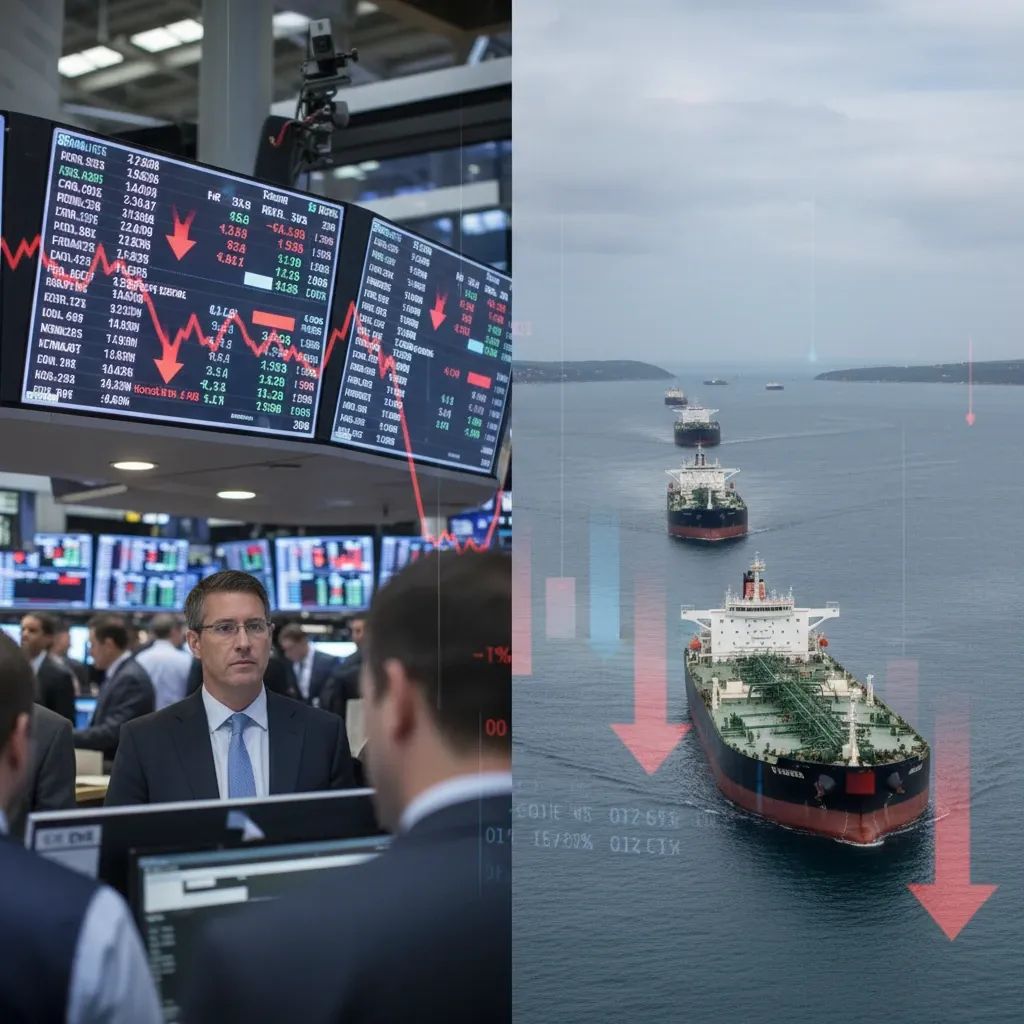
On Monday, June 30, 2026, Italy's main stock exchange closed the morning session with modest gains, as geopolitical turbulence in the Middle East and a sweeping rally in semiconductor stocks offset weakness across banking and cement sectors. The FTSE Mib index edged up just 0.1% to 51,317 points, reflecting a cautious mood among investors weighing the fallout from renewed tensions in the Strait of Hormuz against renewed optimism in tech hardware.
Why This Matters:
• Energy costs rising: Natural gas futures jumped 3.5% to €42.27/MWh on supply concerns, while crude oil climbed 0.9% to $69.86/barrel—a direct hit to household and industrial budgets across Italy. For Italian households, a sustained increase to €50/MWh in gas prices would translate to approximately €15-25 more per month in heating and electricity costs for an average apartment, with larger impacts on families in northern regions during winter months.
• Semiconductor surge: STMicroelectronics (STM), one of Italy's heavyweight tech stocks, rallied 3.6% after Barclays upgraded the stock to "Equalweight" (equivalent to a neutral, hold rating) from "Underweight" (sell) and raised its price target from €34 to €65—a 91% increase, citing AI and satellite revenue potential exceeding €3.6B by 2027.
• Corporate consolidation: Icop launched a €273M takeover bid for Trevi, targeting full control of the underground engineering firm with a 20% premium to Friday's closing price.
Energy Jitters Ripple Through European Markets
Italy's FTSE Mib wasn't alone in its tepid performance. Frankfurt slipped 0.07% into negative territory, while Paris shed 0.35% and Madrid dropped 0.44% as European investors digested the latest flare-up between the United States and Iran over the weekend. The two nations have been locked in a series of tit-for-tat strikes since late February, and the Strait of Hormuz—the artery for over 20% of global oil and LNG exports—remains a flashpoint. Iran and Oman held their first direct talks on managing the strategic waterway, but markets remain jittery.
The immediate consequence: crude oil futures (WTI) advanced to nearly $70/barrel, and European natural gas spiked, reflecting fears that any prolonged closure of the strait could send TTF benchmark prices above €100/MWh within two months. For Italy, where 95% of oil and 88% of gas are imported, the implications are direct: higher energy bills for households and manufacturers, and renewed pressure on the European Central Bank to balance inflation concerns against sluggish growth.
STMicroelectronics Leads Tech Rebound
The standout performer in Milan was STMicroelectronics, which surged 3.6% after Barclays upgraded the stock to "Equalweight" (a neutral, hold rating) from "Underweight" (sell) and raised its target price from €34 to €65—a 91% increase. The upgrade came as the investment bank revised revenue forecasts upward, driven by robust demand in artificial intelligence and satellite infrastructure.
Barclays now projects STM will generate €2.3B in AI-related revenue by 2027, up from roughly €1B in 2026, and expects satellite segment sales to reach €1.3B next year. The move reflects a broader reassessment of European semiconductor firms, which have lagged their U.S. and Asian peers but are now seen benefiting from strategic government subsidies and reshoring trends. France's Soitec climbed 9% on the same report, and Infineon added 1.5%, underscoring renewed appetite for the sector.
For Italian investors, STM's rally is significant: the stock is a top-10 constituent of the FTSE Mib and a bellwether for the country's limited but growing exposure to advanced manufacturing and defense electronics. The company's share price has been volatile—the FTSE Mib itself touched an all-time high of 52,434 points on June 18 before surrendering 3% over the past week on a tech sell-off. Today's rebound offers some relief, though the stock remains sensitive to global chip cycle dynamics.
Energy Stocks Ride the Oil Rally
The uptick in crude prices provided a lift to Italy's energy-linked equities. Saipem advanced 2.8%, buoyed by both the oil price and anticipation around its pending merger with Norway's Subsea7, which rose 2.5% in parallel. Eni, the state-backed oil major, climbed 1.6%, while Repsol in Spain and Shell in London posted more modest gains.
The energy sector's resilience stands in contrast to the broader market's subdued tone. With the Brent crude benchmark hovering around $72.57/barrel, analysts estimate that a month-long closure of Hormuz could add another $10–15/barrel, a scenario that would further inflate Italy's import bill but boost the profitability of integrated oil companies like Eni.
Banking Sector Under Pressure
Italy's major lenders faced headwinds, with UniCredit dropping 0.9%, BPER Banca down 0.7%, and Intesa Sanpaolo off 0.5%. Smaller players Banco BPM, Monte dei Paschi (MPS), and Mediobanca also declined, though by narrower margins.
The weakness came despite relatively stable bond spreads. The BTP-Bund spread held at 73.5 basis points, with Italy's 10-year yield rising modestly to 3.59% and Germany's to 2.86%. The sell-off appears tied less to sovereign risk and more to profit-taking after a strong first half: Italian bank stocks have outperformed most European peers year-to-date, and some investors are rotating out of financials as rate-cut expectations by the European Central Bank dampen net interest margin outlooks. For Italian savers and mortgage holders, continued ECB rate cuts mean lower returns on deposits but also reduced borrowing costs for new home loans—a mixed picture as the housing market remains tight in major cities.
Icop Bids for Trevi in Consolidation Play
One of the session's headline corporate stories unfolded in the mid-cap space, where Trevi Finanziaria Industriale surged 11% but failed to establish a stable trading price after Icop, a fellow Italian engineering firm, announced a voluntary public exchange offer valuing Trevi at approximately €273M.
Under the terms disclosed this morning, Icop is offering 0.133 newly issued shares for each Trevi share—equivalent to 133 Icop shares per 1,000 Trevi shares. Based on Icop's closing price of €31.30 on Friday, the implicit value per Trevi share is €4.16, representing a 20.1% premium to Trevi's last traded price of €3.47.
The strategic rationale centers on creating a €1B+ revenue champion in special foundations and underground engineering, with a combined order backlog exceeding €2B. Icop projects €120–140M in additional annual revenues and €55–75M in incremental EBITDA by the fourth year post-merger, driven by cross-selling opportunities (Icop's niche technologies through Trevi's Asia-Pacific client base) and operational synergies (asset optimization, procurement efficiencies, and corporate integration). For Italy's construction and infrastructure sectors—critical to housing development and public works that affect residents—the consolidation signals a maturing industry seeking scale to compete with French and German rivals for EU-funded projects.
Icop also intends to delist Trevi from Euronext Milan upon completion, contingent on securing at least 90% acceptance and exercising sell-out rights. The transaction is classified as a "reverse takeover" under Euronext Growth Milan rules, given Trevi's larger revenue and asset base. Separately, Icop has initiated a process to uplift its own listing from Euronext Growth Milan to the main regulated market, signaling ambitions to attract a broader investor base.
Equita SIM analysts view the deal favorably, citing the industrial logic of scale, geographic complementarity, and potential to rationalize Italy's fragmented engineering sector. However, the offer remains subject to Consob (Italy's securities regulator) approval, and market participants will watch closely for competing bids or revised terms.
What This Means for Investors
For those tracking Italian equities, the session underscores several themes likely to persist through the second half of 2026:
• Volatility linked to energy: Italy's heavy reliance on imported fossil fuels means any escalation in the Middle East will translate quickly into higher costs for consumers and manufacturers, and into share-price swings for energy-sensitive sectors.
• Tech as a wild card: STM's rally shows that Italy's equity market, often stereotyped as a play on banks and utilities, has meaningful exposure to global technology cycles. The semiconductor upgrade cycle could provide upside, but the sector remains prone to sharp corrections.
• Consolidation accelerating: The Icop-Trevi deal is the latest in a string of mid-cap mergers as Italian firms seek scale to compete internationally. Investors should monitor regulatory approvals and integration execution risks.
• Banking sensitivity to rates: With the ECB widely expected to continue trimming rates, Italian banks face margin compression despite healthy credit quality. Dividend yields remain attractive, but capital appreciation may be limited.
The FTSE Mib remains up roughly 32% over the past 12 months and 2.7% in the last month alone, positioning it among Europe's stronger performers. Yet the index's recent pullback from its June 18 record high of 52,434 points—a 3% drop in one week—serves as a reminder that valuations have stretched, and external shocks can swiftly reverse gains. For residents juggling household budgets, the energy price trajectory bears close watching: today's modest uptick in gas and oil is a harbinger of potentially steeper bills should the Hormuz situation deteriorate further.


