
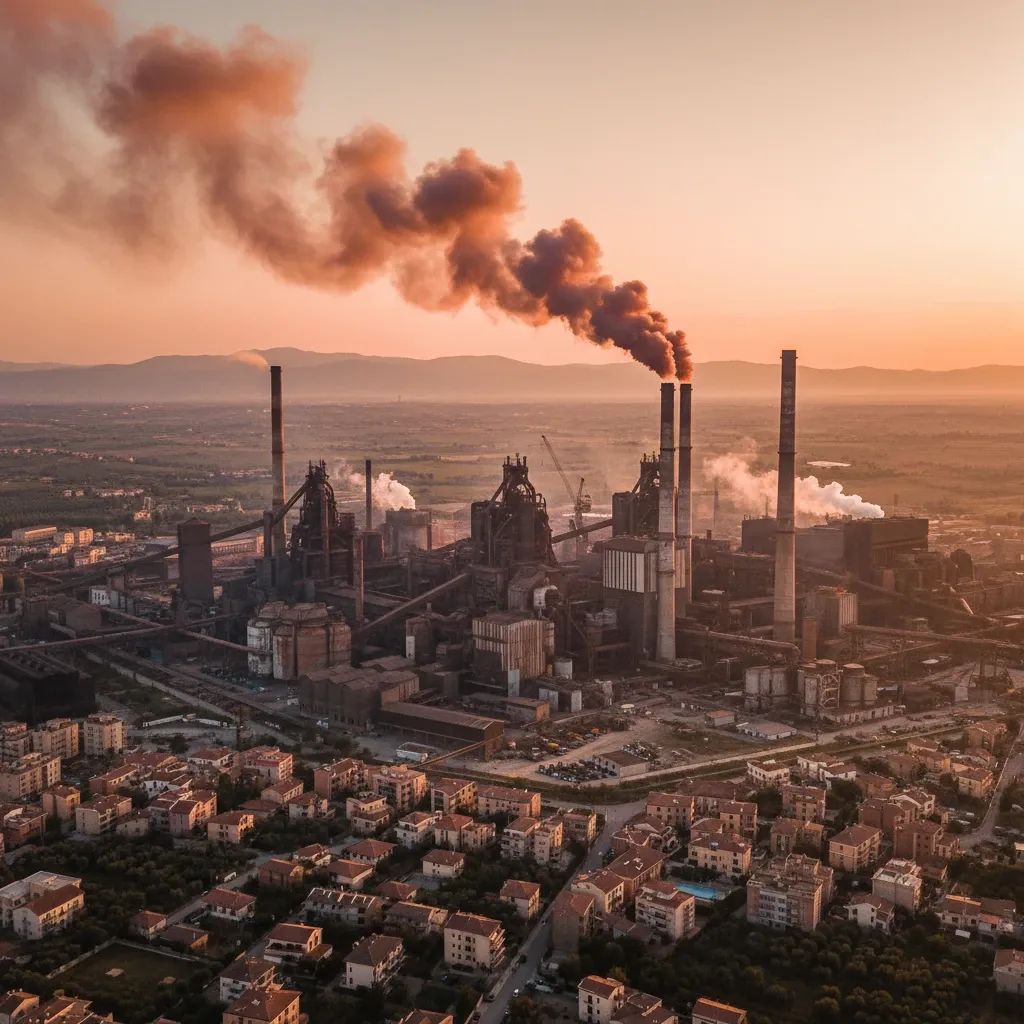
Italy's Milan civil court has ordered the suspension of hot-rolling operations at the former ILVA steelworks in Taranto starting August 24, 2026, citing "current risks of harm to public health." The ruling, which partially invalidates the plant's 2025 environmental permit, gives the state-controlled steel company a six-month window to implement concrete environmental safeguards — or face a production shutdown at what was once Europe's largest steel facility.
Why This Matters
• Health impact: Residents of Taranto, Statte, and nearby neighborhoods face documented cancer rates 70% higher than city averages, with child tumor cases up 54%.
• Legal precedent: The court applied a June 2024 European Court of Justice ruling that prioritizes public health over industrial production when serious threats persist.
• Economic stakes: Flacks Group is in final negotiations to acquire Acciaierie d'Italia (ADI) for up to €5 billion, with closing expected by April 2026.
• Not yet enforceable: The suspension order can be appealed and is not immediately binding.
The Court's Environmental Red Lines
Presiding judges Fabio Roia and Angelo Mambriani issued the decree at the conclusion of an injunction proceeding brought by Taranto citizens. The Italy Tribunal of Milan ruled that five key environmental prescriptions in the plant's 2025 Integrated Environmental Authorization (IEA) lack binding timelines for implementation — violating EU law by allowing indefinite delays while health risks persist.
The disputed prescriptions include mandatory monitoring of PM10 and PM2.5 particulates, enforcement of "wind-day" protocols (operational halts during severe weather conditions that trap pollution), proper storage of hazardous substances, minimum combustion temperatures for steel refining torches, and complete interception of diffuse coke transfer emissions. The court found that ADI's permits allowed the company to conduct feasibility studies and develop implementation plans without committing to actual execution dates.
In its 26-page decree, the tribunal cited the European Court of Justice's June 25, 2024, ruling (Case C-626/22), which established that industrial operations must be suspended whenever they pose grave and significant threats to environment or human health. That Luxembourg-based court held that Italy's practice of granting repeated deadline extensions for environmental compliance violates the 2010 Industrial Emissions Directive when serious dangers remain unresolved.
Six-Month Countdown for Compliance
Acciaierie d'Italia SpA and its holding companies, all operating under extraordinary state administration (a temporary Italian legal status where the government appoints commissioners to manage a company in crisis, rather than its regular management or private ownership), have until August 24, 2026 to secure an updated IEA that specifies "certain and reasonably short" timelines for implementing environmental protection measures. If the companies commit to these deadlines in a revised permit, the suspension can be avoided.
Should they fail to meet that threshold, administrative and technical procedures to halt hot-rolling operations must begin on August 24. The suspension will remain in effect until the companies fulfill all environmental requirements. The court emphasized that the decree serves to "accelerate execution" of pollution controls that have languished for years.
The ruling is not immediately enforceable, meaning operations will continue under current conditions while ADI exercises its legal right to appeal the decision. The suspension order becomes binding only if ADI does not appeal within the statutory timeframe or if appeals are ultimately rejected. The Milan court has transmitted a copy of its decree to the European Court of Justice for procedural coordination.
What This Means for Taranto Residents
For the 190,000 people living in Taranto and surrounding municipalities in Puglia (southern Italy), this court decision represents the first judicially imposed deadline for environmental action after decades of health crisis. Taranto, located in the Puglia region of southeastern Italy, has experienced severe economic dependence on the steel plant, which historically employed thousands of workers and anchored the local economy.
Medical data compiled by Italy's National Institute of Health (ISS) through 2021 show alarming patterns:
• 2,035 occupational diseases recognized among ILVA workers between 2005 and 2024, including 934 cancers and 691 deaths.
• Children born or living near the factory exhibit reduced IQ scores and elevated rates of congenital malformations.
• The Tamburi and Paolo VI neighborhoods immediately adjacent to the plant report tumor incidence rates 70% above Taranto's overall average.
• Benzene concentrations in Tamburi air samples increased steadily from 2016 to 2023, despite reduced production volumes.
The International Association of Doctors for the Environment (ISDE Italia) and local physicians have repeatedly called the situation a public health emergency. United Nations Special Rapporteur Marcos A. Orellana designated Taranto a "sacrifice zone" in a 2023 report on pollution and human rights. Approximately 600 cases of mesothelioma — a cancer caused almost exclusively by asbestos exposure — were registered in Taranto between 1993 and 2021, accounting for 40% of all Puglia cases over 25 years.
What This Means If You Live Near Taranto
• For air quality: The court's environmental prescriptions focus on preventing future emissions, not remediating past contamination. Residents should not expect immediate air quality improvements; implementing these controls will take months once a revised permit is approved.
• If operations halt: A production shutdown would affect roughly 8,100 direct ILVA employees and an estimated 12,000 workers in the steel supply chain across southern Italy. The Italian government would likely activate unemployment benefits and worker retraining programs, but details remain to be determined by negotiations between labor unions, government ministries, and the prospective new owner.
• During the appeal period: Operations will continue normally while legal challenges proceed. This process could extend several months before higher courts issue rulings.
The Flacks Acquisition and Green Transition Promises
US-based private equity firm Flacks Group — a type of investment company that typically acquires struggling businesses, restructures operations to improve profitability, and aims to resell at higher value — entered exclusive negotiations with the Italy Ministry of Enterprises and Made in Italy (Mimit) in December 2024. On January 5, 2026, the companies announced they had reached an agreement in principle with the Italian government. On January 30, 2026, Mimit granted ADI's extraordinary commissioners a formal mandate to finalize the sale. Flacks representatives toured the Taranto site on February 9, 2026, and closing is anticipated between late February and April 2026.
Context on the investment: The €5 billion total investment—comprising €3 billion earmarked specifically for electrification and environmental remediation—represents a significant but not unprecedented commitment for European steel sector modernization. Major steelworks upgrades typically require multi-billion-euro investments; however, the substantial environmental remediation component (€3 billion) reflects the severity of contamination and operational demands imposed by the court ruling and EU regulations.
Flacks has pledged over €3 billion specifically for electrification and environmental remediation, as part of a total €5 billion modernization plan. The centerpiece is replacement of traditional blast furnaces with three electric arc furnaces (EAF), which produce steel from scrap metal rather than iron ore and emit significantly less CO2. Some reports suggest the final configuration may include two EAFs supplemented by one conventional furnace to maintain capacity for specialty steel grades.
Michael Flacks, the group's founder and chairman, has stated that "occupational safety, production, and environmental protection must proceed in parallel" and committed to meeting global ESG standards. The company has promised to establish an independent pollution monitoring commission, with experts selected in consultation with local communities, civil society groups, and political representatives. That pledge directly addresses residents' longstanding complaint that environmental oversight has been captured by industrial and political interests.
Important context for residents: Private equity acquisitions carry both opportunities and risks for workers and communities. While Flacks has made environmental commitments, private equity firms typically seek to maximize returns through operational restructuring, which may include workforce reductions, facility consolidation, or supply chain reorganization. Residents should monitor negotiations with labor unions regarding employment protections and final workforce size commitments.
Nonetheless, opposition lawmakers from the Five Star Movement and Democratic Party have questioned Flacks Group's "industrial, financial, and environmental credibility," demanding the government disclose detailed plans for employment, production volumes, and financing. The acquisition comes as ADI's extraordinary commissioners are pursuing a €7 billion damages claim against ArcelorMittal, the previous operator, for alleged neglect and equipment deterioration during the 2018-2024 ownership period.
Wider EU Context on Industrial Pollution
The June 2024 European Court ruling cited by the Milan tribunal has implications far beyond Taranto. The Luxembourg court held that repeated deadline extensions for environmental compliance are incompatible with EU law when grave health risks persist, and that Health Impact Assessments (VIS) must be central components of industrial permits, not optional annexes.
A 2013 Legambiente dossier identified 19 Italian industrial facilities — including steelworks, refineries, and power plants — operating without proper environmental authorizations, for which the Italy government had already been sanctioned by EU courts. Investigative reporting by CORRECTIV.Europe and Cittadini Reattivi has documented similar "sacrifice zones" across the continent, where industrial pollution concentrates in working-class communities with limited political leverage.
While the research does not provide a current roster of specific plants facing parallel legal action, the strengthened precautionary principle established in the ILVA case will likely be invoked in future challenges to heavy industry permits throughout the European Union. The precedent that production must halt when serious health threats remain unaddressed shifts the burden of proof onto operators and permitting authorities, rather than requiring citizens to demonstrate harm after the fact.
What Happens Next
The immediate focus shifts to ADI's legal team and the Italian government's response. The companies can appeal the Milan decree within statutory deadlines (typically 30 days), which would suspend its enforceability pending higher court review. Alternatively, they can negotiate with regional and national environmental authorities to secure an amended IEA that satisfies the court's requirement for binding implementation schedules.
Timeline for residents to watch:
• By late August 2026: Deadline for ADI to either appeal the ruling or submit a compliant revised environmental permit
• September-December 2026: If appeal is filed, higher courts will review the case; if no appeal, implementation of environmental prescriptions begins
• Through April 2026 and beyond: Flacks acquisition process; success or failure may depend on whether environmental liability is resolved
Environmental advocates argue that the technical measures ordered by the court — PM monitoring, wind-day protocols, hazardous material storage, torch combustion controls, and coke emission capture — represent minimum standards that should have been mandatory from the outset. Industry observers note that implementing these controls during active negotiations with a prospective buyer creates financial and operational uncertainty, potentially affecting the final purchase price and timeline.
For Taranto's residents, the decree offers a concrete enforcement mechanism after years of broken promises. If the August 24 deadline passes without compliance, the suspension order would mark the first court-mandated production halt in the facility's history — a test of whether European environmental law can override the political and economic pressures that have shielded polluting industries for decades.


