
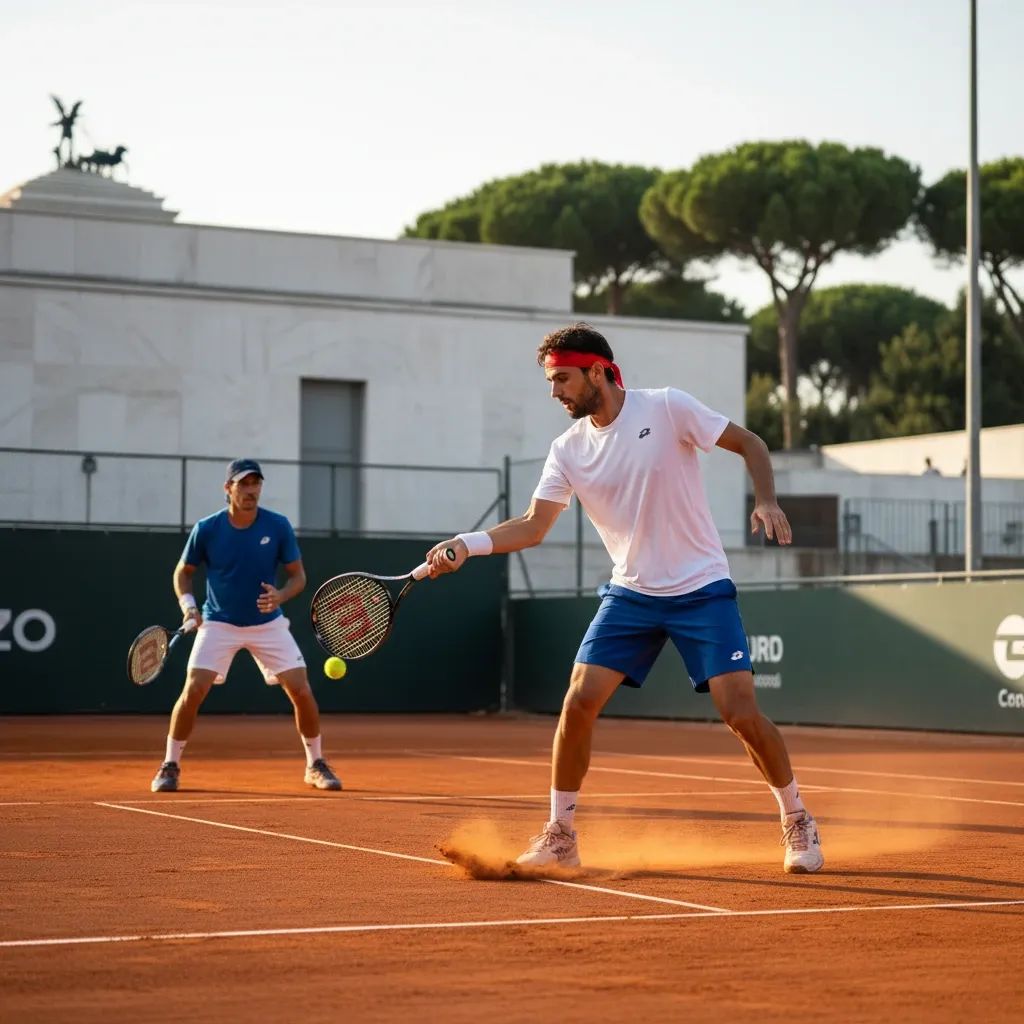
Italy's top-ranked tennis player Jannik Sinner is scheduled to train with compatriot Flavio Cobolli on one of the secondary courts at the Foro Italico this Saturday afternoon, just hours before both athletes take the stage at the Internazionali BNL d'Italia 2026—a move that underscores the collaborative spirit fueling the nation's tennis development.
Why This Matters
• Sinner chases history: The world number 1 aims for a significant Masters 1000 title run, building on recent victories at Indian Wells, Miami, Monte Carlo, and Madrid.
• Italian tennis talent on display: Matteo Arnaldi has already delivered a dramatic upset, defeating world number 8 Alex de Minaur in a rain-soaked thriller.
• Social impact on display: Youth from the Caivano Fiamme Oro tennis academy—a government-backed initiative in a historically troubled Naples suburb—attended the tournament as living proof that sport can transform communities.
Sinner and Cobolli Share Court Ahead of Saturday Showdowns
Jannik Sinner, fresh off a crowd-pleasing practice session on Friday that drew thousands to the stands, will return to the Rome complex for a 4:00 PM training slot on Saturday alongside Flavio Cobolli. The Italian duo will fine-tune their games on a side court before making their main-draw debuts later that evening. Sinner faces Austria's Sebastian Ofner, while Cobolli takes on France's Terence Atmane—both matches carrying significant stakes for the home crowd.
Cobolli, enjoying a career-best season, reached the quarterfinals in Madrid and captured the Mexican Open title in February. His ascent reflects a broader Italian wave: the country now boasts multiple competitive men in the top ranks, a depth unthinkable a decade ago. Training alongside Sinner—who holds a 23-match winning streak spanning four continents—offers Cobolli both tactical insight and psychological reinforcement.
The practice arrangement also highlights the collaborative ethos within Italy's tennis federation. Unlike more individualistic tennis cultures, Italian players frequently share courts, coaches, and even mental preparation strategies. That culture has paid dividends: Italian players continue to make significant advances at major tournaments.
Arnaldi's Rain-Soaked Upset Energizes Home Crowd
While Sinner prepares off-court, Matteo Arnaldi has already delivered the tournament's most dramatic moment. The 23-year-old rallied from a set down against Australia's Alex de Minaur, the 6th seed and one of the tour's most consistent clay-courters, winning 4-6, 7-6(5), 6-4 in front of a drenched but enthusiastic Roman audience.
"Under the rain, it's even more beautiful," Arnaldi said moments after match point, still dripping. "Winning like this, in front of the Italian public, is something I never imagined." His victory demonstrated the competitive depth Italian tennis has developed in recent years.
Caivano Youth Witness the Dream at Foro Italico
Among the thousands packing the stands were dozens of children from Caivano, a working-class suburb north of Naples long associated with social challenges. These young players, enrolled in the Gruppo Sportivo Fiamme Oro tennis academy at the newly refurbished Pino Daniele Sports Park, traveled to Rome as guests of the Italian government—a symbolic gesture linking grassroots sport to elite performance.
The Caivano project, managed by the Italian State Police's sports division, transformed a derelict municipal complex into a multi-sport hub offering tennis, football, athletics, and basketball. The initiative is explicitly framed as a crime-prevention and social-cohesion tool, targeting youth who might otherwise drift into delinquency.
"From Caivano to the Centrale at Foro Italico," read one government press release, "with the dream of seeing the world's number 1, Jannik Sinner, up close." For many of these children, tennis was an unknown sport until the academy opened. Now they attend matches featuring players they watch on television, blurring the line between aspiration and reality.
While the Caivano academy is not designed to produce Grand Slam champions—its mission centers on inclusion and social redemption—it forms part of a broader national strategy. Other Italian programs, such as the I Tennis Foundation's "Little Tennis Champions" scholarship scheme, specifically identify and fund promising young athletes from low-income families, offering technical, tactical, and mental coaching pathways. Together, these initiatives are reshaping the demographic profile of Italian tennis, once an elite pastime, into a sport accessible to broader socioeconomic strata.
What This Means for Residents and Tennis Fans
For Italians, the Internazionali BNL d'Italia is more than a sporting event—it is a week-long national celebration blending sport, culture, and civic pride. The tournament attracts substantial crowds to the Foro Italico's tree-lined clay courts and holds significant economic importance for Rome.
The Foro Italico complex, originally constructed decades ago, has been systematically modernized to contemporary standards. New LED lighting, improved drainage systems, and expanded hospitality areas have elevated the venue to meet modern ATP and WTA requirements. The upgrades have ensured Rome retains its status as one of the tour's premier clay events.
For casual fans, the tournament offers accessible tennis viewing. General admission tickets provide affordable access to world-class competition, and the spacious grounds permit spectators to enjoy multiple matches in a single afternoon. Evening sessions under floodlights accommodate working professionals and families.
Looking Ahead
As the tournament progresses, Italian tennis continues to demonstrate remarkable development. The combination of elite talent like Sinner, emerging players like Arnaldi and Cobolli, and grassroots initiatives reaching communities like Caivano represents a comprehensive transformation of the sport in Italy. For a nation that once struggled to produce consistent top players, Italy now stands as a significant force in international tennis.


