
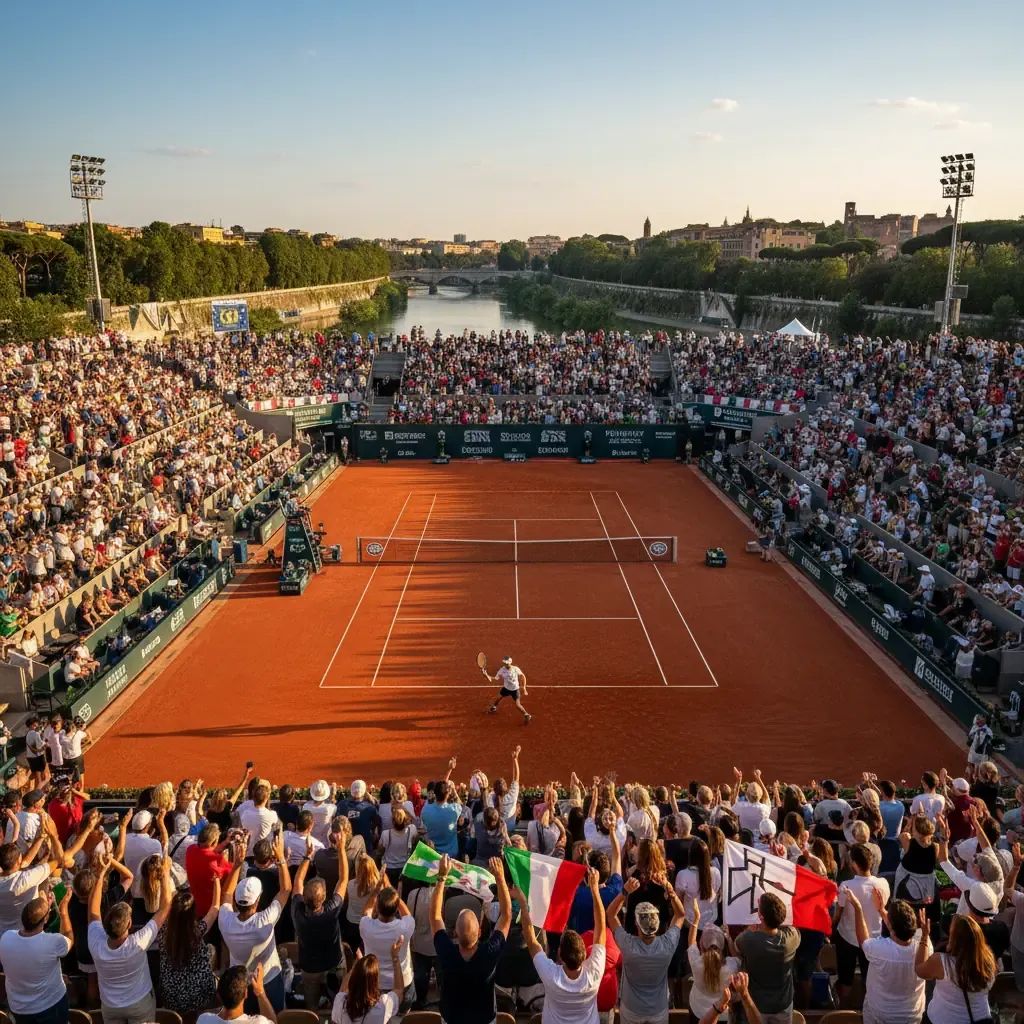
Sport e Salute, the state-owned sports company managing the Internazionali BNL d'Italia at Rome's Foro Italico, has confirmed an unprecedented surge in attendance: on Thursday, May 8, the tournament saw over 40,000 tickets sold in a single day, shattering every previous record in the event's history. The afternoon session alone accounted for 30,703 tickets, with the evening matches pushing the daily total past the 40,000 mark. It is a milestone that underscores the tournament's leap from regional prestige to what organizers are calling a "fifth Grand Slam" in ambition and scale.
Why This Matters
• Economic windfall: The 2026 edition is projected to generate an economic impact approaching €1 billion for the Roman economy, up from €400M in prior years.
• Capacity under strain: Pre-sales for this year have already exceeded the entire 2025 tournament's ticket tally of 300,000, prompting urgent infrastructure expansion.
• Sinner effect: World No. 1 Jannik Sinner headlines a golden age for Italian tennis, with five Italian men ranked in the global top 21—a cohort that has turned the clay-court event into a national spectacle.
Crowds, Queues, and the Sinner Mania
Foro Italico's Campo 5 became a bottleneck of its own success on Thursday afternoon. Jannik Sinner and rising Italian player Flavio Cobolli held a pre-match training session that drew standing-room-only crowds—literally no seats available, only vertical space along the fences. The same court that once hosted warm-ups for Roger Federer and Rafael Nadal now plays to a domestic audience whose appetite for homegrown champions has rewritten the event's attendance metrics.
The training session stretched beyond an hour, observed by Sinner's father and punctuated by chants and applause from the packed terraces. Rain had suspended play across other courts, funneling even more spectators toward the covered practice venue. When Lorenzo Musetti joined for a final set of drills before his evening debut on the central court, the scene resembled a concert crowd more than a tennis warm-up. Sinner himself is slated to make his tournament debut in the evening session on Friday, May 9, facing Austria's Sebastian Ofner in a match scheduled no earlier than 19:00.
The fervor is not limited to star players. Italian Matteo Arnaldi upset world No. 8 Alex de Minaur in three sets (4-6, 7-6, 6-4) in a rain-soaked thriller, advancing to the third round where he will meet Spain's Jodar. "Winning like this, in front of an Italian crowd, is something I never imagined," Arnaldi told reporters courtside. "Under the rain it's even more beautiful. Here I'm at home." Meanwhile, Germany's Alexander Zverev dispatched compatriot Daniel Altmaier 7-5, 6-3 to set up a third-round clash with Argentina's Francisco Cerundolo.
What This Means for Rome's Economy and Tourism
For residents and businesses in the capital, the Internazionali BNL d'Italia now functions less as a tennis tournament and more as a two-week economic engine. The event runs from April 28 to May 17, and its ripple effects extend well beyond the gates of the Foro Italico.
Hotels, restaurants, and luxury retail outlets are reporting surge bookings. The tournament's organizers—Sport e Salute in partnership with the Italian Tennis and Padel Federation (FITP)—are targeting 400,000 paying spectators for this edition, a 33% increase over 2025's 300,000 total. If achieved, the figure would eclipse the 304,675 tickets sold in 2024, which itself was a record. Pre-sales data from mid-April showed 299,535 tickets sold, an 11% year-on-year jump, and the pace has only accelerated since.
The economic modeling is clear: each attendee spends an average of several hundred euros per day on accommodation, dining, transport, and shopping. The tournament's estimated €1 billion impact—double the €400M generated in 2022—comes from this multiplier effect. For context, the broader tertiary sector in Rome (hospitality, retail, services) stands to pocket around €200M from the event alone, according to trade associations.
Infrastructure Under Pressure: Expansion and the 2028 Vision
The surge in demand has exposed capacity constraints. The Foro Italico, a Fascist-era sports complex along the Tiber, now hosts 21 courts across 20 hectares, including two new arenas: the BNP Paribas Arena in the Stadio dei Marmi (capacity 7,000+) and the SuperTennis Arena, both designed to bring spectators closer to the action. Yet even this expansion struggles to meet demand; single-day records like Thursday's 40,000 tickets push fire-code and logistical limits.
The solution is already underway. Sport e Salute and the FITP have earmarked over €160M for further redevelopment, including a retractable roof for the central court by 2028. The goal is to transform the venue into a year-round hub, not just a May fortnight, and to inch closer to the "fifth Slam" branding—an unofficial status that would elevate Rome to the prestige tier of Melbourne, Paris, London, and New York.
Angelo Binaghi, president of the FITP, has been explicit about the ambition: "We want to be the tournament that sits between the four Grand Slams, a place where champions must come to win." The strategy hinges on infrastructure, yes, but also on scheduling clout—Rome sits just one week before the French Open, making it the final clay-court dress rehearsal for Roland Garros contenders.
The "Sinner Effect" and Italian Tennis Boom
No single factor explains the attendance explosion more than Jannik Sinner. The 24-year-old from South Tyrol ascended to world No. 1 in 2025 and has since become a cultural phenomenon in Italy, transcending tennis to occupy prime-time television slots and front-page headlines. His presence at the Foro Italico is a guaranteed sell-out.
But the depth of Italian talent matters too. Matteo Arnaldi, Flavio Cobolli, Lorenzo Musetti, and Matteo Berrettini (recovering from injury) all rank within the top 21, most of them specialists on clay. This cohort grew up in an era when Italy invested heavily in youth academies and clay-court infrastructure, and the payoff is now visible in both ATP rankings and ticket sales.
The sociological shift is palpable. Tennis, long considered a niche sport in Italy—where football reigns supreme—has become aspirational. Parents enroll children in academies. Public courts see waiting lists. The Internazionali has morphed from an annual sporting event into a pilgrimage site for a new generation of fans.
Efficient Crowd Management: Sport e Salute's Test
Handling 40,000+ people in a single day at a historic venue not originally designed for such volume is a logistical gauntlet. Sport e Salute, the state company responsible for managing Italy's major sports properties, deployed a multi-layered system: multiple entry/exit points, real-time IoT monitoring, dedicated emergency zones, and hundreds of stewards. The organization received praise from local authorities for managing flows without major incidents—no small feat given Rome's notoriously tangled public transport and the Foro Italico's constrained riverside footprint.
The cost of such operations is substantial—crowd management, security, and emergency protocols account for a significant slice of the event budget, though exact figures remain undisclosed. Yet the alternative—a stampede, bottleneck, or safety failure—would be catastrophic for both reputation and liability. The success of Thursday's operations is being studied as a template for future high-capacity events, including the 2028 covered-court debut.
A Free Court in Piazza del Popolo
In a novel marketing move, organizers erected a temporary tennis court in Piazza del Popolo, one of Rome's most iconic squares, offering free training sessions and exhibitions throughout the tournament. The initiative aims to democratize access to the sport and serve as an open-air advertisement for the main event. For residents, it's a rare chance to see professional-level play without a ticket—and for tourists, an unexpected collision of Renaissance architecture and modern athleticism.
What Comes Next
Lorenzo Musetti is set to take the central court Friday evening in his opening match. Jannik Sinner follows later in the night session, likely playing to another sold-out crowd. Matteo Arnaldi will face Spain's Jodar in what promises to be another partisan affair. The ATP has confirmed that Friday's schedule will again prioritize Italian players in prime-time slots, a strategic move to maximize attendance and viewership.
For the city of Rome, the next week and a half will test whether infrastructure, hospitality, and crowd management can sustain this new scale. If the current trajectory holds, the Internazionali BNL d'Italia 2026 will not only set records—it will redefine what a Masters 1000 tournament can be in terms of economic impact, public engagement, and cultural resonance.
The tournament has always been beautiful. Now it is also big business—and the two, for once, are not in conflict.


