
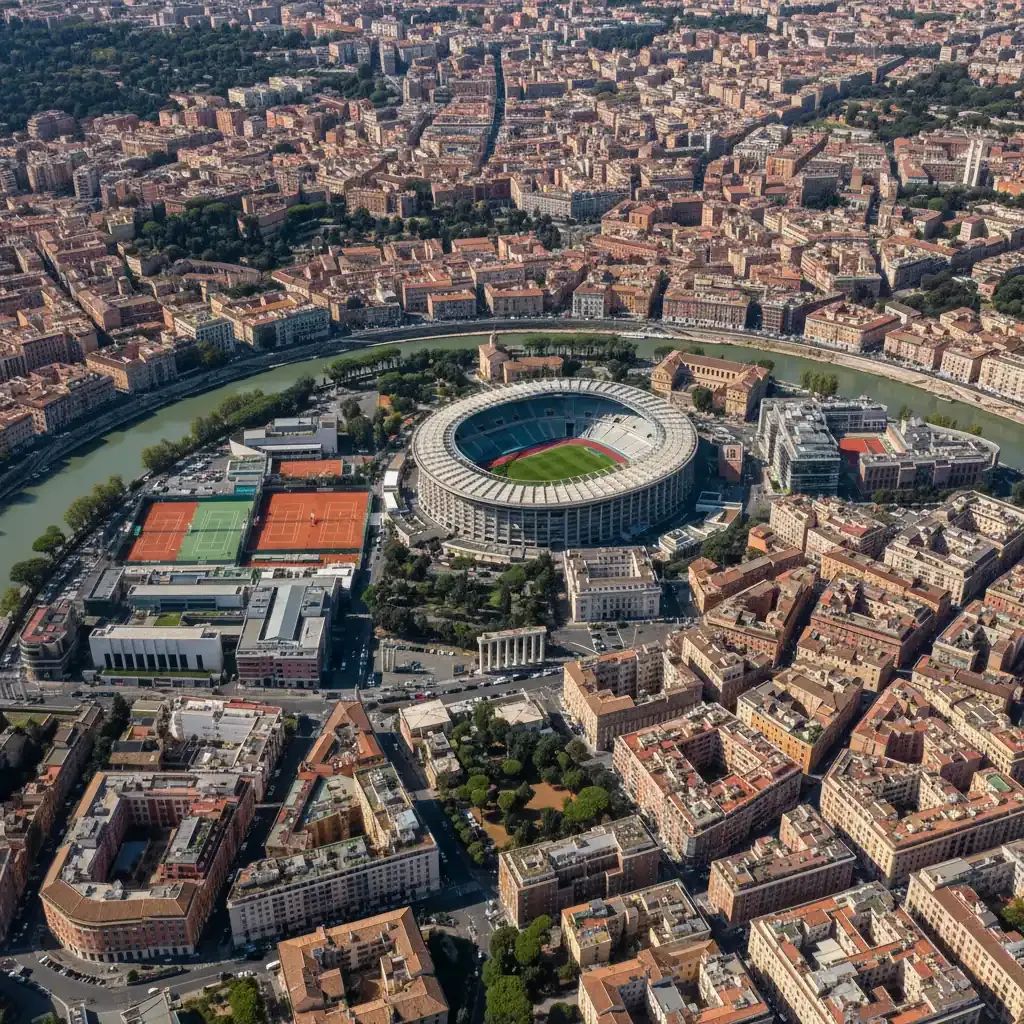
Italy's Serie A has locked in an unusual Sunday lunchtime kickoff for 5 critical matches on May 17, a scheduling compromise that will force tens of thousands of fans to choose between following their teams and enjoying a traditional weekend—while security officials in Rome scramble to manage the Derby della Capitale alongside the men's final of the Internazionali BNL d'Italia tennis tournament, both planned for the same day in adjacent venues.
Why This Matters
• Five matches involving teams fighting for Champions League and Europa League spots will all start at 12:30 PM on Sunday, May 17, including the highly volatile Roma-Lazio derby.
• The Stadio Olimpico (hosting the derby) and the Foro Italico (hosting the tennis final at 5 PM) are located in the same urban district, creating a logistical and security nightmare for authorities.
• A final decision from the Rome Prefecture is still pending—if security concerns prevail, the derby and linked fixtures could shift to Monday evening, disrupting hundreds of thousands of supporters.
• Fans of Como, Parma, Genoa, Milan, Juventus, Fiorentina, Pisa, and Napoli are also caught in the crossfire, with their fortunes tied to the same kickoff slot.
The Scheduling Puzzle: Five Teams, One Kickoff
Italy's Serie A League confirmed the schedule for the 37th matchday late Monday, laying out a compact Sunday program intended to preserve competitive fairness during the final sprint of the season. The league mandated that all teams vying for European qualification play simultaneously to prevent any side from gaining a tactical advantage by knowing rivals' results in advance.
As a result, Como-Parma, Genoa-Milan, Juventus-Fiorentina, Roma-Lazio, and Pisa-Napoli are all slated for 12:30 PM. (The Pisa-Napoli fixture may shift to 6 PM if Napoli secures Champions League qualification before then, removing the need for synchronization.) Three other fixtures follow at staggered times: Inter-Verona at 3 PM, Atalanta-Bologna at 6 PM, and a trio of relegation battles—Cagliari-Torino, Sassuolo-Lecce, and Udinese-Cremonese—at 8:45 PM.
Luigi De Siervo, the chief executive of Lega Serie A, defended the early Sunday slot as the only viable solution. "We sought an equilibrium that respects public order, the tennis final, and the principle of simultaneity mandated for the final two matchdays," he explained. "The 12:30 kickoff accommodates all stakeholders, even if it inconveniences fans."
Collision Course: Football Meets Tennis at the Foro Italico
The root of the controversy lies in Rome's urban geography. The Stadio Olimpico, home to both Roma and Lazio, sits barely a kilometer from the Foro Italico, where the Internazionali BNL d'Italia—one of the premier clay-court events on the ATP calendar—concludes Sunday afternoon. The men's final is scheduled for 5 PM, a slot that could mark the first Italian victory in 50 years, since Adriano Panatta lifted the trophy in 1976.
Alessandro Onorato, Rome's assessor for major events, publicly criticized the decision, arguing that the tennis final should proceed unimpeded on Sunday while the derby moves to Monday at 9 PM. "Working people deserve the chance to attend or get home safely," he said. "Rome should not fear hosting a night derby. It's time for troublemakers to face justice rather than dictate our calendar."
De Siervo rejected that proposal outright. Moving five high-stakes matches to a weekday, he warned, would displace "hundreds of thousands of people across different regions on a workday." More fundamentally, he cited security concerns rooted in recent violence: "Unfortunately, evening derbies in Rome are not feasible given how fans have set the city ablaze in recent encounters."
What This Means for Fans and Cities
The noon kickoff is a double-edged compromise. On one hand, it clears the area around the Olimpico and Foro Italico before tennis fans arrive, theoretically reducing congestion and the risk of clashes between football ultras and casual sports tourists. On the other, it disrupts weekend rhythms for families, forces northern-based clubs like Milan and Juventus to travel midweek or arrive Saturday, and compresses preparation time for teams already exhausted by a season spanning 38 matchdays.
For residents in Rome, the logistics are particularly acute. Both venues fall within the Flaminio and Parioli neighborhoods, where streets will be closed, public transport rerouted, and parking suspended from early morning through late evening. Authorities are deploying an estimated 2,000 officers for the derby alone, a number comparable to previous high-risk fixtures that have seen petrol bombs, brawls, and attacks on police.
A History Written in Violence
The Derby della Capitale ranks among Europe's most combustible rivalries. Over the past two decades, matches have been marred by stabbings, suspended play, and urban guerrilla tactics. In 2004, a false rumor about a child's death sparked a pitch invasion and match suspension. In previous seasons, Lazio ultras were arrested for attempted murder after knifing Roma supporters. More recently, over the past year, officers were injured when fans launched projectiles and clashed with riot squads armed with water cannons and tear gas.
These precedents explain De Siervo's insistence on a daytime kickoff. Italian authorities have consistently refused to schedule evening derbies in Rome unless public-order guarantees are ironclad—a bar that recent incidents have made nearly impossible to clear.
The Missing Variable: The Prefecture's Final Word
Despite Lega Serie A's official announcement, the calendar remains subject to final approval by Rome's public security authorities. The provincial public security committee will review the plan to ensure the dual-event Sunday is manageable. If the prefect and police chief deem the situation untenable, they retain the authority to override the league and force a postponement to Monday.
Such a move would cascade through the schedule: Como-Parma, Genoa-Milan, Juventus-Fiorentina, and Pisa-Napoli would all shift in lockstep to preserve simultaneity, effectively rewriting the final act of the European qualification race. Broadcast contracts, travel arrangements, and ticket sales would need emergency adjustments, compounding an already chaotic situation.
Could This Have Been Avoided?
Critics have pointed out that the Internazionali BNL d'Italia dates—April 27 to May 17—were publicly known when Lega Serie A drafted its fixture calendar months ago. The tennis tournament is a fixture on the ATP calendar, its schedule locked in years in advance. Yet no mechanism exists within Italian football to formally coordinate with other sporting federations or municipal governments during the planning phase.
The result is a recurring pattern: football's commercial imperatives (maximizing TV audiences, satisfying broadcasters' weekend slots) collide with civic realities (traffic, policing, concurrent events), leaving last-minute firefighting to prefects and mayors who lack the authority to rewrite calendars unilaterally.
Impact on the European Race
The stakes extend beyond logistics. Juventus, Milan, Roma, Lazio, Fiorentina, and Napoli are locked in a ferocious contest for the final Champions League berths and Europa League spots. A single point can determine whether a club banks tens of millions of euros in prize money or faces budget cuts and player exits. Forcing these teams to play at noon—when fatigue, heat, and disrupted pre-match routines can tilt outcomes—introduces an element of randomness that feels unjust to fans and coaches alike.
For Como, Parma, Pisa, and Genoa, mid-table sides whose campaigns have already concluded in all but name, the inconvenience is purely logistical. But for the six title contenders, the timing is a variable that could reshape their futures.
What Happens Next
The Rome Prefecture will finalize its decision on whether to greenlight Sunday's plan or trigger a Monday reschedule. Either way, fans should prepare for uncertainty: ticket sales may be paused, travel plans adjusted, and stadium security protocols tightened further.
For those attending the derby or the tennis final, expect heavy police presence, extended security queues, and limited access to surrounding neighborhoods. Public transport will run on expanded schedules, but delays are inevitable given the volume of people converging on a single district.
And for neutrals watching from abroad, the spectacle offers a window into the peculiar challenges of managing a dense sporting calendar in a country where history, passion, and infrastructure collide with unpredictable frequency.


