
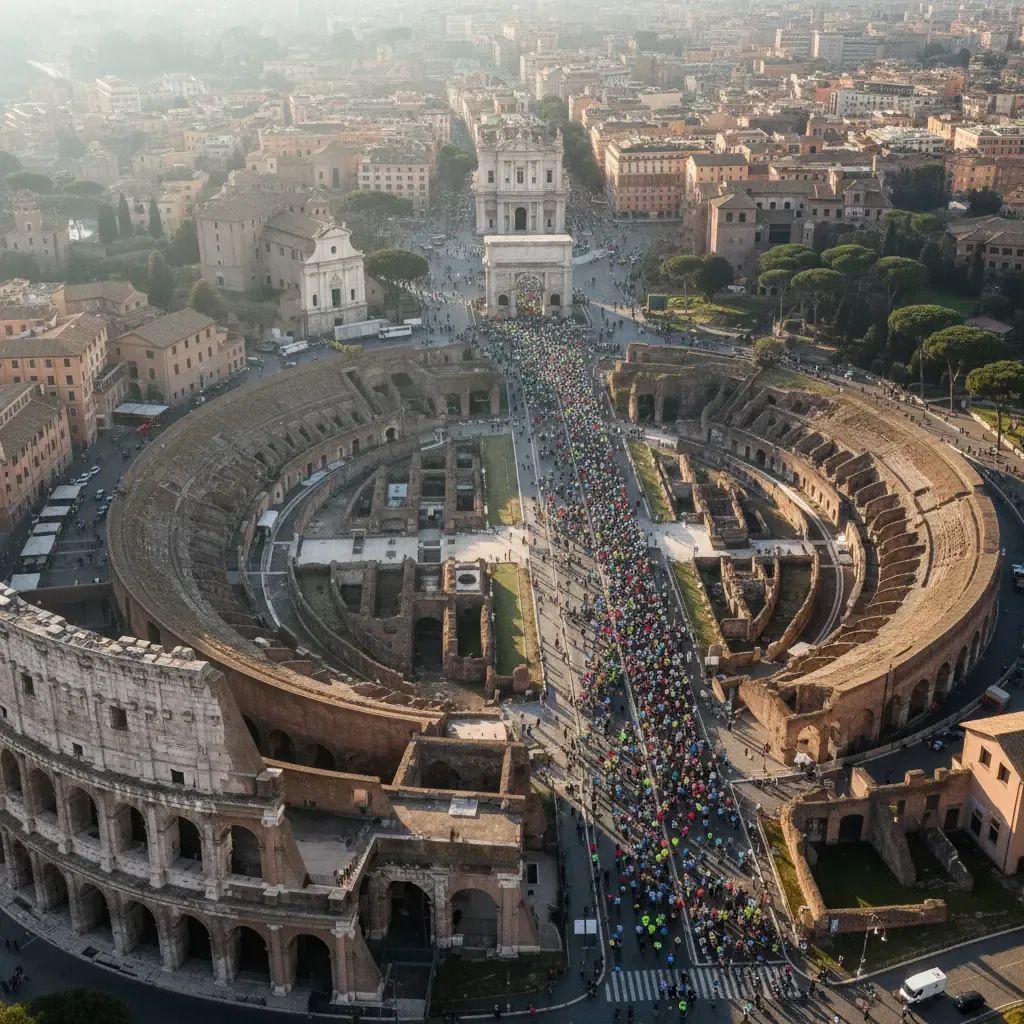
Italy's Capital is bracing for a record-breaking influx of 36,000 marathon runners next Sunday, March 22, when the Acea Run Rome The Marathon takes over historic streets from the Imperial Forums to the Circus Maximus. With athletes from 166 nations descending on the city, the event will generate an estimated €120 million economic boost and bring roughly 120,000 visitors—marking the largest edition in the race's modern history.
Why This Matters:
• Traffic chaos expected: Over 60 bus lines will be diverted and major road closures will affect the city center from early Sunday morning through early afternoon.
• Economic windfall: The estimated €120M impact represents a significant boost to Rome's hospitality, retail, and service sectors during the spring season.
• International recognition: Rome has joined the exclusive European Marathon Classics circuit, placing it alongside Berlin, Paris, and seven other elite events.
• Sustainability milestone: The race coincides with World Water Day and aims for carbon neutrality, with 170,000 liters of water distributed and a 40% reduction in per-runner waste.
A Continental Stage for the Eternal City
The transformation from a modest domestic race to a global spectacle has been rapid. Organizers have capped registration at 36,000—including more than 10,000 women—and turned away hopefuls due to safety limits, making this the largest edition in the race's modern history. The field has been fueled by word-of-mouth among the international running community and aggressive partnerships, including a reciprocal marketing agreement with the New York City Marathon signed last autumn.
Alessandro Onorato, the Rome Capital assessor for major events, sport, tourism, and fashion, told reporters at the Capitol Hill presentation this week that the marathon's inclusion in the European Marathon Classics validates the city's investment. "We are not content to rest on this achievement," he said. "We want to continue raising the bar through synergies with other premier races worldwide."
For residents, the practical consequence is clear: foreign runners and their companions now constitute roughly 70% of all participants, translating into packed hotels, booked-out trattorias, and elevated short-term rental prices across central neighborhoods from Trastevere to Monti. Average visitor spending ranges from €500 to €5,000 per person, depending on length of stay and luxury level, with most international guests remaining between three nights and a full week.
What This Means for Residents
Prepare for significant disruption on Sunday, March 22. The Rome Services for Mobility agency has published detailed route maps showing more than 60 bus line diversions beginning at 6:00 AM and lasting until approximately 2:00 PM. Central metro stations—particularly Colosseo, Circo Massimo, and Termini—will see heavy congestion. Residents planning essential travel are advised to use the metro network where possible or defer trips to the afternoon.
Parking restrictions will be enforced along the entire 42-kilometer route, with tow-away zones marked 48 hours in advance. The Via dei Fori Imperiali, traditionally closed to private vehicles but open to taxis and service traffic on weekends, will be completely sealed from midnight Saturday through 3:00 PM Sunday.
On the upside, the economic multiplier effect is tangible. Hospitality workers, taxi drivers, and street vendors can expect one of the busiest weekends of the spring season. The €120M figure reflects accommodation and food spending, retail purchases, guided tour bookings, and auxiliary services like laundry, childcare, and airport transfers.
Environmental Ambitions and the Water Marathon
Timing the race to coincide with World Water Day on March 22 was a deliberate choice by organizers and sponsor Acea, the Rome-based water and energy utility. The marathon will distribute approximately 170,000 liters of water to runners via compostable cups rather than single-use plastic bottles, part of a broader sustainability strategy that has earned the event ISO 20121 certification since 2022.
The race is targeting carbon neutrality for 2026, having already offset direct emissions (Scope 1 and 2) and a portion of participant travel emissions (Scope 3). Supporting measures include the Rome Marathon Forest, a reforestation project comprising 3,000 trees planted by the organization, and a logistics fleet powered by electric trucks supplied by partner FERCAM.
Food waste will be tackled through a partnership with Banco Alimentare Roma, which recovered 43 tons of surplus beverages and snacks in 2023 alone. Leftovers from refreshment stations—fruit, energy bars, isotonic drinks—are collected and redistributed to charitable organizations serving vulnerable communities in the capital's periphery.
A novel feature this year is the Plogging Relay, an event that combines running with litter collection. Participants pick up trash along designated stretches of the route, with prizes awarded for the most refuse gathered. The initiative aligns with ongoing campaigns by environmental groups Retake Roma and Plastic Free, which have mobilized volunteers in the weeks leading up to race day to pre-clean high-traffic areas.
Peace, Records, and a Papal Audience
Beyond athleticism and ecology, the 2026 edition carries symbolic weight. The "Mother's Call" initiative—dubbed the "Bridge of Peace"—will feature an Israeli mother and a Palestinian mother running side by side, a gesture organizers hope will resonate amid ongoing tensions in the Middle East. The women will jointly carry a banner calling for dialogue and mutual recognition.
In a separate bid for global attention, the race will debut the World Pacer Team, a squad of 252 pacers assembled to guide runners toward specific finish times. If verified, this will set a Guinness World Record for the largest pacing crew ever fielded in an official marathon. Pacers, identifiable by colored bibs corresponding to target times (e.g., 3:00, 3:30, 4:00), are a staple of major races, but Rome's organizers have scaled the concept to unprecedented proportions.
Religious observance also features prominently. A delegation of runners, including 37 athletes from Athletica Vaticana (the Vatican's official sports association), a cardinal, and members of the Swiss Guard, will participate in relay events. On Wednesday, March 18—four days before the marathon—this group will attend a special audience with Pope Francis at the Vatican, receiving a blessing ahead of their effort.
Relay Races and the 60,000-Runner Weekend
While the marquee 42.195-kilometer marathon draws the headlines, two additional races expand the event's reach. The Acea Run4Rome Relay is a charity-focused team competition involving more than 40 nonprofit organizations, which collectively raise funds to sponsor an additional 6,000 runners. Teams of four to six members each cover a segment of the full marathon distance, handing off a baton at designated exchange zones.
The Acea Water Fun Run, a non-competitive 5-kilometer jog open to families and casual participants, rounds out the program. Combined, these events push total participation to approximately 60,000 people wearing race bibs on Sunday, not counting the estimated 60,000 additional spectators lining the route.
All races start at the Imperial Forums and finish at the Circus Maximus, where a new Expo Village will operate from March 19 through 22. The village—open to the public, not just registered runners—features sponsor booths, gear vendors, pasta-loading stations, and live entertainment. First-time visitors to Rome are advised to arrive early in the week to collect race packets and avoid last-minute queues.
Broadcast Reach and Long-Term Vision
For the first time, the marathon will be broadcast live in more than 60 countries, including new distribution deals in the United States and Canada. This expanded media footprint reflects Rome's ambition to rival the so-called World Marathon Majors—Boston, New York, Chicago, London, Berlin, and Tokyo—a club it has not yet joined but clearly aspires to.
The Rome Capital government has signaled its commitment by allocating €28.6M for event management and organization from 2027 through 2031, securing continuity and enabling multi-year planning. Officials believe the marathon can serve as an anchor for a broader strategy to position Rome as a year-round sports tourism destination, complementing soccer, tennis, and equestrian events already on the calendar.
Whether Sunday's logistical ballet runs smoothly will depend on coordination among municipal police, transport authorities, medical services, and thousands of volunteers. For residents, the trade-off is clear: a day of inconvenience in exchange for a weekend that showcases the city to a global audience and injects millions into the local economy. For the 36,000 runners, it is a chance to race through history—past the Colosseum, along the Tiber, beneath the shadow of St. Peter's—in what organizers are billing as the most ambitious edition yet.


