
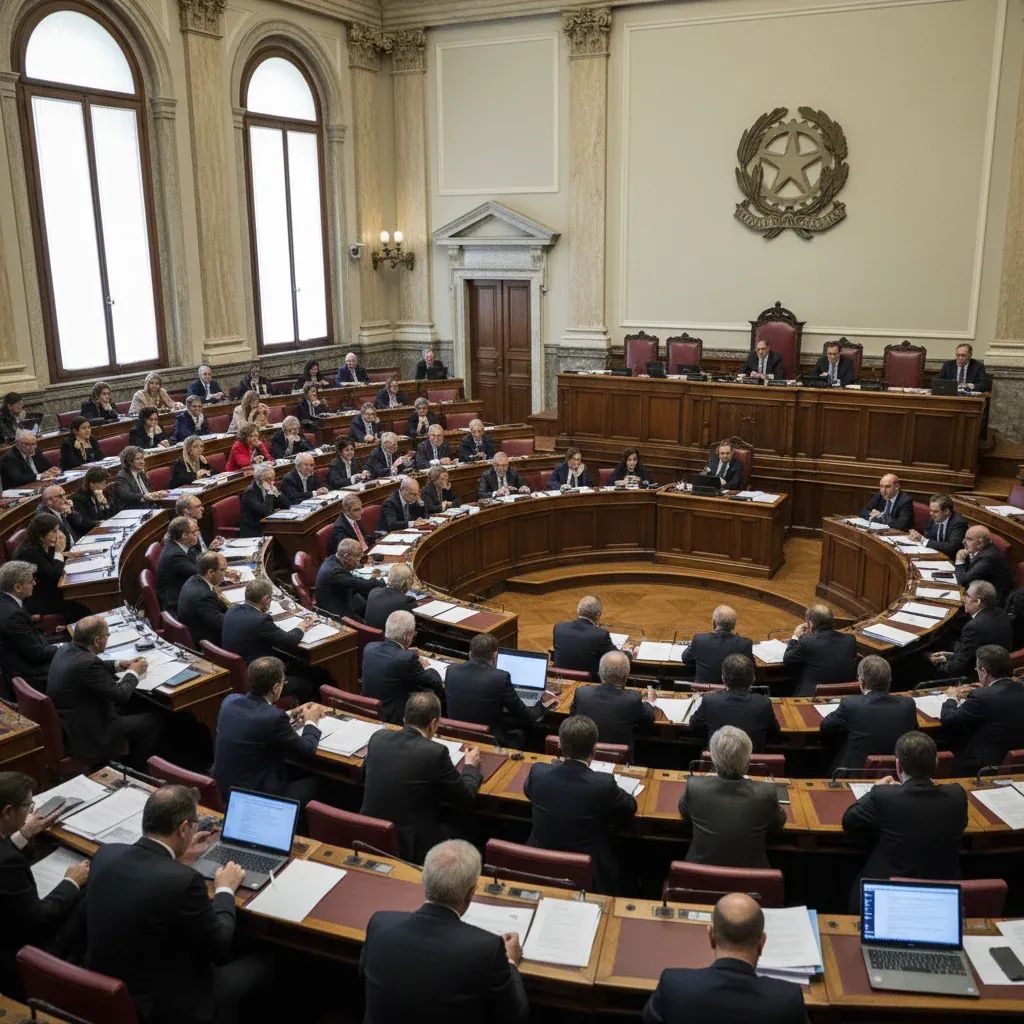
A Parliamentary Stalemate Reaches Its Breaking Point
After 12 days without food, Italia Viva deputy Roberto Giachetti ended his occupation of the Italian Lower House Chamber on May 15, having secured a concrete commitment from the ruling coalition to restore functioning governance at Rai, the nation's state broadcaster. What began as a personal health crisis transformed into a high-stakes institutional negotiation that exposed deep fractures within Prime Minister Giorgia Meloni's government—and revealed how parliamentary paralysis can force urgent reform when traditional channels fail.
Key Takeaways
• Coalition breakthrough: Four centre-right lawmakers publicly pledged to ensure attendance at the May 27 Rai Oversight Commission meeting, breaking a 20-month deadlock.
• Rai leaderless for 18 months: The broadcaster has operated without a permanent president since Marinella Soldi's departure in 2024, with rotating caretaker leadership undermining editorial independence.
• European pressure mounting: The European Media Freedom Act, binding since August 2025, prohibits political interference in public broadcasters—and Italy's current situation risks formal EU infraction proceedings.
• Your broadcast fee at stake: The €90 annual Rai license fee funds a broadcaster locked in governance limbo, unable to implement meaningful oversight or strategic direction.
The Twenty-Month Institutional Vacuum
Rai exists in institutional purgatory. Since Soldi's exit, the broadcaster's leadership has cycled through Roberto Sergio and then Antonio Marano, both board members delegated to temporary executive roles. This arrangement was never meant to last beyond months; nearly two years later, it persists as a symptom of a broader crisis in Italian political governance.
The root cause lies in the Parliamentary Oversight Commission for Rai, the body responsible for hiring permanent leadership and exercising editorial supervision. To elect a new president requires a two-thirds supermajority vote—a threshold the Meloni coalition cannot clear without opposition support, and opposition parties refuse to grant without concessions the coalition will not offer.
The result is institutional theater masquerading as democracy. Commission meetings have been convened and then abandoned when the majority deliberately absented itself, denying quorum. Opposition lawmakers accused the coalition of deliberately "sequestering" the commission, holding it hostage to prevent any appointment they could not control. The Democratic Party alleged the coalition was constructing a "vote market," shopping the presidency to the highest bidder.
President Sergio Mattarella intervened multiple times, calling the paralysis "unacceptable" and demanding the political class restore institutional functionality. His warnings went unheeded for 18 months—until Giachetti's theatrical protest forced action.
Why Giachetti's Gamble Worked
The deputy's escalation strategy was deliberate. On May 3, Giachetti announced a hunger strike demanding quorum assurance. For nine days, the gesture generated media coverage but no political movement. On the 12th day, sensing waning momentum, he escalated dramatically: physical chains. He purchased handcuffs online, secured himself to his parliamentary desk, and announced he would refuse water as well as food.
The spectacle worked because it became undeniable. A lawmaker slowly dying on the House floor presented coalition leaders with a choice: either negotiate or preside over a colleague's medical collapse on national television. Speaker Lorenzo Fontana visited Giachetti to express concern. Then came the call that shifted calculus: Prime Minister Meloni telephoned the deputy personally, signaling her willingness to broker a compromise.
Giachetti, who lost approximately 5 kilograms over 12 days, later attributed the breakthrough to Meloni's intervention. "She understood my reasons," he said, adding that the prime minister had "somehow facilitated the majority's position." Whether Meloni genuinely believed Rai governance required reform or simply wanted to end an embarrassing spectacle remains debatable—but the result was concrete.
Within hours, Francesco Filini of Brothers of Italy, Roberto Rosso of Forza Italia, Giorgio Maria Bergesio of the League, and Maurizio Lupi of Noi Moderati released a joint statement: "We disagree with Giachetti's methods, but we are prepared to guarantee quorum at the next commission meeting." It was a measured capitulation, framed as institutional respect rather than political defeat.
Coalition Tensions Laid Bare
The crisis revealed structural instability within Italy's governing alliance. Forza Italia's candidate for the Rai presidency, Simona Agnes, had previously failed to secure required votes, signaling that coalition partners harbored competing ambitions for broadcasting control. Reports suggest internal bargaining over "compensation"—with some coalition members feeling cheated by the distribution of governance roles across Rai, the state media authority, and related institutions.
Brothers of Italy, Meloni's party and the largest coalition partner, has faced opposition accusations of seeking to weaponize Rai as a propaganda tool. The charge, while disputed by the majority, reflects broader anxieties about political control of public media.
The coalition's fragility on this issue reflects deeper tensions. The distance between Brothers of Italy, Forza Italia, and the League is narrower than public posturing suggests, leaving little margin for defection when internal disputes surface. Meloni's personal intervention was partly designed to reassert coalition discipline before tensions metastasized into public rebellion.
The European Compliance Risk
Italy faces a regulatory deadline it cannot ignore. According to EU regulations, the European Media Freedom Act (EMFA), effective since August 2025, obligates member states to maintain editorial independence and managerial autonomy at public broadcasters. The regulation prohibits political interference and mandates transparent appointment procedures insulated from executive pressure.
Italy's current governance model, reshaped by a 2015 reform that concentrated appointment authority in the executive and parliamentary majority, sits uneasily with European standards. The European Commission has been monitoring the situation, with signals that patience is finite. Prolonged failure to appoint permanent leadership or demonstrate functional oversight creates legal exposure: potential infraction proceedings, mandatory corrective measures, and financial penalties that ultimately fall on Italian taxpayers.
International press freedom metrics already flag Italy for declining media pluralism and rising political capture of public broadcasting. An EU infraction ruling would deepen reputational damage and tighten financial constraints on state media operations. For Italy—already under scrutiny for judicial independence and budget deficits—another Brussels compliance failure carries diplomatic and fiscal costs.
The breakthrough on May 15 was partly driven by this external pressure. Meloni's coalition could not indefinitely maintain a posture of institutional paralysis while Brussels watched and documented violations of binding EU law.
What Functional Oversight Actually Means
For viewers and taxpayers, restoring the Rai Oversight Commission to working order translates into concrete changes. The commission's core responsibilities include auditing executive spending, reviewing editorial compliance with public service obligations, and ensuring programming serves the full political spectrum rather than functioning as a partisan megaphone.
That €90 annual license fee Italians pay (typically folded into electricity bills) funds an organization operating without meaningful adult supervision. A functioning commission cannot reverse political interference overnight, but it can impose transparency requirements, demand journalistic standards documentation, and create consequences for editorial deviations from public service mandates.
The May 27 meeting will determine whether the coalition's quorum commitment translates into sustained institutional function or a one-time gesture designed to deflate public anger. If voting actually occurs, the commission can advance stalled presidential nominations and initiate audits of Rai CEO Giampaolo Rossi and director general Roberto Sergio, whose programming decisions have drawn opposition criticism for perceived bias.
Skeptics note that Italian broadcasting governance has historically been entangled with coalition politics, regardless of which party controls government. The structural problem is not unique to Meloni's administration but reflects a systemic design flaw: requiring supermajority votes on media appointments invites gridlock whenever political fragmentation intensifies.
Parliamentary Theatrics and Institutional Crisis
Giachetti's protest sits within a longer Italian tradition of parliamentary confrontation, though its nature is distinctively modern. The Chamber of Deputies has witnessed physical violence: in 1949, Communist deputy Giuliano Pajetta hurled a desk drawer during NATO accession debates; in 1953, the so-called "legge truffa" electoral reform triggered what contemporaries described as an "epic brawl" in the Senate.
But Giachetti's 12-day ordeal represents a different category: nonviolent civil disobedience designed to exploit media attention and force elite negotiation. The lawmaker, who has employed hunger strikes in previous campaigns (including prison reform advocacy), weaponized personal bodily integrity as political leverage. Medical staff maintained constant surveillance; the public watched a democratically elected representative slowly deteriorate to force his colleagues toward compromise.
The tactic succeeded because it transcended normal parliamentary procedure. In ordinary debate, opposition arguments can be ignored or procedurally delayed. But a visibly weakening body commands institutional attention. Colleagues cannot indefinitely maintain rhetorical distance from a colleague whose physical condition worsens nightly on the chamber floor.
Giachetti acknowledged that not all his demands had been met. He sought, additionally, Senate debate on Rai governance reform and a permanent presidential appointment—neither of which the coalition fully committed to beyond vague assurances. Yet he deemed the quorum pledge sufficient to suspend his protest, signaling that partial victory was preferable to exhausting nonviolent tactics toward diminishing returns.
The Narrow Path Forward
May 27 looms as a test of political credibility. If the promised quorum materializes and the commission begins functioning, the crisis enters a new phase where procedural gridlock gives way to substantive negotiation over institutional reform. If attendance collapses and the same paralysis resumes, Giachetti's sacrifice will be reframed as performative rather than transformative.
The larger question concerns Italian democratic architecture itself. A system requiring supermajority agreement on key governance appointments produces periodic institutional paralysis when political fragmentation deepens. Whether Italy's leadership will pursue structural reform—potentially weakening supermajority requirements or creating alternative accountability mechanisms—remains unclear. For now, the immediate crisis has been temporarily defused, allowing the broadcast fee payers and viewers to resume their ordinary negotiations with a state media system that operates at institutional gunpoint.


