
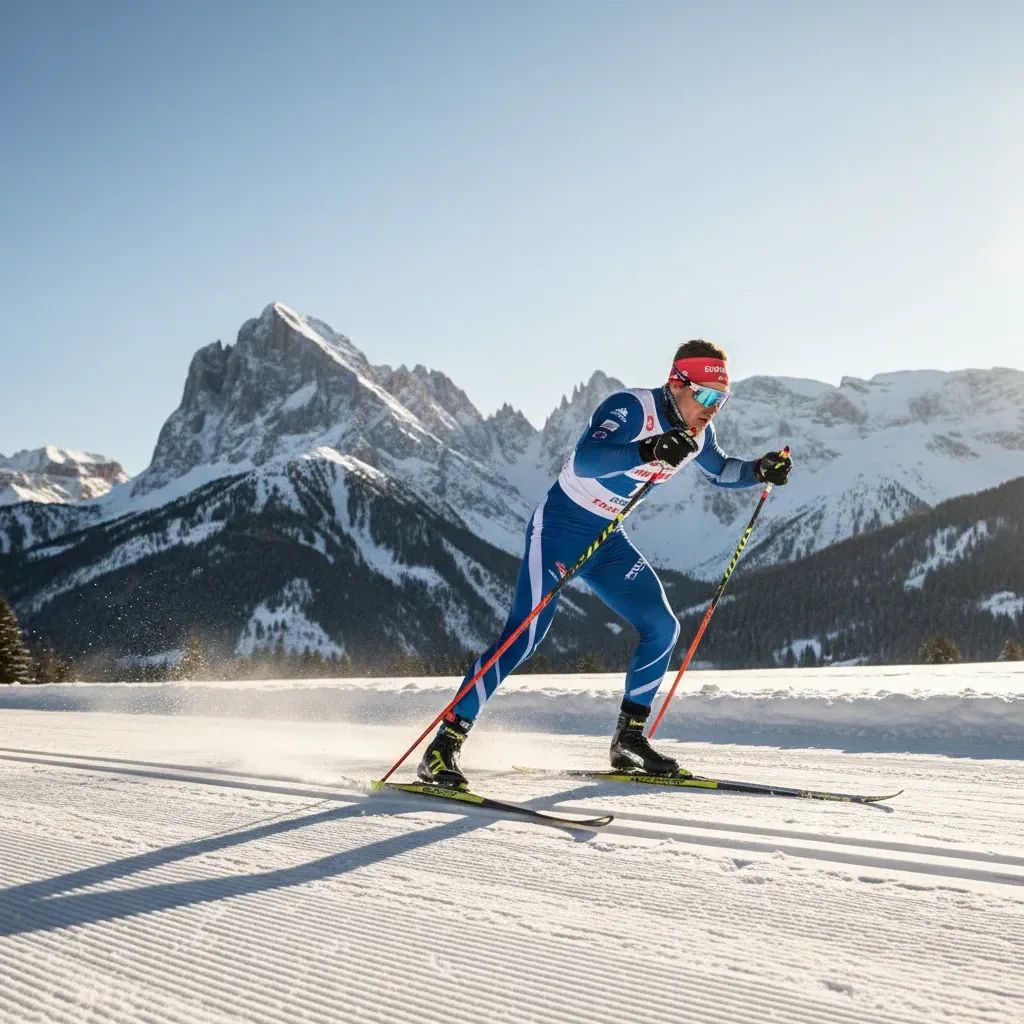
Norway's Johannes Klæbo has completed an unprecedented sweep of all six men's cross-country skiing races at the Milano Cortina 2026 Winter Olympics, claiming his eleventh career Olympic gold and shattering a record that has stood since American speed skater Eric Heiden dominated the 1980 Lake Placid Games. The 29-year-old from Oslo closed the Olympic program with a commanding victory in the grueling 50 km mass start classic race at Lago di Tesero in Val di Fiemme, cementing his status as the most decorated male Winter Olympian in terms of gold medals.
Why This Matters
• Historic milestone: Six golds at a single Winter Games breaks the 46-year-old record set by Heiden, who won five individual speed skating titles in 1980.
• Dominance redefined: Klæbo's eleven career Olympic golds make him the most successful male athlete in Winter Olympic history, trailing only swimmer Michael Phelps on the all-time list.
• Norwegian powerhouse: Klæbo alone secured half of Norway's 12 gold medals at these Games, matching the entire tallies of traditional powerhouses like Sweden, Switzerland, and Germany.
• Val di Fiemme showcase: Italy's Trentino region hosted the Nordic skiing events at one of Europe's premier cross-country venues. Val di Fiemme has a storied history in international Nordic skiing, having hosted multiple FIS World Championships and World Cup events, making it a natural choice for the Olympic Nordic competition.
A Calculated Strategy Behind the Sweep
The Norwegian skier's extraordinary performance at Milano Cortina represents the culmination of meticulous physical preparation and a recalibrated mental approach. Leading up to these Games, Klæbo employed extended altitude training camps, sometimes skipping Norwegian national team sessions to follow his personalized program. His regimen included brutal three-hour solo sessions combining running and cycling, alongside his signature workout: six intervals of ten minutes on roller skis at near-anaerobic threshold intensity.
But perhaps more significant was his shift in mindset. After years of what he himself described as "maniacal" dedication—isolating himself for months, avoiding social contact, and even wearing masks indoors to prevent illness—Klæbo adopted a more balanced approach for 2026. He credited training alongside teammate Emil Iversen with bringing a lighter atmosphere to his preparations, stating he was in a "better mental situation" than in previous years and that he was truly enjoying competition again.
From Doubt to Dominance in Val di Fiemme
Klæbo's Olympic campaign in the Fiemme Valley began with palpable tension. His initial races showed nerves, and he maintained his cautious isolation strategy early in the competition. Yet as the Games progressed, the Norwegian systematically dismantled each challenge, winning the 20 km skiathlon, individual sprint classic, 10 km freestyle, 4x7.5 km relay, team sprint freestyle, and finally the 50 km mass start classic.
In the marathon closing race, Klæbo broke away with compatriots Martin Nyenget and Emil Iversen, then surged in the final kilometers to claim victory ahead of both Norwegian teammates. French skier Theo Schely finished fourth, while independent Russian athlete Savelii Korostelev placed fifth. Italy competed without Federico Pellegrino, sidelined by influenza, leaving Simone Daprà to finish 18th and Elia Barp 22nd.
At the Lago di Tesero stadium after his final triumph, Klæbo struggled to articulate the achievement: "It's incredible," he said. "After the world championships, we knew it was possible, but when you actually do it, it's difficult to find the right words. I tried so many emotions when I crossed the finish line."
The Evolution of a Legend
Klæbo's dominance isn't accidental. His distinctive technique—nicknamed the "Klæbo-kliv" for his exceptionally efficient uphill skiing style—results from years of technical refinement and athletic development under the mentorship of his grandfather, Kare Høsflot, who coached him from childhood. The Norwegian has systematically improved his performance in longer distances without sacrificing his elite sprint capabilities, making him formidable across all cross-country formats.
His perfect six-for-six performance at Milano Cortina mirrored his clean sweep at the 2025 FIS Nordic Ski World Championships in Trondheim, Norway, where he captured all six available world titles. That preview of his form should have warned competitors what awaited them in Italy.
The young skier from Oslo now holds 11 Olympic golds, one silver, and one bronze, plus 15 world championship titles. He has surpassed legendary Norwegian predecessors including Bjørn Dæhlie (8 Olympic golds) and Ole Einar Bjørndalen (8 golds in biathlon). Only Marit Bjørgen, with 8 golds and 15 total medals, rivals his Norwegian skiing legacy.
What This Means for Italian Winter Sports
For Italy's winter sports infrastructure, the Milano Cortina Games provided an opportunity to demonstrate the country's technical capabilities in hosting Nordic events. The Val di Fiemme venues in Trentino were utilized for the cross-country skiing competition, delivering facilities that met international standards. The event showed that Italy's investments in Nordic skiing infrastructure—particularly in Trentino-Alto Adige—have created venues suitable for major international competitions and training camps.
The absence of Pellegrino due to illness in the 50 km race underscored the challenges Italian athletes face against the depth of the Norwegian team. Nevertheless, the competition demonstrated the organizational requirements and venue quality necessary to host top-tier cross-country events in Italy.
Looking Beyond Milano Cortina
At 29, Klæbo now faces the question that confronts all dominant athletes: where to find new motivation. "There are choices to make," he reflected after his sixth gold, "and this year we made all the right ones. When you start to perceive training as sacrifice, I think that's the moment to find something else to do."
He acknowledged the sacrifices required for sustained excellence but suggested that as long as he continues enjoying competition and avoiding the feeling of burden, he'll keep racing. His family and fiancée, he noted, provide crucial support that makes the demanding lifestyle sustainable.
In a gracious nod to his departing rival, Klæbo praised Pellegrino, one of the few sprinters capable of beating him: "We've had many tight and exciting duels. He's had a great career. We'll miss him."
Norway's Milano Cortina Domination
Klæbo's six golds represented half of Norway's 12 gold medals at these Winter Olympics. The nation's other victories came from three titles in Nordic combined (an exclusively male event), two from women's ski jumping, and one from the women's cross-country relay. This means Klæbo alone matched the entire gold medal hauls of Sweden, Switzerland, and Germany—countries with deep winter sports traditions.
The Norwegian's achievement also accounted for one-third of his nation's total medal count, underscoring his singular importance to Norway's Olympic success. His performance in the Trentino mountain venues will likely be remembered as a defining athletic achievement of the Milano Cortina 2026 Winter Games.
Klæbo's legacy extends beyond statistics. He has redefined what's possible in cross-country skiing, proving that dominance across sprint, middle-distance, and marathon formats is achievable through intelligent training, technical mastery, and evolving mental approaches. As he contemplates his future, the skiing world waits to see whether he'll pursue more records or step away at the peak of his powers—a legend who rewrote the history books on Italian snow.


