
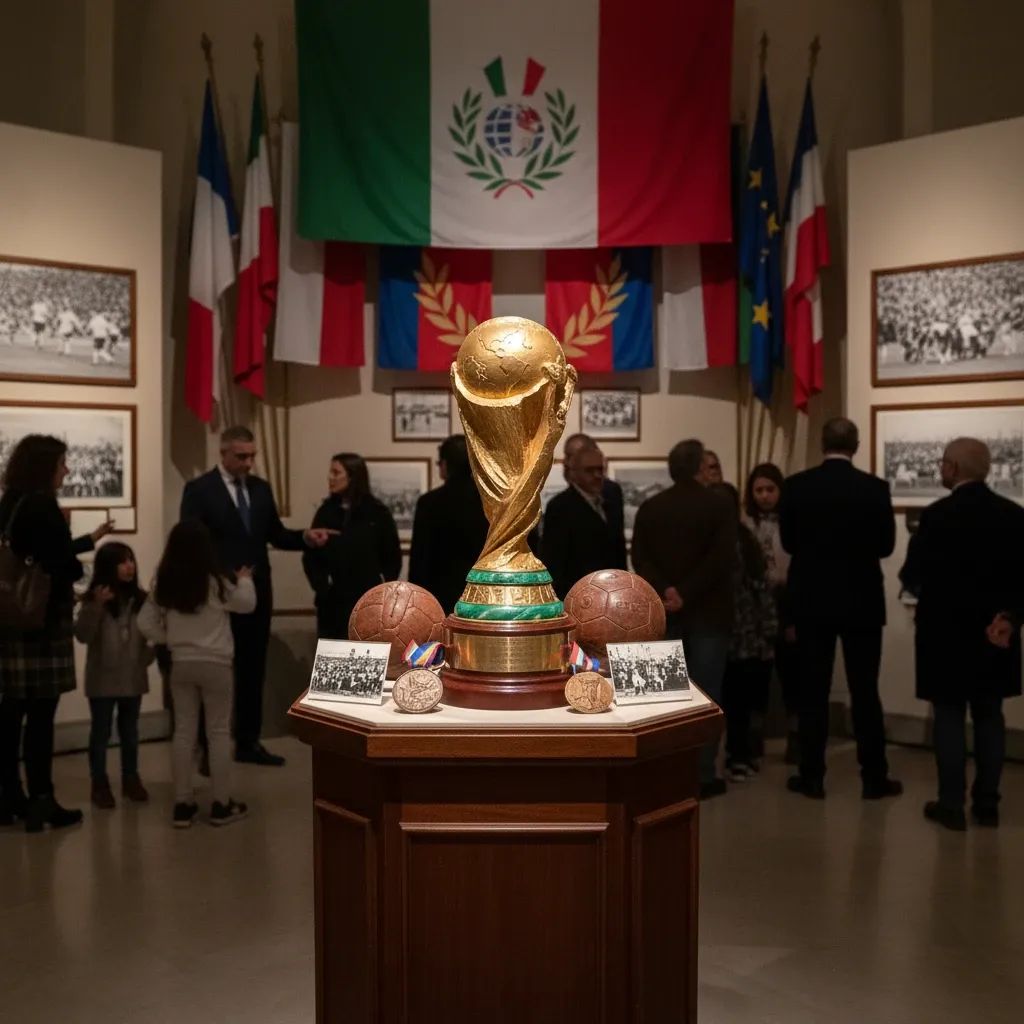
Italy's football authorities will recognize Marco Tardelli, the 1982 World Cup hero, with the Onda Azzurra 2026 award on March 18 at Palazzo Valentini, the Rome Metropolitan City headquarters, underscoring a wider effort to reconnect younger Italians with the glory days of the Azzurri. The ceremony forms part of a touring exhibition that will bring World Cup trophies to coastal communities later this month.
Why This Matters
• World Cup memorabilia on display: The actual trophies from Spain 1982 and Germany 2006 will be exhibited in Ostia and Fiumicino from March 27-29.
• Free public access: The exhibition, titled "Un Secolo d'Azzurro," aims to give families and youth direct contact with Italian football heritage.
• Legacy preservation: The initiative addresses what organizers see as a generational disconnect between today's youth and the values that defined Italian football's golden eras.
A Recognition Rooted in Transmission
The Onda Azzurra 2026 prize, awarded annually by the amateur sports association ASD Ostia 1984, singles out athletes who have successfully conveyed the passion and principles of football to new generations. This year's recipient, Marco Tardelli, remains one of the most visceral symbols of Italian football triumph—his tear-streaked sprint after scoring in the 1982 final against West Germany is still replayed in highlight reels across the country.
Giancarlo Abete, president of the Italy National Amateur League, and Alessandro Onorato, Rome's sport assessor, will present the award to Tardelli. The ceremony also honors Francesco Franchi, president of the foundation named after his father Artemio Franchi, the former UEFA president and FIFA vice president whose tenure coincided with Italy's 1982 victory.
Artemio Franchi, who led Italian and European football governance during a transformative period, died in a car accident in 1983. His foundation now works to preserve his legacy through scholarships and cultural initiatives, including a special exhibition planned for Palazzo Vecchio featuring documents and photographs from his years at the helm of UEFA and the Italian Football Federation.
The Tardelli Template
Marco Tardelli's playing career offers a case study in versatility and grit. Over a decade with Juventus from 1975 to 1985, he collected 5 Serie A titles, 2 Coppa Italia trophies, and became one of only three players—alongside Antonio Cabrini and Gaetano Scirea—to win all three major UEFA club competitions: the UEFA Cup (1977), the Cup Winners' Cup (1984), and the European Cup (1985).
His style defied the rigid defensive doctrine of Italian football at the time. Nicknamed "Schizzo" (dasher) by teammates for his lean frame and relentless pace, Tardelli operated as a two-way midfielder who could tackle, distribute, and score. He trained himself to use both feet by studying Gigi Riva, the left-footed striker he idolized, and his tactical intelligence allowed him to shift between midfield roles and even defensive positions.
In total, Tardelli earned 81 caps for Italy, appearing in three World Cups (1978, 1982, 1986) and Euro 1980. But it is his left-footed strike in the 1982 final—and the primal scream that followed—that defines his legacy. In later interviews, he described the moment as the release of a lifetime's tension, the realization of a childhood dream in front of millions.
After retiring in 1988, Tardelli moved into coaching. He led Italy's under-21 national team to victory at the 2000 UEFA European Under-21 Championship, though he later admitted management didn't suit his temperament. Still, his public comments on Italian football's "generational issue"—particularly the scarcity of quality strikers—reflect an ongoing concern for the sport's future in his country.
World Cup Trophies Come to the Coast
The Onda Azzurra ceremony also serves as the official launch for a touring exhibition titled "Un Secolo d'Azzurro – In viaggio con la Coppa del Mondo" (A Century of Azzurro – Traveling with the World Cup). The exhibition will run from March 27 to 29 in two locations:
• Ostia Lido: Fondazione Roma Litorale, Lungomare degli Abruzzi 24
• Fiumicino: Municipal headquarters, Piazza Generale Alberto Della Chiesa
The displays will feature the actual World Cup trophies from Spain 1982 and Germany 2006, along with match-worn shirts, official match balls, and other artifacts from Italy's four World Cup victories (1934, 1938, 1982, 2006). The Fiumicino venue will include a special section titled "Calcio e Volo" (Football and Flight), focusing on goalkeepers and featuring a dedicated area on Roberto Baggio.
Organizers from ASD Ostia 1984 emphasize that the event is designed to be accessible to families, schools, and youth groups, offering direct contact with objects that until now have been confined to federation archives or private collections.
What This Means for Residents
For anyone living in or around Rome, this is a rare opportunity to view championship trophies and memorabilia that are seldom displayed publicly. The coastal locations were chosen deliberately to reach communities outside the capital's traditional cultural circuit.
Parents and educators may find the exhibitions useful for introducing children to a tangible piece of Italian sports history. The 1982 World Cup, in particular, remains a cultural touchstone for Italians over 50, but younger generations often know it only through grainy footage. Seeing the trophy in person, alongside the shirts worn by Paolo Rossi, Dino Zoff, and Tardelli himself, provides a physical link to that era.
The initiative also reflects a broader concern within Italian football about fan engagement and youth participation. Amateur leagues have reported declining registration numbers in recent years, and officials are searching for ways to reinvigorate interest at the grassroots level. By framing the exhibition as "beyond the match," organizers signal an intent to promote values—teamwork, discipline, national pride—rather than just athletic achievement.
A Broader Campaign
The Onda Azzurra 2026 program is part of a multi-year effort by amateur football associations and the Italian Football Federation to maintain relevance in a media landscape dominated by international club competitions and social media personalities. The federation has also scheduled a series of events for 2026, including the 15th edition of the Premio di Laurea Artemio Franchi, a scholarship award ceremony to be held in Florence's Salone dei Cinquecento.
The timing is strategic. With Italy not hosting or competing in a major tournament this year, officials are using anniversaries—44 years since Spain 1982, 20 years since Germany 2006—to keep the Azzurri brand visible. The involvement of figures like Tardelli, who embody both past success and ongoing engagement with the sport, lends credibility to the effort.
Whether these initiatives will translate into measurable increases in youth participation or public interest remains to be seen. But for residents of Ostia and Fiumicino, the next two weeks offer a chance to stand next to the hardware that defined Italian football's proudest moments—and perhaps to understand why a grown man once ran across a Madrid pitch, fists clenched, tears streaming, screaming into the void.


