
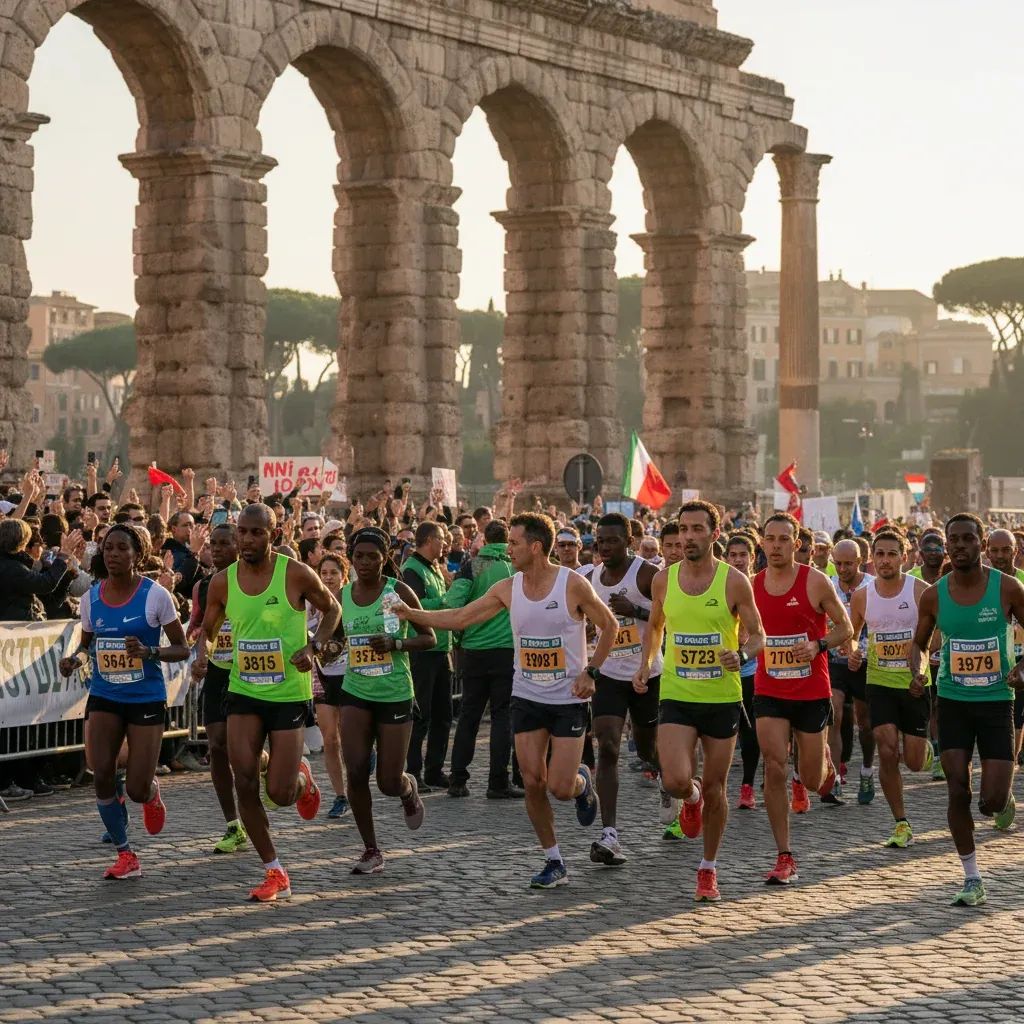
Kenya's Asbel Rutto has claimed victory at the 31st Acea Run Rome The Marathon, defending his 2024 title with a commanding performance through the Italian capital's historic streets. The 36,000-runner event, which doubled as a celebration of World Water Day, delivered both athletic excellence and a pointed message about resource sustainability for residents and visitors alike.
Why This Matters
• Course record repeated: Rutto's 2h06:32 finish marks his second consecutive Rome win, cementing Kenya's dominance of the event
• New women's benchmark: Pascaline Kibiwot's 2h22:44 shatters the previous female course record by 8 seconds
• Sustainability showcase: The race distributed 500,000 water cartons and offset carbon emissions through certified Nigerian water projects
Rutto Reclaims His Crown After Difficult 2025
Asbel Rutto crossed the finish line at the Circo Massimo in 2h06:32 on Sunday, narrowly edging compatriot Henry Tukor Kichana (2h06:36) and Ethiopian Lencho Tesfaye Anbesa (2h07:43). The victory represents a significant rebound for the Kenyan athlete, whose racing has shown resilience through demanding international competition.
Rutto's 2024 Rome performance—a course-record 2h06:24 that smashed the previous 2h06:48 benchmark—had established him as a rising force in marathon racing. That breakthrough came after he led from the halfway point, which he reached in 1h02:36, and represented his first major marathon victory. His return to form in Italy confirms his status among elite marathon competitors.
The men's podium reflected the East African stranglehold on elite marathon competition. Kenyan runners occupied 9 of the top 10 positions in the 2024 edition, and while complete 2026 results are still being processed, early data suggests a similar pattern. Anbesa, the bronze medalist, brought a personal best of 2h06:18 into the race, making him technically the fastest runner on paper—though Sunday's conditions and tactics favored Rutto's tactical approach.
Kibiwot Breaks Barrier, Establishes New Standard
On the women's side, Pascaline Kibiwot Jelagat of Kenya delivered the day's most statistically impressive performance. Her 2h22:44 finish not only secured gold but also erased the 2h22:52 record set by Ethiopia's Kebede Megertu Alemu in 2019. The 8-second improvement may seem modest, but in elite women's marathoning—where course records often stand for years—it represents a meaningful psychological and competitive threshold.
Kibiwot's time still sits roughly 12 minutes and 48 seconds behind Ruth Chepngetich's world record of 2h09:56, set in Chicago in October 2024. Yet within the context of Rome's challenging terrain—including the notorious sampietrini cobblestones that ripple through historic districts—the performance ranks among the strongest ever recorded on Italian soil.
Ethiopian runners Genet Tadesse Robi (2h24:55) and Aberash Fayesa Robi (2h25:43) rounded out the women's podium, ensuring East African athletes swept all six medals on offer.
Water Scarcity Meets Athletic Endurance
The Acea Run Rome The Marathon deliberately scheduled its 2026 edition to coincide with UN World Water Day, transforming the sporting event into a platform for environmental advocacy. This alignment fulfilled what Virman Cusenza, communications director for Acea—Italy's largest water utility—described as a "dream" to connect athletic performance with resource stewardship.
Acea erected a 200-square-meter "Water Marathon House" at the Expo Village near the Circo Massimo finish line, featuring augmented reality experiences that simulate the infrastructure required to deliver clean water to Rome's residents. The installation emphasizes that water delivery is itself a daily marathon requiring constant maintenance, investment, and vigilance—a message particularly relevant to Italy, where aging aqueducts and climate-driven drought cycles strain municipal systems.
The event distributed 500,000 water cartons in collaboration with the Centrale del Latte di Roma dairy cooperative. Beyond hydration logistics, organizers pursued carbon neutrality certification by offsetting emissions through a Gold Standard project in Nigeria that provides efficient water purification systems to schools and communities. This initiative addresses the theme of World Water Day 2026—"Water and Gender: Where Water Flows, Equality Grows"—by reducing the burden on women and girls who typically handle water collection in resource-scarce regions.
Impact on Residents and the Rome Event Calendar
For Italy-based runners and spectators, the marathon represents both a premier athletic showcase and a logistical undertaking that reshapes the capital's Sunday rhythm. The course launched from the Fori Imperiali and wound through Piazza di Spagna, along the Tevere River, past Piazza San Pietro, and concluded at the Circo Massimo—requiring road closures and public transport adjustments that affect local mobility.
The 36,000 registered runners included elite athletes chasing prize money and course records, recreational joggers participating in the concurrent Acea Water Fun Run, and charity runners raising funds through the Acea Run4Rome program. The total participant and spectator count approached 60,000, making it one of Italy's largest single-day sporting gatherings and a significant economic driver for hospitality, retail, and tourism sectors in Rome.
Andrea Lo Cicero, former Italian rugby international and member of the Sport e Salute "Illumina" team, emphasized the event's civic dimension during a pre-race panel. "Sport makes cities live," he noted, drawing parallels between rugby's demanding physicality and the marathon's test of endurance. His presence underscored efforts by Italian sports authorities to position mass-participation events as public health interventions, not merely competitive spectacles.
The FAO (Food and Agriculture Organization), headquartered in Rome, served as a partner for the water-focused campaign, with branding along the route and information booths at the Marathon Village. Patricia Mejias, the FAO's Land and Water Expert, participated in the "Acea Run for Water" panel alongside Tommaso Sabato, Acea's chief regulated business officer, and Riccardo Tempestini, vice president of Rari Nantes Florentia, a historic Florentine swimming club.
Elite Credentials and International Context
The World Athletics Elite Label Race designation places the Rome Marathon among roughly 40 global events that meet stringent standards for course measurement, anti-doping protocols, prize money, and elite field quality. This status attracts top-tier African runners who might otherwise focus exclusively on the lucrative circuits in Berlin, London, or New York.
Rutto's winning margin of just 4 seconds over Kichana illustrates the compressed competitiveness of modern elite marathoning, where pacing strategies and late-race surges often determine outcomes within a single minute. The men's podium times—all under 2h08:00—would have placed in the top 5 at most major marathons worldwide on the same weekend.
For context, Rutto's 2h06:32 sits comfortably within the top 50 marathon times recorded globally in early 2026, though still distant from the sub-2h05:00 performances that increasingly dominate the absolute elite tier. His resurgence confirms his position among elite marathon competitors.
What This Means for Residents
Italy-based endurance athletes now have confirmation that Rome's course—despite its cobblestones and urban complexity—can produce world-class times when conditions align. The Kibiwot women's record establishes a new benchmark for Italian-based female marathoners to chase, while Rutto's repeat victory signals that the event's prize purse and prestige are sufficient to attract defending champions.
Sustainability-conscious residents will note the event's ISO 20121 certification for sustainable event management and the partnership with Circularity, a benefit corporation specializing in environmental monitoring. These credentials matter in a country where public opinion increasingly demands that large-scale events minimize ecological footprints, particularly in historic urban centers vulnerable to over-tourism and resource strain.
The water-focused messaging carries practical weight: Italy experienced severe drought conditions across the Po Valley and southern regions in recent years, with municipalities from Milan to Palermo implementing rationing measures. Acea's campaign positions water infrastructure as critical national infrastructure, a framing that may influence public support for utility investments and rate adjustments in Rome and beyond.
Finally, the #runforwater social media campaign launched on March 8 ties the marathon to broader conversations about gender equity and resource access—issues that resonate in Italy, where rural and southern communities still face intermittent water service challenges that disproportionately burden women managing household needs.


