
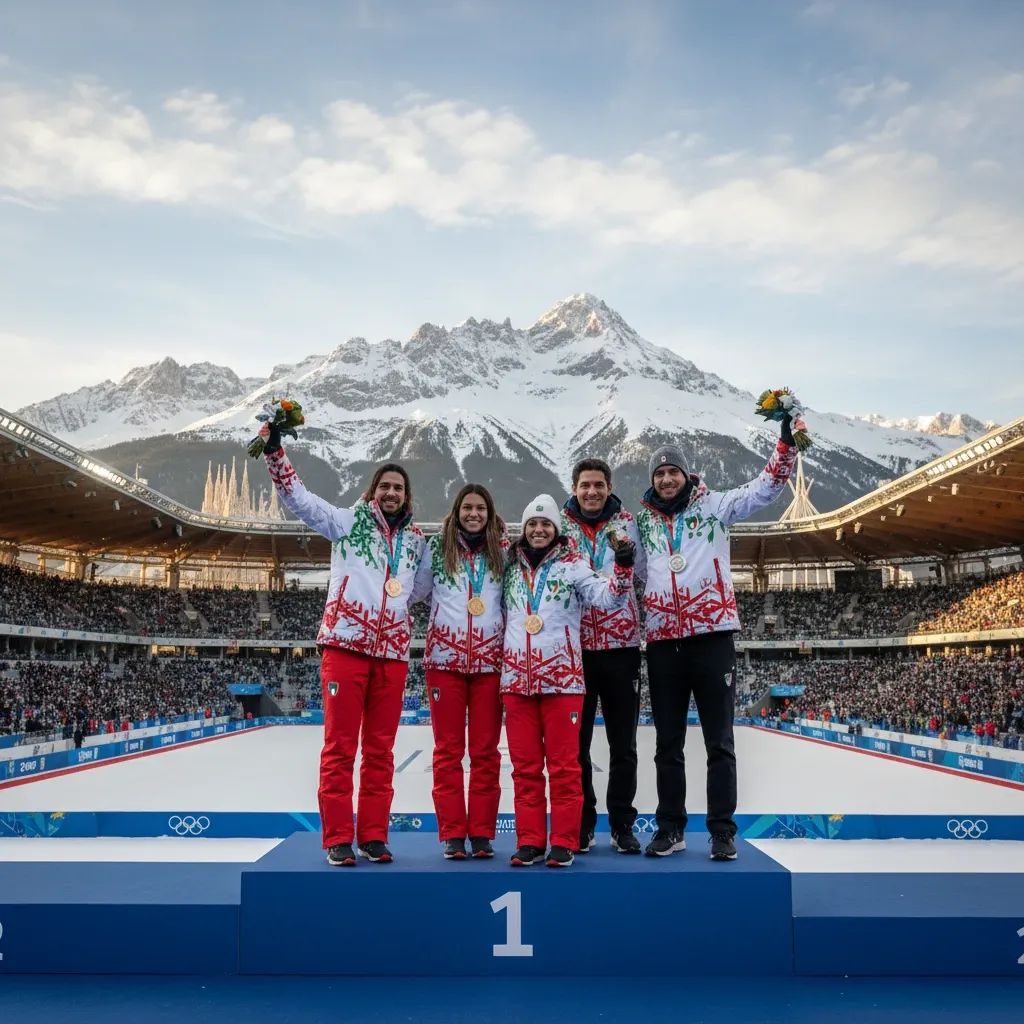
The Italian government and Olympic organizers closed the Milano Cortina 2026 Winter Games with a formal handover ceremony at Verona's Arena, marking the end of a 16-day event that delivered Italy's most successful Winter Olympics in history—27 total medals (9 gold, 5 silver, 13 bronze)—while setting the stage for a potential €5.3B-€6.1B economic windfall extending well into the next two years.
Why This Matters
• Infrastructure Legacy: Student housing, transportation upgrades, and year-round sports facilities will remain after the Games, directly benefiting residents of Lombardy and the Veneto.
• Tourism Surge: An 80% spike in spending by non-European cardholders during the Games hints at sustained international demand for Italy's winter destinations.
• Job Creation: Over 36,000 direct and indirect positions linked to post-Olympic operations and the tourism multiplier effect.
• Budget Reality Check: Cost overruns pushed total spending past €5.4B—four times initial estimates—raising questions about fiscal discipline and long-term debt.
How Italy Delivered—and What It Cost
Giovanni Malagò, president of the Milano Cortina 2026 Foundation, used the closing ceremony to declare, "Italy kept its promises," a nod to the country's ability to finish construction on key venues and host athletes from 93 delegations without major logistical collapse. Yet behind that rhetoric lies a budget that ballooned from early projections, with the Foundation itself reporting a €108M deficit in 2023 and final public-sector exposure climbing toward €5.4B. Analysts note that while infrastructure—new mobility links, upgraded sports facilities, and a reconfigured Porta Romana district in Milan—will serve residents for decades, the Games also triggered last-minute construction rushes and controversy over a €120M bobsled track in Cortina that required felling four hectares of old-growth forest.
Medal Haul Fuels National Pride
Italy's Team secured a record 27 medals, surpassing previous Winter Olympic benchmarks and cementing the country's status as a force in alpine skiing, biathlon, and speed skating. Speed skater Davide Ghiotto and biathlete Lisa Vittozzi carried the national flag at the closing ceremony, with Vittozzi describing the moment as "the most successful Winter Olympic edition ever for Team Italy." Ghiotto echoed the sentiment, calling the public's energy "indescribable." Malagò praised the athletes as "extraordinary," crediting their performances with uniting Italians domestically and abroad.
The symbolic high point came when alpine skier Federica Brignone claimed her second gold; competitors knelt in respect, a gesture widely shared on social media and now considered one of the Games' defining images. Other memorable scenes include President Sergio Mattarella riding Milan's yellow tram No. 26 to reach San Siro for the opening ceremony—a video that humanized Italy's head of state—and the dual lighting of Olympic cauldrons in Milan and Cortina, a logistical first that underscored the Games' "diffused" geographic model.
Gastronomy as Soft Power
The Olympic Villages served 164,000 meals over 16 days, dispensing 365 kg of pasta and 12,000 pizza slices daily, alongside 60 kg of Grana Padano cheese and 8,000 espressos. Chefs from Valtellina and celebrity cooks Davide Oldani and Tommaso Arrigoni anchored menus designed to showcase Italian cuisine, which UNESCO recognized as intangible cultural heritage in December. Canadian short-track skater Courtney Sarault's viral "Oh my God!" video praising a warm chocolate torte became an unofficial advertisement for Italian hospitality, while Brazilian-born slalom champion Lucas Pinheiro Braathen celebrated his gold medal with a dinner of pizzoccheri, the Valtellina buckwheat-pasta specialty that earned a feature in The New York Times.
Foundation data show that stacking every meal tray would create a 60 km tower—18 times the height of Cortina's Tofane peaks. Beyond food, the Villages distributed 4,000 duvets, nearly 3,000 mobile phones, 1,200 makeup sessions, 696 orthopedic solutions, and 7,000 commemorative pins, underscoring the scale of athlete services.
Casa Italia's Cultural Experiment
For the first time, Italy opened its official Olympic hospitality pavilion to the public, drawing 120,000 visitors across three sites: Milan's Triennale, the Aquagranda Olympic Training Center in Livigno, and Farsettiarte in Cortina. The "Musa" exhibition paid homage to Italy's historical role as global muse, spanning 6,000 m² of curated space with 504 design objects, 700 lighting fixtures, 310 m² of LED screens, 60 historic Olympic artifacts, and 123 artworks by 86 Italian and international artists. The gambit transformed a closed VIP lounge into a public-facing cultural platform, blending gastronomy, design, and Olympic heritage in a format organizers plan to replicate at future Games.
The €6B Question: Will Economic Projections Hold?
Banca Ifis estimates a €5.3B total impact—€2.3B from tourism, €3B from infrastructure and legacy investments. Unimpresa pushes the figure to €6.1B, breaking it into €1.1B direct tourism spending during the event, €1.4B induced tourism over 24 months, €3.2B infrastructure value, and €400M net multiplier effects. Regional data from Visa show a 160% surge in arrivals to northern Italy and an 80% increase in extra-European cardholder spending during the 16-day window. Milan alone recorded 8.7M tourist arrivals in early 2026, a record driven partly by Olympic curiosity. Assolombarda and Milano & Partners forecast that Milan's GDP will grow 1.7% in 2026, with Olympic tailwinds contributing a measurable share.
Yet history counsels caution. Previous host cities have seen short-term spikes dissipate as infrastructure debt compounds and visitor interest fades. Critics warn of overtourism in fragile alpine ecosystems, already strained by the mass deployment of artificial snow—a climate-adaptation measure that consumes vast water and energy resources. The WWF Italia withdrew from sustainability talks, labeling official green claims as "window dressing" and pointing to the Cortina bobsled track as emblematic of environmental disregard.
What This Means for Residents
Housing and Urban Renewal
The Porta Romana Olympic Village in Milan, built on a disused rail yard, will convert into Italy's largest subsidized student residence, easing pressure on a rental market notorious for high prices. Cooling strategies, rooftop gardens, and photovoltaic panels aim to make the complex a model of urban sustainability. Meanwhile, Cortina's temporary mobile-home village will be dismantled, with units repurposed for hospitality elsewhere, honoring a pledge not to overdevelop the Dolomites.
Year-Round Sports and Culture
The Arena di Santa Giulia in Milan transitions into a multipurpose venue for concerts and professional sports, anchoring a new entertainment district. Mountain resorts—Livigno, Bormio, Val di Fiemme, Anterselva—retain upgraded piste and facilities primed for World Cup circuits and recreational tourism. In Anterselva, the biathlon center's deep local roots ensure continued use; in Cortina, the sliding center is billed as the "future certainty" for bobsled and luge. Regional funds for energy-efficient retrofits of public sports halls promise safer, cheaper facilities for amateur clubs and school programs.
Job Market and Local Procurement
The "Impact 2026" program directed contracts to local and social enterprises, creating training pipelines for vulnerable groups. Over 36,000 positions—construction, hospitality, event management—emerged during the ramp-up, though sustainability depends on whether tourism maintains elevated levels through 2027. Early signs are positive: lodging bookings for the 2026-27 ski season remain above historic norms.
Controversies and Unfinished Business
Despite the official fanfare, the Games exposed organizational strains and ethical fault lines:
• Cost Blowouts: Quadrupled budgets and a €108M foundation deficit fuel accusations of opacity and weak fiscal control. Watchdogs flagged subcontractor Bracchi srl, barred from regional tenders yet present on Olympic sites, as evidence of lax oversight.
• Environmental Backlash: Activists denounce the Cortina bobsled track—four hectares of century-old forest cleared for a venue with no guaranteed post-Olympic use—and the reliance on artificial snow as symptomatic of climate-driven unsustainability.
• Social Friction: Protests in Milan decried gentrification, rent hikes, and the prioritization of prestige projects over affordable housing. Groups argued that the Games enriched developers while squeezing working-class residents.
• Geopolitical Echoes: The participation of Israeli athletes and planned deployment of Qatari security personnel drew criticism from human-rights advocates, while the presence of U.S. Immigration and Customs Enforcement analysts sparked privacy debates.
• Sporting Oddities: A Ukrainian skeleton pilot was disqualified for a helmet honoring fallen soldiers; a Norwegian biathlete confessed to infidelity live on television after winning bronze; and rumors of performance-enhancing genital injections among ski jumpers ("Penisgate") circulated without formal substantiation.
Torch Passes to French Alps 2030
Milan Mayor Giuseppe Sala and Cortina Mayor Gianluca Lorenzi handed the Olympic flag to representatives from the Rhône-Alpes and Provence-Alpes-Côte d'Azur regions, which will co-host the 2030 Winter Games. As the cauldrons in Milan, Cortina, and Verona were extinguished to pianist Gloria Campaner's interpretation of Ludovico Einaudi, the ceremony titled "Beauty in Action" closed with performances by the evening's ensemble. Prime Minister Giorgia Meloni, Chamber of Deputies President Lorenzo Fontana, Transport Minister Matteo Salvini, and Sports Minister Andrea Abodi attended alongside International Olympic Committee Vice-President Kirsty Coventry and regional governors from Lombardy, Veneto, and Trentino.
Legacy or Liability?
The post-Olympic verdict hinges on whether induced tourism sustains the €1.4B projection over the next 24 months and whether upgraded infrastructure alleviates—or exacerbates—tensions around affordability and environmental stress. For mountain communities dependent on seasonal income, the Games delivered immediate cash flow and global visibility; for Milan, they accelerated urban renewal long stalled by bureaucracy. Yet the €5.4B public tab and unfinished projects—Tirano bypass, Bormio lift system—remind residents that Olympic promises often outlast Olympic budgets. As the French Alps prepare to inherit the Winter Games mantle, Italy's challenge is to convert medal glory and culinary soft power into tangible gains for citizens navigating a post-Olympic economy.


