
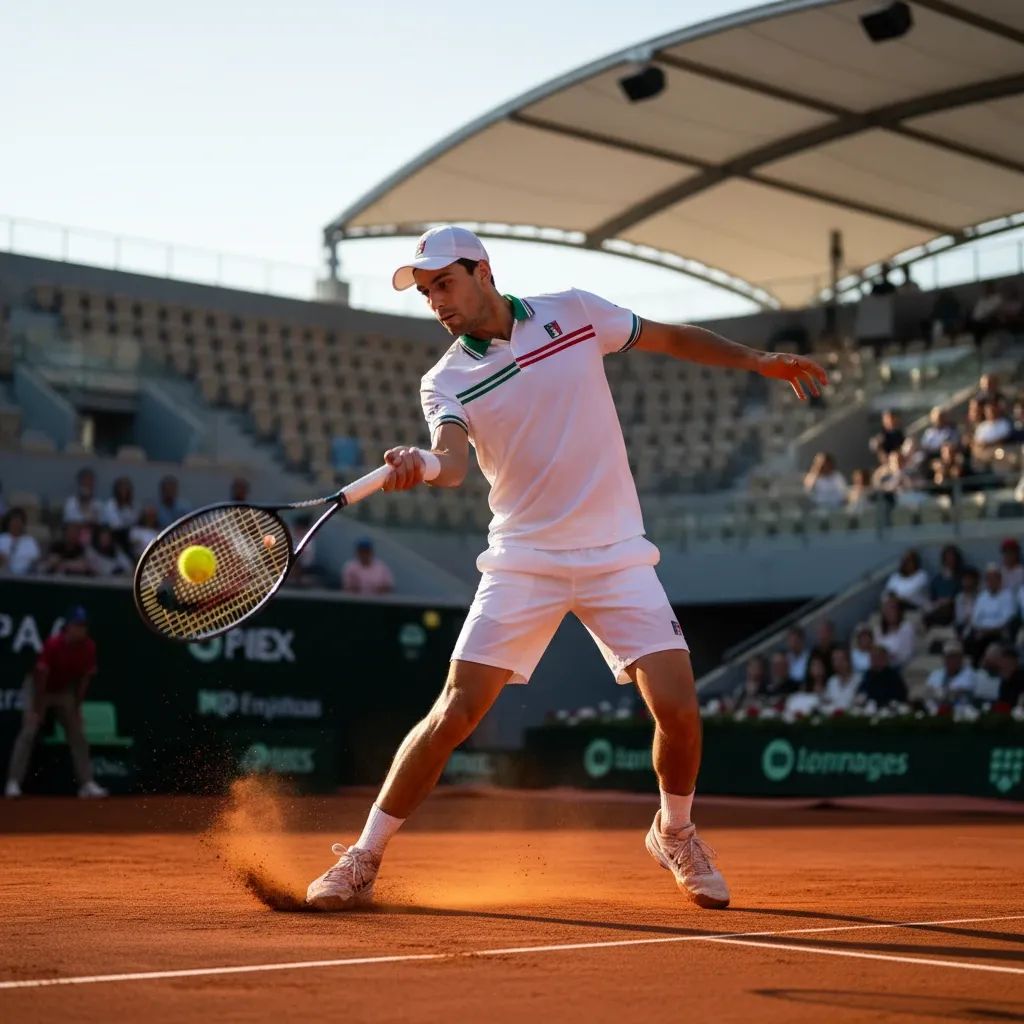
When the Italy Tennis Federation welcomes the men's and women's national teams to the Quirinal Palace for a ceremonial reception, the gesture carries weight beyond protocol. President Sergio Mattarella, responding to the teams' achievements, announced he will attend matches at the Internazionali BNL d'Italia now underway in Rome—a quiet but unmistakable signal that Italy's tennis resurgence has transitioned from a sporting phenomenon into a matter of national pride.
Why This Matters
• Record-breaking streak: Italy's Davis Cup victory marks the nation's third consecutive triumph; the women's BJK Cup title was their second straight defense, demonstrating sustained team excellence.
• Economic engine: According to federation reports, the Italy Tennis Federation generated significant revenue during 2025, marking unprecedented growth in the sport's commercial activity.
• Tournament begins this week: The Rome Internationals (May 5-17) feature world number one Jannik Sinner on a 23-match winning streak, with women's star Jasmine Paolini competing for Italy. Residents can watch matches through Supertennis, the federation's free television channel, or visit the tournament venue directly.
The Palace Reception: More Than Ceremonial
On May 4, the day before tournament play began, the Quirinal Palace reception was deliberately understated in tone but dense with meaning. Mattarella met with athletes who had delivered what he termed "unimaginable achievements"—successive team championships that shattered the narrative of Italian tennis as a collection of isolated talents. The president's specific remarks—emphasizing that he did not wish to be perceived as a "talisman"—carried an implicit recognition: this is not luck, but the product of systematic excellence.
Tathiana Garbin, captain of the victorious women's team, reframed the encounter in practical terms during a brief statement outside the palace. "The real motivation," she said, "comes from the people who embrace us in the street. This recognition validates what we hold closest: the transformation of individual effort into collective will." Her words pointed to a cultural shift within Italian sport—the realization that team victories at the global level generate tangible social cohesion and justify sustained investment.
Sinner's May Momentum
The timing of Mattarella's attendance pledge arrives as Jannik Sinner enters the Rome tournament fresh from his most audacious achievement yet. On May 3, the 24-year-old from South Tyrol defeated Alexander Zverev at the Madrid Open, claiming his fifth consecutive Masters 1000 title. This feat—occurring after victories in Indian Wells, Miami, Monte-Carlo, and Madrid—has no precedent in men's professional tennis.
Sinner's current season record stands at 30 wins against only 2 losses, the defeats coming early: one to Jakub Mensik at the Qatar Open on February 19, followed by an unbeaten stretch of 23 matches. His ranking of number 1 globally, backed by 14,350 ATP points, reflects both depth and dominance. At the Rome tournament, beginning this week, he faces a field that includes Novak Djokovic, Carlos Alcaraz, and Zverev once again—each capable of disrupting his trajectory.
The draw, conducted on May 5, positions Sinner as the defending finalist from 2025, when he lost to Alcaraz in the championship match. A Rome title would signal that his hard-court excellence translates seamlessly to clay, the surface where Italian tennis has historically demanded respect but rarely achieved sustained supremacy at the highest level.
Women's Tennis: Breadth Beyond Paolini
While Sinner's brilliance dominates headlines, Italy's women have assembled a more distributed portfolio of talent. Jasmine Paolini won the singles crown at the 2025 Rome Internals and, partnering with veteran Sara Errani, successfully defended their doubles title at the same event. Paolini's consistency across surfaces—hard courts, clay, and grass—has positioned her within the WTA's elite tier.
The Billie Jean King Cup showcased this depth. Italy demonstrated structural resilience with victories that underscored the women's squad's strength across multiple competitors. Unlike the men's contingent, which leans heavily on Sinner's output, the women draw from Paolini, Errani, and emerging players who reduce reliance on any single performer. The federation has qualified for the 2026 final series, where Italy will seek its third consecutive title.
How This Changes Things Locally
For residents of Italy, the tennis boom represents a tangible economic transformation and a shift in how sport is organized nationally. The Italian Tennis and Padel Federation (FITP), under president Angelo Binaghi, operates on a model that generates substantial revenue internally through tournament income, broadcasting rights, and federation services. This financial self-sufficiency is rare among Italian sports bodies.
The infrastructure evolution tells a parallel story. In 2010, hard courts comprised only 5% of Italy's tennis facilities; today that figure stands at 40%. The shift accommodates modern tennis's faster pace and ensures young Italians can develop proficiency on all surfaces without emigrating. The FITP has simultaneously expanded its investment in regional and lower-tier tournaments, increasing Challenger and ITF events by 57% over 25 years. This means emerging players now find competitive pathways at home.
Supertennis, the federation's free television channel launched in 2008, has democratized viewing access. National broadcasts now include everything from qualifying rounds at minor tournaments to grand slam events, a distribution that fueled the "Sinner effect"—viewership surges triggered by domestic success. Membership in the FITP reached 1.15 million in 2024, marking a 266% increase since 2020 and establishing tennis as Italy's second-largest sport by registered participants, behind only football.
The Economic Spillover
The Madrid Open victory and Rome tournament attendance by the president will translate into immediate economic activity. The Rome Internationals alone generated significant direct revenue in recent years; the tournament's 2026 edition, enhanced by presidential visibility and Sinner's winning streak, will likely draw substantial attendance and viewership. The ATP Finals, held annually in Turin, produced considerable economic impact for the Piedmont region.
Beyond the majors, smaller tournaments throughout Italy's regions now attract quality players and media attention previously reserved for events in Spain, France, or Germany. This geographic distribution of tennis wealth—spreading across Rome, Turin, and emerging secondary cities—provides economic stimulus and reduces the sport's dependency on any single municipality.
Roland Garros and the Clay-Court Challenge
Italy's tennis renaissance has built itself partially on hard courts and indoor conditions, territories where Sinner's game flourishes. The French Open, beginning later this month, represents the ultimate test of sustained dominance. Lorenzo Musetti, ranked world number 5 as of January 2026, reached the semifinals at Roland Garros in 2025 and carries national hopes on the clay of Paris. Paolini, meanwhile, has proven competitive at all grand slams but has not yet seized a major title.
Mattarella's public support—including his pledge to attend Rome—implicitly extends to these forthcoming tournaments. The presidential seat, whether occupied or symbolically reserved, underscores that Italian tennis now operates as a matter of state validation, not merely sporting interest.
The Larger Narrative
Italy's transformation from a tennis nation by geography and tradition to one by achievement marks a shift in how sports infrastructure, private enterprise, and national identity intersect. The growth in professional tennis creates benefits across taxation of player earnings, hospitality sectors in Rome and Turin, and media rights valuations.
Yet the sustainability question persists. Sinner's exceptional talent created momentum, but the federation's strategic decisions—regarding youth development, court infrastructure, and federation autonomy—ensure that momentum does not dissipate with a single player's eventual decline. Paolini, Musetti, and emerging Italian talents provide continuity. The next challenge is whether Italy can maintain its position when, inevitably, Sinner's dominance recedes.
Mattarella's Rome attendance is, ultimately, a recognition of an established fact: Italian tennis has arrived. The question is no longer whether it belongs at the global table, but whether it can sustain the edge that placed it there.


