
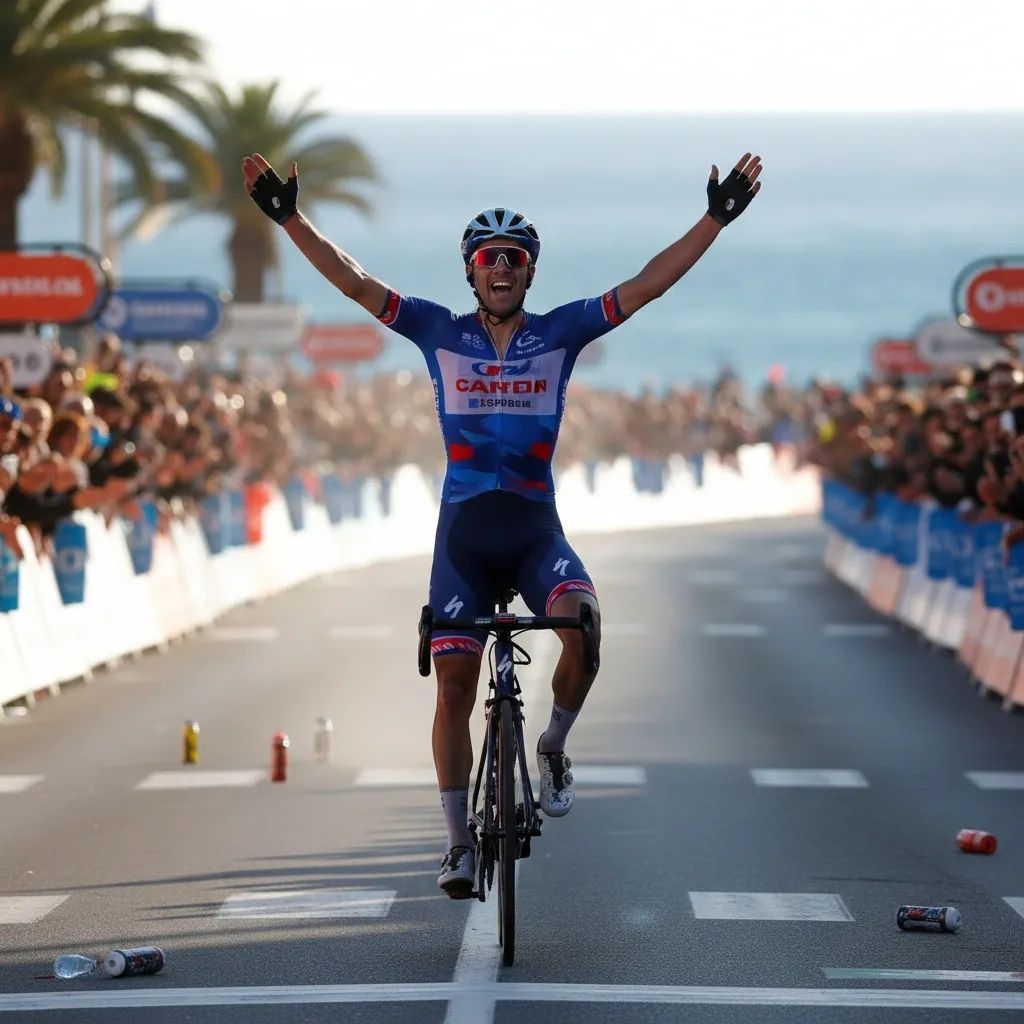
The Lidl-Trek rider Giulio Ciccone has finally claimed the Maglia Rosa at the Giro d'Italia, ending a 78-stage drought for Italian cyclists at the top of their home Grand Tour and realizing a childhood dream that had eluded him for a decade of professional racing.
Breaking the Drought
For Italians, the Giro d'Italia isn't merely a cycling race—it's a cultural touchstone woven into national identity, a stage where cycling prowess becomes national pride. The Maglia Rosa, that salmon-pink jersey introduced in 1931, carries the weight of generations: Fausto Coppi, Gino Bartali, and Alfredo Binda wore it for weeks at a time. Ciccone's ascent, though just one day into his tenure, marks a turning point in a nation's cycling renaissance.
Why This Matters
• Historic achievement: First Italian to lead the Giro d'Italia since Alessandro De Marchi in May 2021—spanning nearly 5 years and 78 race stages.
• National pride at stake: Ciccone's ascent interrupts a sharp decline in Italian dominance. From 2020-2024, Italians held the pink jersey for just 7 days (representing 6.67% of all stages), a stunning collapse from the period 2000-2009, when Italians wore pink for 153 days (72% of stages). For Italian cycling enthusiasts, this represents more than lost statistics—it signals a fading presence in the race that defines Italian cycling culture.
• Career milestone: The 31-year-old has worn yellow at the Tour de France and won the climber's classification, but the Maglia Rosa remained his "obsession" until stage 4 in Calabria.
The Tactical Shift That Changed Everything
Ciccone seized the lead on stage 4, a deceptively brutal 138 km route from Catanzaro to Cosenza—the first stage contested entirely on Italian soil. While Ecuador's Jhonatan Narváez (UAE Emirates) took the stage win, Ciccone's Lidl-Trek team executed a calculated strategy to harvest bonus seconds (time advantages earned at designated sprint points) at intermediate sprints and the finish line.
The race exploded on the Cozzo Tunno climb, where Movistar riders Lorenzo Milesi and Iván García Cortina set a blistering pace that shattered the peloton. The previous race leader, Guillermo Thomas Silva, cracked under the pressure, while Ciccone stayed composed in the elite front group. A third-place finish, combined with time bonuses collected at the Red Bull KM sprint checkpoint (an official bonus sprint point during the stage), vaulted him into the overall lead by 4 seconds over Swiss talent Jan Christen and Germany's Florian Stork.
"It Was a Bit of an Obsession"
Speaking after the stage, Ciccone struggled to contain his emotion. "The Maglia Rosa is a very special color. I've always dreamed of wearing it, even if just for a moment," he said. "I've seen it up close, maybe worn by a teammate, and inside I truly dreamed that one day I could put it on."
For a rider who has contested 150 Giro d'Italia stages without leading the race, the moment carried profound weight—not just personal, but existential. As an Italian rider in his home tour, watching others wear pink while he remained chasing felt like a weight pressing down year after year. "I feel maybe 100 kilos lighter," he admitted. "It was an obsession, so it's like a weight has been lifted." Yet he tempered expectations: "Defending it is my job and I don't want to let it go because I love it, but let's be realistic—everyone is within a few seconds."
What This Means for Italian Cycling
Ciccone's breakthrough is more than personal—it's a reprieve for a national cycling system facing existential questions. Roberto Pella, president of Lega Ciclismo, hailed the result as validation of Italy's grassroots development pipeline. "This is the fruit of the Italian nursery system," Pella noted, pointing out that Ciccone was groomed by Colpack (one of Italy's premier youth cycling academies) before turning professional with the Bardiani CSF (a domestic professional team that serves as a launching pad for young Italian talent) feeder team under Bruno Reverberi.
He now rides under Italian team manager Luca Guercilena, who was honored at the Chamber of Deputies in January by Parliament Speaker Lorenzo Fontana during the presentation of the 2026 Coppa Italia delle Regioni. The symbolic loop—from local youth development to national recognition—underscores how rare such successes have become.
Italy's grip on the Maglia Rosa has loosened dramatically. In the 2010s, Italians wore pink for 46 days (22% of stages); since 2020, that figure collapsed to 7 days. The last Italian to win the Giro outright was Vincenzo Nibali in 2016, a decade ago. Before Ciccone's breakthrough on Tuesday, only Filippo Ganna and Alessandro De Marchi had briefly held the jersey since the start of the 2020s.
The Road Ahead: Can He Hold On?
Ciccone faces an immediate challenge: the Giro's mountain stages are just beginning. Stage 5 will test his durability, but the real crucible arrives when the race crosses into Abruzzo—his home region. Racing in one's native territory carries both psychological advantage and enormous pressure; for Ciccone, competing in front of local crowds on the steep pitches of the Blockhaus climb will be both a homecoming and a trial by fire. The emotional weight of defending pink on home soil cannot be overstated for Italian riders.
His rivals are lurking within striking distance. The top 10 riders are separated by mere seconds, and the race features several strong climbers and time trialists capable of erasing gaps on a single bad day. Jan Christen, the 23-year-old Swiss sensation riding for UAE Emirates XRG, sits just 4 seconds back and will have team support from stage winner Narváez. Florian Stork of Tudor Pro Cycling is equally close.
Narváez, for his part, acknowledged the tactical chess match ahead. "We were asking ourselves at dinner what would happen on a 40-minute climb," the Ecuadorian said. "The surprise was that I pedaled with a lot of strength. Today they worked hard—this is cycling. Another day we can work to see if we can win again."
A Weight Lifted, But the Work Begins
Ciccone's journey to pink reflects both personal tenacity and structural fragility. He entered professional cycling through the traditional Italian pathway: youth academies, domestic pro teams, and gradual European exposure. Now, at 31, he stands as one of the few Italian riders capable of contending in Grand Tours—a cohort that has shrunk alarmingly.
The symbolism is potent. The Maglia Rosa, introduced in 1931 to echo the salmon-pink newsprint of La Gazzetta dello Sport, remains Italian cycling's most treasured icon. Legends like Fausto Coppi, Gino Bartali, and Alfredo Binda wore it for dozens of stages; Ciccone has one day so far, but in the current landscape, even that feels like a minor renaissance.
Whether he can extend his lead through the Apennines and defend it into the Alps remains uncertain. The margins are razor-thin, and the Giro's unpredictable terrain favors aggressive racing. But for now, an Italian rider once again leads the Corsa Rosa, and a nation starved for success in its signature race has something to celebrate—at least until tomorrow's stage begins.


