
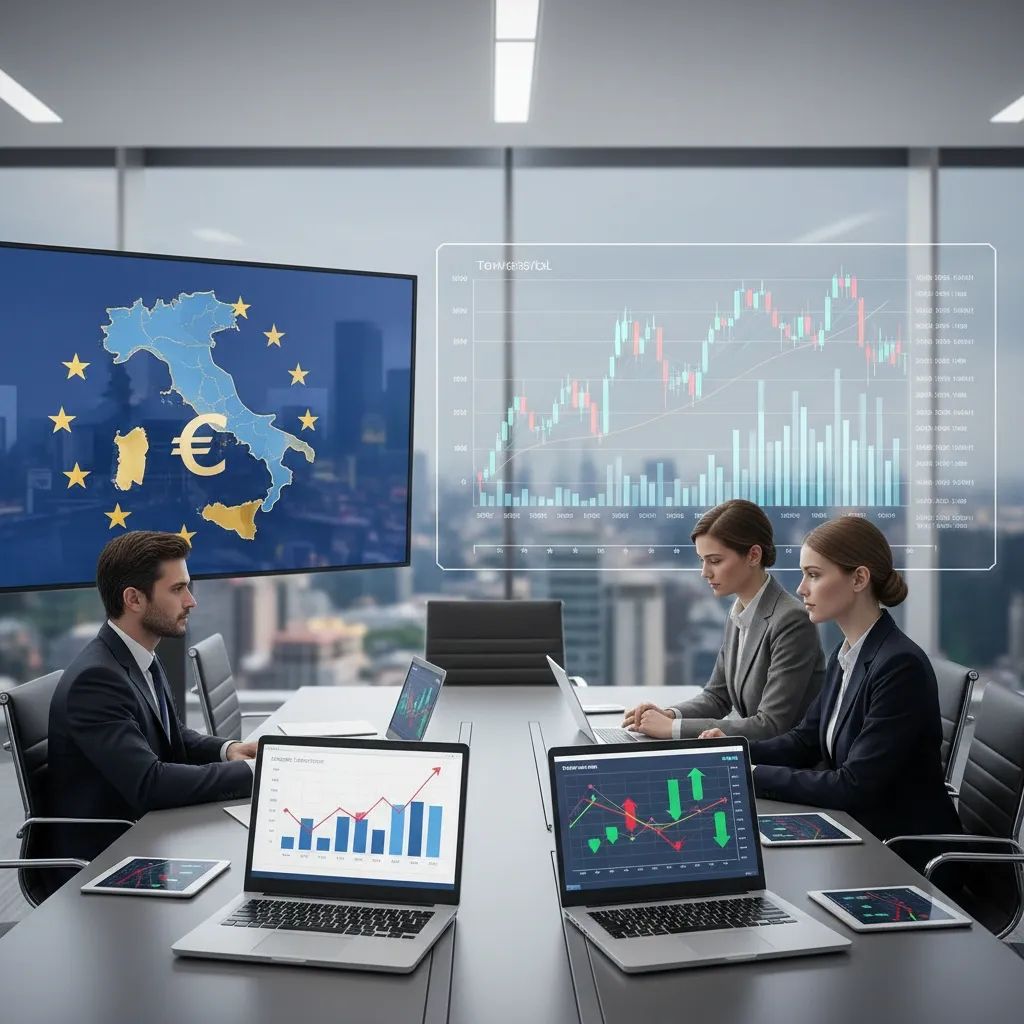
The Italy Cabinet has formally requested that Brussels extend the Stability Pact exemption—currently reserved for defense expenditures—to cover emergency energy spending, a move that would unlock additional fiscal firepower to shield households and businesses from spiraling costs. But the European Commission has signaled it is not ready to move, urging Rome instead to tap into the €95 billion in unspent EU energy funds already sitting on the table.
Why This Matters
• Fiscal flexibility at stake: Italy wants to spend beyond Stability Pact limits on energy relief without triggering deficit penalties.
• €300 billion already allocated: The Commission says EU funds for energy transition—including Next Generation EU and cohesion programs—are underutilized.
• Germany holds the key: Chancellor Friedrich Merz, representing the "frugal" bloc, has warned against excessive borrowing but maintains a strategic alliance with Prime Minister Giorgia Meloni.
• Domestic pressure mounts: Fuel excise cuts expire May 22, forcing the Italy government to decide whether to extend emergency subsidies ahead of local elections.
The Request: Energy Exemption on Par with Defense
In a letter to European Commission President Ursula von der Leyen, Prime Minister Giorgia Meloni argued that it would be "very difficult to explain to public opinion" why the bloc's new SAFE loan program—designed for military procurement—enjoys budget exemptions while energy spending does not. Meloni framed the energy crisis as a strategic priority on par with defense, citing surging costs driven by the Middle East conflict and the Strait of Hormuz blockade.
The request is not for a brand-new carve-out but rather an extension of the same conditions already granted to defense under the Stability Pact. Italy has warned that without such flexibility, its participation in the SAFE defense program could be jeopardized. Economy Minister Giancarlo Giorgetti pressed the case in bilateral talks with French and German counterparts at the G7 Finance summit in Paris, and again with Commission Vice President Valdis Dombrovskis.
Brussels Pushes Back: Use What's There First
At a daily briefing, European Commission spokespersons Paula Pinho and Balazs Ujvari declined to comment directly on Meloni's letter but made the Commission's stance clear: "At this stage, the focus is on fully exploiting already available EU financing, which is truly substantial." They cited approximately €300 billion earmarked for energy sector investments through Next Generation EU, cohesion policy funds, and the Modernisation Fund, with around €95 billion still unused.
The Commission also pointed to recent changes in state aid rules, which it says offer member states more room to maneuver without requiring a formal Stability Pact waiver. Officials emphasized that the EU "continues to closely monitor developments and is ready to act accordingly, including by using existing flexibilities," but stopped short of endorsing Italy's proposal.
The message from Brussels: spend what you have been allocated before asking for more.
What This Means for Residents and Businesses
For people living in Italy, the standoff has immediate implications. The current fuel excise cut expires May 22, and without either EU fiscal flexibility or a domestic decision to extend the subsidy, pump prices are set to rise. The Italy Cabinet is expected to convene Friday—just hours before local elections—to discuss emergency measures, with particular attention to the trucking sector, which has been hit hardest by diesel costs.
If Rome cannot secure the budget exemption it seeks, any further relief measures will have to be funded within the constraints of the Stability Pact, potentially forcing cuts elsewhere or limiting the scope of intervention. Households already facing elevated heating and electricity bills could see another round of price increases as global oil and gas markets remain tight due to geopolitical instability.
Meanwhile, businesses in energy-intensive sectors—manufacturing, logistics, steel—are awaiting clarity on whether the government can afford to maintain temporary subsidies or whether they will have to absorb the full brunt of cost increases. Industrial production across the eurozone fell 1.2% in January 2026 compared to the previous year, with energy costs cited as a primary drag.
Germany's Dilemma: Frugality vs. Alliance
Much depends on the position of Germany, the EU's largest economy and traditional leader of the fiscally conservative camp. Chancellor Friedrich Merz, who has repeatedly stressed the need to avoid excessive debt, stated: "It is important, and it is for me personally, that there is no excessive indebtedness in Europe. This indebtedness already today threatens sovereignty in some cases and hampers competitiveness."
Yet Merz also leads a government that has pursued its own energy pragmatism. His cabinet scrapped a controversial heating law that mandated 65% renewable energy for new installations, and Germany is now focusing on controllable generation capacity—gas plants that can eventually run on hydrogen—to backstop renewables as coal is phased out. Berlin has also introduced a tax-free "crisis bonus" of up to €1,000 for workers affected by energy cost increases tied to the Iran conflict, a measure in effect until June 2027.
The Italy-Germany relationship under Meloni and Merz has been described as a "close alliance," but divergences on fiscal governance remain stark. Germany's continued resistance to expanded deficit flexibility suggests that Italy faces an uphill battle, even with a sympathetic partner.
The Broader European Energy Picture
The energy crisis hitting Italy is not an isolated shock. Across the EU, member states are grappling with similar pressures. Industrial output has declined, inflation remains sticky, and the specter of stagflation—slow growth paired with rising prices—looms over economic forecasts.
Yet the EU has mobilized significant resources. The REPowerEU plan, launched in May 2022 to reduce reliance on Russian fossil fuels, channels funds into electrification, grid upgrades, and renewable capacity. By early May 2026, total Next Generation EU payments exceeded €400 billion. In April, the Commission proposed the AccelerateEU package to deepen coordination among member states, protect consumers from price spikes, and accelerate the shift to clean energy.
More than two-thirds of EU electricity now comes from low-carbon sources—48% from renewables and 23% from nuclear. Renewable generation jumped 15% in Q1 2026 compared to the same period in 2025. The EU has also diversified gas imports, cutting its dependence on Russia from 45% in 2021 to 12% in 2025, with increased shipments from the U.S. and Norway.
But the transition is costly and uneven. Countries like Italy and Germany, which rely heavily on gas for power generation, are more vulnerable to price spikes than Spain or France, which have greater nuclear or renewable capacity. The Commission estimates that meeting 2030 climate targets will require €660 billion in annual investments between 2026 and 2030—far beyond what public budgets alone can cover.
The Political Front: Opposition Attacks, Government Defends
At home, Italy's opposition parties have seized on Meloni's letter as evidence of policy failure. Democratic Party (PD) leader Elly Schlein said: "It's easy to blame Europe for the total failure of Meloni's economic policy." Five Star Movement (M5S) leader Giuseppe Conte accused the prime minister of hypocrisy, noting that she signed off on the reformed Stability Pact when it was approved unanimously by EU leaders.
From the government's perspective, the strategy is one of persistence. Carlo Fidanza, head of the Fratelli d'Italia (FdI) delegation in the European Parliament, argued: "The EU must abandon its accounting logic and urgently prepare all useful instruments to enable itself and member states to face this crisis."
Sources at the Ministry of Economy and Finance (MEF) said negotiations are ongoing, and that the government sees an opening in the Commission's reluctance to flatly reject the proposal. The key, they believe, is framing the request not as a new exemption but as an extension of an existing one—a technical distinction that could carry political weight.
What Happens Next
The decisive moments are likely to come in the next few weeks. On Friday and Saturday, the Eurogroup and informal Ecofin meetings in Cyprus will revisit the economic consequences of the energy crisis. The European Council in June could provide the final verdict on whether Italy's request gains traction or is shelved indefinitely.
In the meantime, Rome must decide how to respond domestically. The May 22 excise deadline is imminent, and any extension will require funding—either through creative accounting within existing budget constraints or by dipping into reserves. The political calendar adds urgency: local elections are scheduled for the weekend, and the government cannot afford to appear paralyzed or out of touch with household economic pain.
For now, the Commission has drawn a line: use the money already allocated before asking for more room to spend. Whether that line holds, or whether the escalating energy emergency forces a shift, will define the fiscal landscape for Italy—and much of the EU—in the months ahead.


