
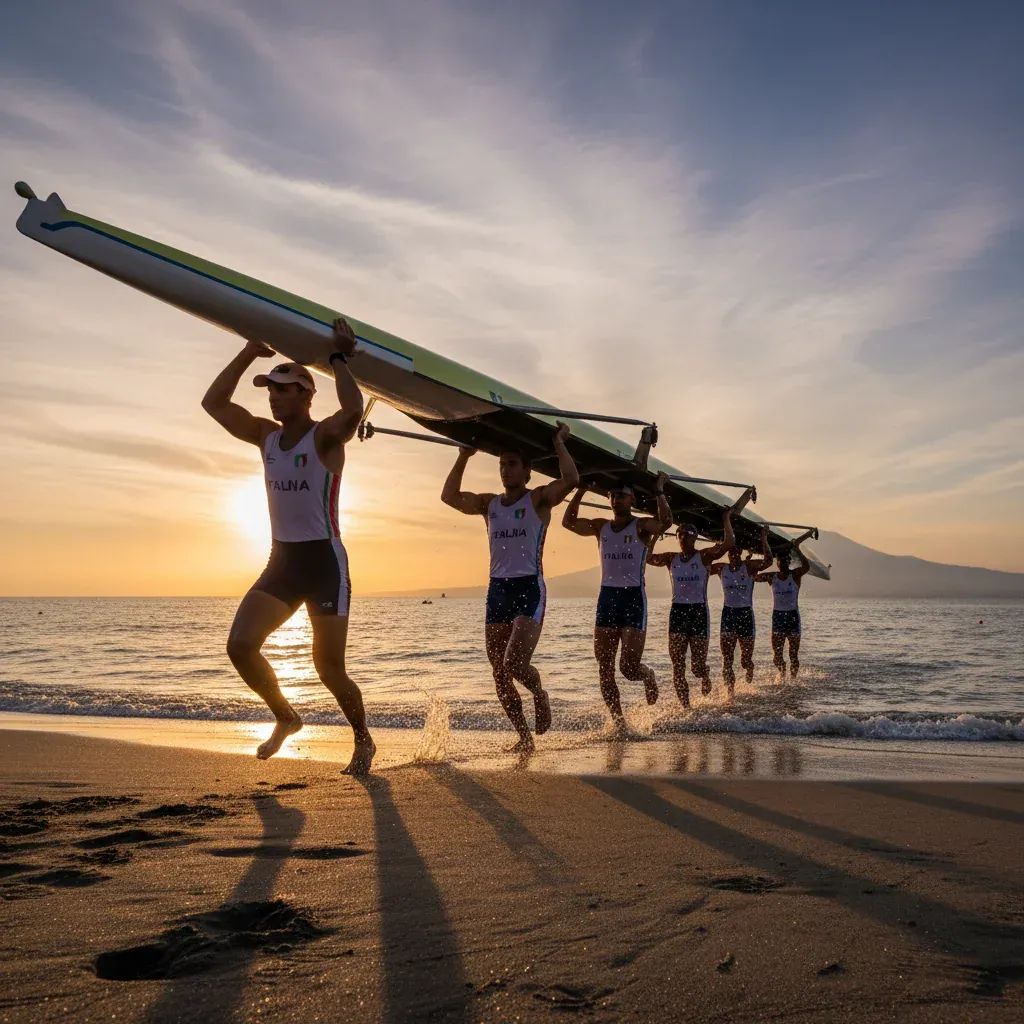
The Italian Rowing Federation's newest cohort of athletes delivered another five-medal haul at the Bacoli stop of the Trofeo Filippi Beach Sprint international circuit, cementing Italy's position as a rising force in a discipline that will debut at the Los Angeles 2028 Olympics. The regatta, held along the Naples coastline from May 8-10, drew over 600 competitors from 21 nations including the United States, China, and Saudi Arabia, and offered a critical testing ground for athletes chasing points toward the season finale's €20,000 prize pool.
Why This Matters
• Olympic pivot underway: Beach sprint rowing—a hybrid of beach running and open-water rowing—debuts at LA 2028, and Italian athletes are building momentum in a discipline where traditional flatwater pedigrees mean less.
• Youth pipeline strengthening: Three of the five medals came from the Under 19 category, signaling depth in Italy's developmental system.
• International validation: Italy now has 11 medals across the first three international stops of the Trofeo Filippi circuit, with one final round in Marina di Castagneto scheduled for June 5-7.
What Happened in Bacoli
The regatta unfolded on open water flanked by sand, where competitors sprint approximately 10-50 meters to their boats, row 250 meters through a slalom of buoys, execute a 180-degree turn, and then beach again before a final dash to a buzzer—all in under three minutes. The format rewards explosive power and adaptability, qualities the Italian squad displayed across multiple categories.
Federica Cesarini, the Tokyo 2020 Olympic gold medalist in the lightweight double sculls, claimed bronze in the senior women's single. After falling to China's Zhu in the semifinal, Cesarini regrouped to defeat Germany's Tertuente in the third-place final. The 33-year-old, who represents Fiamme Oro and Canottieri Gavirate, has now medaled at all three international stops this season—silver at Mondello in late March, gold at Fano in mid-April, and bronze here.
In the Under 19 women's single, Carlotta Savona of CS Urania took silver, losing the final to the same Chinese rower, Zhu, who had dispatched Silvia Messina in the semifinal. Messina, rowing for Peloro Rowing, bounced back to secure bronze by defeating Poland's Kusmider. On the men's side, Andrea Sciavicco Fasano, also from Peloro Rowing, claimed bronze in the U19 single after falling to the Czech Republic's Krizek in the semifinal and then overcoming Estonia's Runin in the consolation round.
The fifth medal came in the mixed double U19, where the Canottieri Palermo pairing of Munteanu and Cassina earned silver. The duo's performance underscores the club system's role in cultivating younger talent for a discipline that demands crew coordination under chaotic coastal conditions.
The Broader Circuit and Competitive Landscape
The Trofeo Filippi Beach Sprint is a four-stage international series running parallel to a domestic circuit. Points accumulated across the rounds determine seeding and prize distribution at the Marina di Castagneto finale in early June. The event's structure mirrors World Rowing's push to elevate coastal rowing, a discipline that has historically lived in the shadow of flatwater regattas but now enjoys a direct Olympic pathway.
At the Fano stop in April, Italy collected six medals, including gold from Cesarini and Federico Ceccarino in the senior mixed double, and another gold from Gabriele Loconsole in the men's single. The consistency across venues—Mondello's Sicilian shores, Fano's Adriatic sands, and Bacoli's volcanic coastline—demonstrates the athletes' ability to adapt to varied water and weather conditions, a critical skill in coastal rowing where wind and swell can shift within minutes.
Why Beach Sprint Matters for Italy
Beach sprint rowing diverges sharply from the discipline that has long anchored Italy's international reputation. Traditional flatwater races unfold over 2,000 meters (or 1,500 meters at LA 2028) on calm, controlled courses where technique and endurance dominate. Beach sprint, by contrast, compresses the action into a 600-meter gauntlet of sand, surf, and slalom, prioritizing anaerobic power and tactical agility.
The boats themselves are wider, flatter, and heavier, designed to handle waves rather than slice through still water. Athletes wear mandatory life jackets, and vessels must feature self-bailing hulls and watertight compartments—a far cry from the sleek, fragile shells of flatwater rowing.
For athletes like Cesarini, who lost her Olympic category when World Rowing eliminated lightweight events, beach sprint offers a viable second career. "Staying in traditional rowing became extremely difficult after the lightweight classes were removed," she noted in past interviews. Her pivot to coastal racing—crowned by a national beach sprint title and consistent international podiums—positions her as a frontrunner for Italy's LA 2028 roster.
Savona, still in the U19 ranks, represents the next wave. With gold at Mondello and silver at Bacoli, she is accumulating the race experience and point totals that could translate into senior-level success by the time the Olympic qualifying cycle intensifies in 2027.
What This Means for Residents and Rowing Fans
For those tracking Italian sport, the beach sprint surge offers a rare case study in how Olympic program changes can redirect talent pipelines and create opportunity in emerging disciplines. The Italian Rowing Federation (FIC) has leaned into this shift, scheduling domestic events like the Piediluco National Meeting in March and leveraging partnerships—including a deal with sports nutrition brand ProAction running through 2028—to support athletes in transition.
The upcoming calendar is dense with high-stakes competition. Italy will host the European Rowing Championships at Lake Varese from July 30 to August 2, a prestigious assignment that FIC President Davide Tizzano has described as validation of the country's organizational capacity and the lake's status as a world-class venue. Later in August, the World Rowing Championships will take place in Amsterdam, followed by the Coastal Rowing World Championships in Qingdao, China, in October.
For spectators in Naples and surrounding regions, beach sprint regattas offer a spectator-friendly alternative to the often-distant flatwater courses. The compressed race format, visible start and finish on the beach, and unpredictable conditions make for compelling viewing, a factor World Rowing has explicitly cited in pushing the discipline toward Olympic inclusion.
The Road to Marina di Castagneto
With one round remaining, Italy's athletes face a final opportunity to refine tactics, secure ranking points, and stake claims to roster spots for the summer's major championships. The Marina di Castagneto event will likely draw an even larger international field, as the cumulative point standings and prize purse create heightened competitive pressure.
Cesarini's consistent medaling positions her as the senior flag-bearer, while the youth contingent—Savona, Messina, Sciavicco Fasano, and the Canottieri Palermo duo—has demonstrated the depth that national federations prize when building Olympic programs. The challenge now is translating circuit success into podium finishes at the Coastal Rowing Worlds and, eventually, at the LA 2028 trials.
For a country with deep rowing tradition but limited recent Olympic medals in the sport, beach sprint represents both renewal and opportunity—a chance to compete on equal footing in a discipline where established powers hold no historical advantage.


