
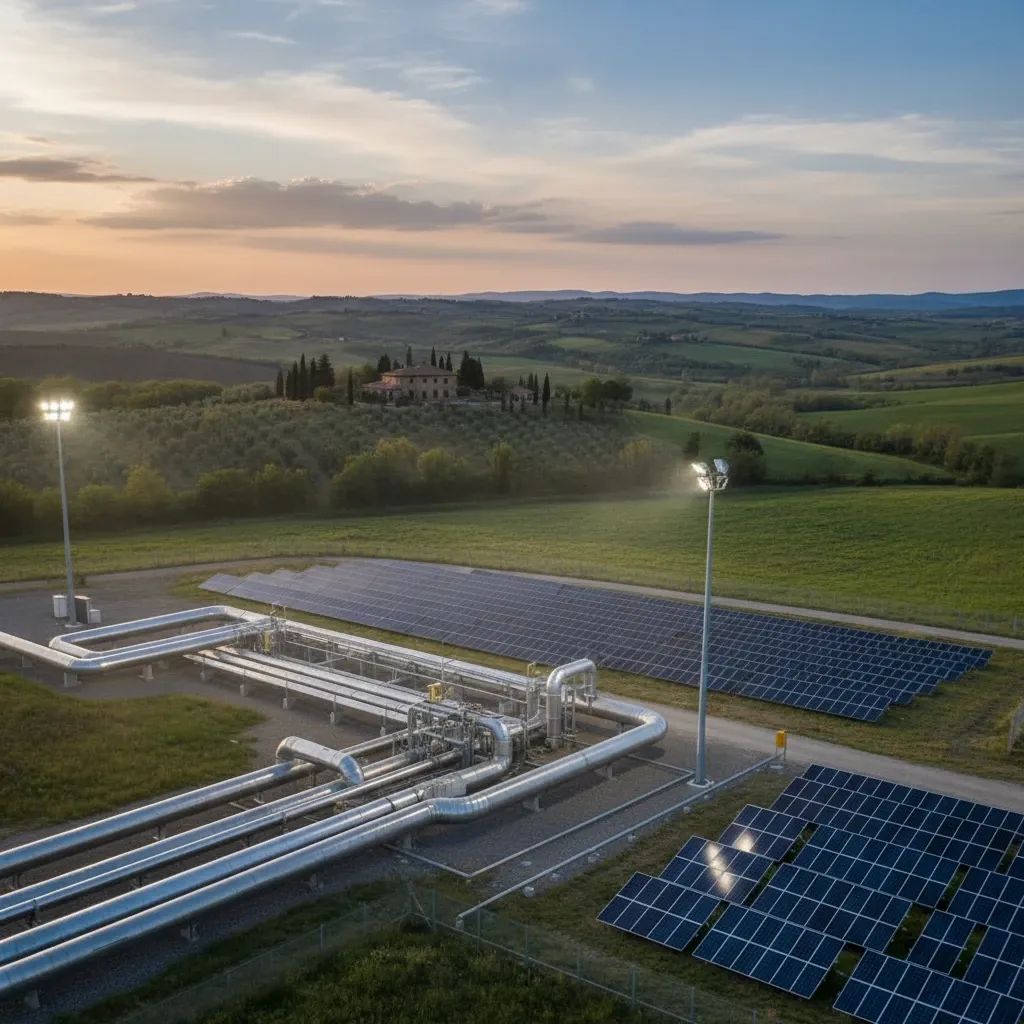
Snam Spa, the Italy-based natural gas infrastructure operator, has confirmed its full-year financial targets despite a sharp decline in quarterly net profit, emphasizing that accelerated investments in energy security infrastructure are reshaping its balance sheet as the country pushes to become the Mediterranean's dominant gas hub.
Why This Matters
• €991M in first-quarter investments — nearly triple the year-ago figure — signals a historic expansion of gas storage, regasification, and hydrogen-ready pipelines across Italy.
• 90% storage target by October 2026 is part of a national strategy to insulate Italy from geopolitical supply shocks and position it as a net exporter to Central Europe.
• Regulated cash flows remain intact, providing predictable returns for investors even as accounting profit dips due to non-cash charges from faster asset depreciation.
The company's CEO, Agostino Scornajenchi, described the environment as "highly volatile" yet underscored that operational performance and regulatory visibility remain "solid" — the company maintains it can sustain returns despite transition pressures affecting other European infrastructure operators.
Record Investment Cycle Drives Down Accounting Profit
Snam reported a headline net profit of €292M for the first quarter, down 40% from €491M in the same period of 2024. The decline is almost entirely attributable to higher depreciation charges stemming from the rapid buildout of new infrastructure assets and the consolidation of OLT Offshore LNG Toscana, the offshore regasification terminal near Livorno that Snam now controls entirely. The terminal alone added €544M to the quarter's investment total.
Adjusted net income, which strips out non-recurring items and accounting effects that create volatility in headline figures, came in at €375M — reflecting the underlying cash generation capacity of Snam's regulated asset base, which includes over 38,000 km of high-pressure gas pipelines, six major storage fields, and three LNG terminals.
Revenue climbed 3% to €999M, while adjusted EBITDA rose 1.8% to €775M. Excluding one-time accounting distortions, EBITDA growth accelerates to 9.3%, driven by the expansion of regulated infrastructure and increased fees from market solutions such as biomethane connection services and dual-fuel compression stations. The Italy energy regulator sets tariffs on a multi-year basis using a Regulated Asset Base (RAB) model, which guarantees a predictable return on capital deployed — a crucial feature for a company investing at this scale.
For Italian households and businesses, the RAB mechanism means that infrastructure costs Snam invests are passed through to consumers via regulated gas tariffs. This provides budget predictability for utilities and end-users, as tariff increases reflect actual infrastructure expansion and maintenance rather than market speculation.
Net debt reached €18.5B at the end of March, up from €17.5B at year-end 2025, reflecting the capital outlay, a dividend payment, and the refinancing of a convertible bond tied to Italgas, Snam's former gas distribution subsidiary.
What This Means for Italian Energy Security
Italy's energy independence hinges on two pillars: diversified import routes and robust storage capacity. Snam is the primary operator behind both.
Since the collapse of Russian gas imports — which fell from over 45% of total supply in 2021 to roughly 5% today — Italy has pivoted toward multiple suppliers and liquefied natural gas sources. The country now ranks third in Europe for regasification capacity, and Snam's network is the backbone that stitches these diverse sources into a unified system.
By the end of April, Italy's storage fields had reached 50% capacity — the highest level in the European Union at this point in the calendar year. Snam aims to secure at least 90% allocation by the final auction rounds ahead of the 2026–2027 winter season, a threshold that exceeds the EU's mandatory 80% requirement and reflects the Italian government's strategy to maintain a buffer against potential disruptions from conflicts in the Middle East or sanctions escalation.
The company is also extending gas pipeline infrastructure to Sardinia, the only Italian region without direct access to the national network, and completing the Linea Adriatica, a north-south artery designed to move incremental volumes from new LNG terminals on the Adriatic coast to landlocked markets in Central and Eastern Europe. This dual role — serving domestic demand and acting as a transit hub for neighbors like Austria and Slovakia — is expected to generate export flows of up to 7 billion cubic meters annually by 2030, a major revenue line that did not exist five years ago.
Hydrogen and Carbon Capture Take Center Stage
While natural gas remains Snam's core business, the 2026–2030 strategic plan allocates €14B in total investment over five years, with 2026 capex targeted at €2.8B. Substantial allocations are directed toward hydrogen-ready infrastructure and carbon capture and storage (CCS). Roughly 60% of the existing pipeline network will be retrofitted to carry hydrogen by the end of the decade, with nearly 1,000 km certified for hydrogen transport by the close of 2026.
The €800M Ravenna CCS project, developed jointly with Eni, aims to create a national CO₂ transport and sequestration network with capacity exceeding 500 million tonnes. Offshore depleted gas fields in the Adriatic will serve as storage reservoirs, a model that leverages existing subsurface geology and reduces the need for greenfield infrastructure.
Biomethane development is another growth vector. Snam's subsidiary Bioenerys is expanding connection capacity for agricultural and waste-derived biogas producers, targeting 70 MW of capacity by 2027. These investments align with the European Union's "Green Gas" directive and position Italy as a leader in renewable gas injection, a technology that can use the same pipelines and storage facilities as conventional natural gas.
Regulatory Tailwinds and Investor Implications
Snam operates under a highly regulated financial model, which insulates it from commodity price swings but ties returns directly to infrastructure investment and asset utilization. The Italy energy regulator updates the company's RAB — the capital base on which tariffs are calculated — annually, and the 2026 target stands at €28.8B, up from €27.8B in 2025.
This mechanism offers equity and bond investors a degree of predictability rare in the energy sector. Even as accounting profit fluctuates due to non-cash charges, the regulated tariff structure ensures steady cash flow. The company maintained its full-year guidance: €3.1B in EBITDA, €1.45B in net income, and €2.8B in capital expenditure for 2026, with net debt expected to stabilize around €19B by year-end.
For fixed-income investors, Snam's bonds remain a core holding in Italian corporate credit portfolios, with the company frequently issuing green bonds tied to specific decarbonization projects. The firm has committed to carbon neutrality by 2040 and net zero emissions by 2050, targets that support continued access to sustainable finance markets.
Equity holders, meanwhile, are betting on a dual thesis: stable dividend yield from the regulated gas business (supported by Italy's ongoing gas demand, which is expected to remain flat through 2035) plus optionality on hydrogen and CCS revenues if the energy transition accelerates faster than consensus forecasts.
Geopolitical Volatility and Market Context
Scornajenchi's reference to a "highly volatile global context" reflects genuine structural challenges. European gas markets remain exposed to cascading risks: the war in Ukraine, instability in the Middle East (including periodic closures of the Strait of Hormuz, which accounts for a significant share of global LNG exports), and divergent regulatory signals from Brussels regarding the long-term role of natural gas.
Market analysts note that volatility itself — rather than the absolute price level — has become a structural feature of the energy market, complicating capital allocation decisions for utilities and infrastructure operators. This underscores why storage capacity and supply diversification are strategic priorities.
Snam's strategy is to hedge this uncertainty through diversification: by controlling multiple entry points for gas (LNG terminals, cross-border pipelines), by investing in flexibility (storage, dual-fuel compressors), and by building optionality into future revenue streams (hydrogen, CCS, biomethane). The company's pivot from "energy transition" to "energy integration" reflects a recognition that the path to decarbonization will not be linear and that natural gas infrastructure will play a balancing role for decades, particularly as intermittent renewables like solar and wind comprise a larger share of the electricity mix.
The Italian government's push to consolidate the country's status as a Mediterranean energy hub dovetails with Snam's infrastructure investments. Increased export capacity to Central Europe not only diversifies revenue but also strengthens Italy's geopolitical leverage within the EU, transforming the country from a net importer dependent on external suppliers into a transit node with strategic influence over regional energy flows.
Outlook and Strategic Risks
Snam's 2026 guidance implies that the first-quarter results are tracking in line with management expectations, but several variables could alter the trajectory. Slower-than-expected adoption of hydrogen, regulatory changes that cap returns on new investments, or a faster-than-anticipated phase-out of natural gas could all pressure long-term earnings. Conversely, accelerated European decarbonization mandates, supply shocks that elevate the value of storage and flexibility, or successful monetization of CCS capacity could provide upside.
The company's ability to convert legacy gas infrastructure into hydrogen-compatible assets at scale remains unproven, and the economics of CCS are still contingent on carbon pricing and industrial demand that may or may not materialize. Yet the regulated nature of Snam's core business provides a floor beneath these uncertainties, ensuring that even if the energy transition unfolds more slowly than policymakers hope, the company's pipelines, storage fields, and terminals will continue generating returns as long as Italy — and Europe — rely on molecules, not just electrons, to power their economies.


