
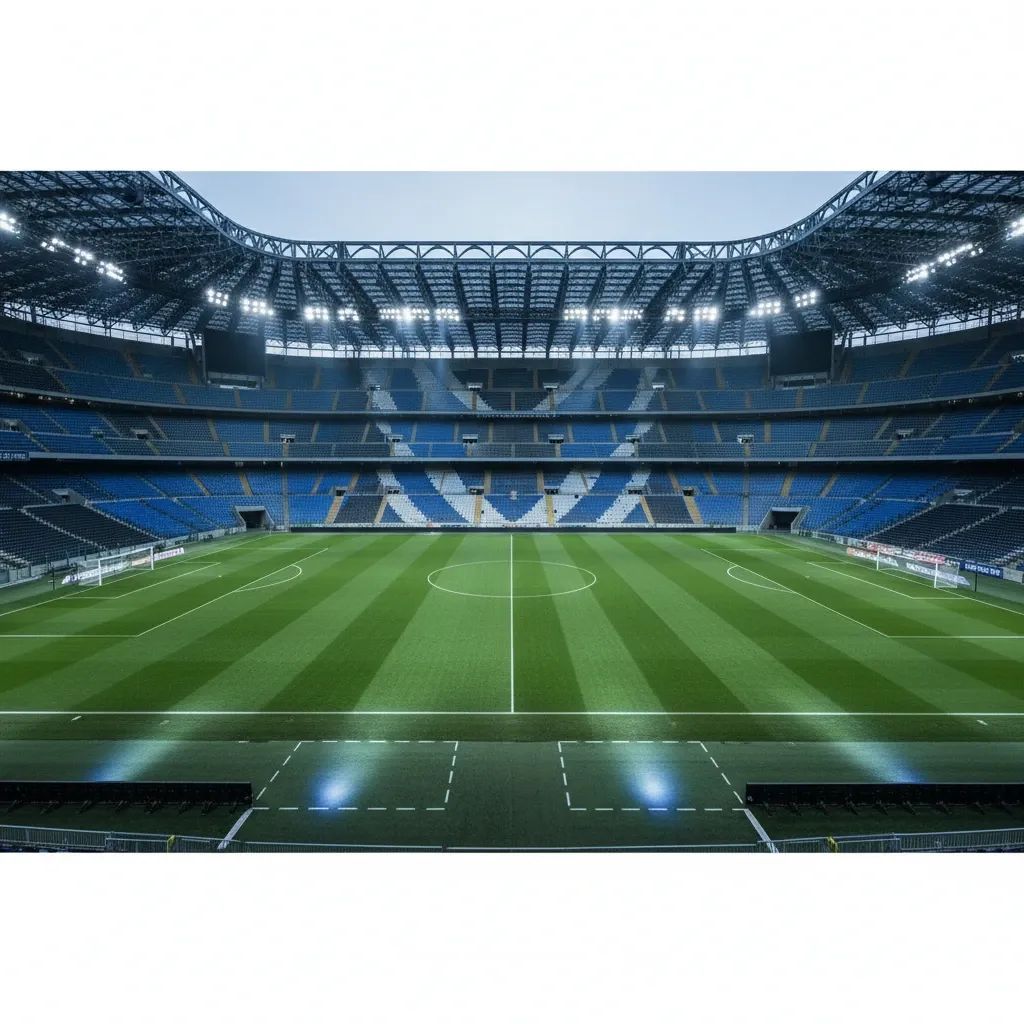
Inter Milan clinches its 21st Scudetto with a commanding display at San Siro, positioning the club ahead of crosstown rival Milan while narrowing the historic gap with Italy's most decorated institution, Juventus. The victory over Parma—secured via goals from Marcus Thuram and Henrikh Mkhitaryan—arrived three weeks before the formal conclusion of the season, a scheduling advantage that afforded management time to plan an open-top bus celebration through Milan's principal thoroughfares and allow the squad to maintain momentum toward a potential secondary trophy.
Why This Matters
• Transportation impact: The May 16-17 trophy procession covering eight kilometers from San Siro through central Milan will create sustained congestion on Viale Monumental and surrounding arteries; Milan transit authorities have increased capacity but delays remain probable for commuters.
• Financial settlement: Players and technical staff will receive approximately €6M in performance bonuses following championship confirmation, with additional payments contingent on Coppa Italia success against Lazio on May 13.
• Double-trophy scenario: Victory in the Rome final would create a "double" celebration potentially exceeding the 2024 record crowd, with the subsequent May 16-17 parade functioning as a dual achievement showcase.
• City rivalry recalibration: This title moves Inter to within two Scudetti of AC Milan's 19-title total, establishing a competitive hierarchy that will dominate discourse through the summer transfer window.
The Architecture of Dominance
When the Italian Football Federation (FIGC) recognized Inter as mathematically confirmed champions on May 3, the club had accumulated 82 points across 35 matches—26 victories, 4 draws, and 5 defeats. That record reveals a team executing consistently: the forward unit delivered 82 goals while conceding just 31, a difference of 51 that exceeded any rival's goal margin. Lautaro Martínez functioned as the primary attacking catalyst, contributing 16 league goals, while the defensive unit absorbed strategic pressures without significant gaps that characterize closer title races.
The mathematical certainty—secured with three rounds remaining—derived not from a singular brilliant performance but from consistency maintained across tactical changes and personnel adjustments. Second-place Napoli accumulated 70 points, leaving Inter with an irreducible 12-point cushion when only nine points could be garnered from remaining fixtures. That arithmetic eliminated contention; what remained was the ceremonial confirmation.
The Parma encounter itself proved instructive. Inter required merely a draw to secure the crown mathematically. Instead, the squad pursued decisiveness, opening the scoring through Thuram's first-half recovery play that concluded in a goal at the 45-minute mark (technically in added time). The French forward's positioning and timing embodied the rotational principles Chivu had embedded throughout the squad—the notion that quality players operating in carefully managed intervals produced more sustainable excellence than traditional starter-rotation hierarchies. Mkhitaryan's 80th-minute finish followed similar mechanics: a midfielder contributing offensively when called upon, rather than functioning as a purely defensive bulwark.
The Chivu Factor: From Youth Development to Title Glory
The architect commanding this achievement arrived through an unconventional pathway. Cristian Chivu assumed the Inter role on June 9, 2025, following the departure of predecessor Simone Inzaghi, whose tenure had delivered competitive returns but operated within competitive uncertainty that reflected broader ownership transitions and management instability. The Romanian's appointment raised skepticism across Italian football circles; his senior credentials consisted primarily of a six-month interlude with Parma, where he navigated the squad toward a 16th-place finish and Serie A survival in early 2025.
Yet institutional continuity—a principle often sacrificed by Italian clubs pursuing external marquee coaching names—shaped the appointment philosophy. Chivu had operated within Inter's developmental ecosystem from 2021 through 2025, progressively elevating from youth categories through the Primavera coaching role, where he captured the 2021-22 Scudetto del Campionato Primavera 1. That trajectory revealed a tactical philosophy rooted in depth cultivation and rotational efficiency rather than reliance on established star power. When promoted to the first team, he transplanted those principles: younger players received competitive minutes in low-consequence matches, building match experience while preserving elite veterans for consequential fixtures.
The historical record now documents Chivu as only the second manager in Inter's institutional history to claim the Scudetto both as a player and as a head coach, following Armando Castellazzi, who achieved this distinction in the 1950s. As a defender from 2007 through 2014, Chivu contributed to Inter's legendary 2010 Treble campaign, that apex moment when the club captured the Coppa Italia, Serie A, and Champions League within a single calendar year. His return to the organization—initially in coaching capacities, culminating in the first-team elevation—represented an institutional faith in continuity. That faith now carries validation through achieved results.
The achievement is worth emphasizing: Fabio Capello remains the singular Inter manager to capture the Scudetto in his debut season at the club's helm, accomplishing the feat in 1991-92. Chivu's inaugural full campaign achievement places him in rare company, suggesting Inter may have engineered a sustainable competitive model rather than relying on perpetual external coaching recruitment.
The Physical Theater: San Siro to Duomo
The championship confirmation unfolded across two spatial registers—the athletic venue and the urban plaza. At San Siro, the concluding whistle released celebration as players embraced beneath confetti descending across the pitch. The Curva Nord—Inter's principal supporter formation occupying the stadium's northern quadrant—erupted in the chant that has defined the club's identity: "Siamo noi, siamo noi, i campioni dell'Italia siamo noi." That anthem, translated as "We are they, we are they, the champions of Italy are us," carries resonance within Italian football culture, representing not merely victory but collective identity and tribal belonging.
Club president Giuseppe Marotta and the entire administrative structure descended from executive boxes to the playing surface, a gesture embedding institutional legitimacy into the achievement. That symbolic presence—the ownership, management, and technical leadership arrayed alongside the athletes—communicated that the championship represented organizational success rather than isolated player performance.
Coach Chivu deliberately positioned himself beneath the Curva Nord, gesturing toward his squad rather than accepting applause from the stands. The gesture communicated a coaching philosophy that subordinates personality to collective execution. Italian football culture historically elevates managerial figures as authoritative strategists; Chivu's action suggested a different hierarchy, one where players receive credit and coach assumes a facilitating role.
By evening, approximately 3,000 supporters had migrated to Piazza del Duomo, transforming Milan's most iconic civic plaza into an unplanned celebratory venue. Colored smoke canisters released black and blue vapor, oversized flags and banners depicted the Nerazzurri emblem, and pyrotechnic devices created sound and light spectacle. The historic piazza accumulated the physical detritus of prolonged celebration—spent cardboard tubes, torn banner fragments, and shattered glass vessels.
Around 2 AM, multiple Inter players materialized in the piazza, triggering immediate excitement through the assembled crowd. Marcus Thuram, Federico Dimarco, and Pio Esposito appeared first, followed shortly by Lautaro Martínez and Nicolò Barella. Armed with a megaphone, the players assumed informal leadership roles typically reserved for supporter organizations, launching organized chants that thousands of voices echoed back. The improvised concert continued for roughly 30 minutes before the crowd began systematic dispersal, leaving city sanitation services with logistical challenges related to cleanup and debris management.
The spontaneous convergence and player participation reflected the cultural weight Inter supporters attach to championship moments—not as abstract institutional achievements but as collective identity validation, moments when the boundaries between athlete and supporter dissolve into undifferentiated celebration.
Reordering the Competitive Hierarchy
The 21st Scudetto arrival carries strategic significance within Italian football's historical architecture. Juventus remains the apex institution with 36 domestic titles, accumulated across more than a century of dominance interrupted only recently by competitive decline. AC Milan, Inter's crosstown rival, holds 19 Scudetti—a figure that now reads not as competitive parity but as definitive subordination. The two-title gap between Inter (now 21) and Milan (19) registers as a symbolic breach, one that transforms centuries of city rivalry into an articulated competitive hierarchy.
That psychological dimension crystallized most acutely when Inter captured its 20th title in 2024, introducing the "Seconda Stella" (second star) emblem into the club's visual identity. The achievement represented mathematical overtaking of the city rival, a milestone that had gestated across decades of rebuilding and competitive frustration. This 2026 victory was secured through internally groomed coaching talent rather than external recruitment, through rotational squad management rather than superstar accumulation, through systematic efficiency rather than tactical innovation. The sustainability question—can Chivu's model persist across multiple seasons?—now dominates competitive planning discourse within the club's administrative structures.
The distance to Juventus (now 15 titles behind Inter) remains substantial, but the trajectory suggests potential convergence within a five-to-seven-year window should Inter maintain current competitive standards. For Milan's supporters, the competitive recalibration represents a generational shift; for Inter, it validates an institutional philosophy that had been contested throughout ownership and management transitions.
Practical Consequences for Milan's Commuters and Residents
The championship carries immediate operational implications for inhabitants and workers throughout Milan:
Street-level logistics demand planning consideration for residents near San Siro or Piazza Duomo during the May 16-17 trophy procession. The route covers approximately eight kilometers, consuming roughly seven hours based on 2024 precedent. Public transit agencies have announced supplementary capacity, but delays remain probable, and vehicle operators should anticipate extended travel times through central zones.
Commercial sectors surrounding San Siro and the Duomo anticipate inventory constraints and elevated pricing during the celebration window. Inter-branded merchandise typically experiences price inflation during the 7-10 day period following championship confirmation; consumers seeking commemorative goods should expect limited selection and premium pricing relative to standard retail rates.
Municipal enforcement has intensified following the May 3-4 piazza gathering. City authorities responded to unauthorized pyrotechnics and public order violations with enhanced police coordination in celebration zones. Fines for illegal smoke devices and disorderly conduct will be applied with greater consistency through the celebration week, reflecting municipal prioritization of civic property protection.
The trophy presentation occurs during Inter's final home fixture against Hellas Verona on May 16-17. Ticketing is exhausted across all categories, but national broadcasts through RAI and commercial networks will offer live coverage accessible to supporters unable to secure stadium attendance.
The Double Dream Scenario
The Coppa Italia final against Lazio on May 13 introduces a complicating variable into celebration planning and financial structures. Should Inter secure victory in Rome, the May 16-17 parade will commemorate a "double"—the simultaneous capture of Italy's two primary domestic trophies. That scenario would mark the second domestic double in Inter's institutional history; the first occurred in 1964-65. A double achievement would likely generate attendance exceeding the 2024 parade benchmarks, potentially drawing crowds that stress municipal infrastructure and public safety coordination.
The financial implications extend beyond morale considerations. Contractual bonus structures allocate approximately €6M in distributed payments contingent on championship confirmation; additional tranches flow to players and technical staff pending Coppa Italia success. For an organization that weathered years of financial constraint and ownership turbulence, this convergence of sporting achievement and revenue generation reinforces operational stability and competitive investment capacity.
Victory in Rome would position Inter as a potential threat across European club competitions during the 2026-27 season, a prospect that amplifies the organizational resources allocated toward squad maintenance and strategic reinforcement during the summer transfer window.
Institutional Continuity as Competitive Foundation
Inter's championship arrives during a moment when Italian football remains fragmented across competitive centers. Unlike historical eras when Juventus maintained dominance through tactical innovation or Milan asserted supremacy through personnel accumulation, Inter's current model emphasizes institutional coherence and long-term planning.
Giuseppe Marotta's presidency, Chivu's tactical framework, and deliberate squad continuity (characterized by strategic additions rather than wholesale roster reconstruction) constitute an institutional architecture designed for multi-year sustainability rather than one-season heroics. The contrast with managerial rotation patterns that historically defined Italian clubs—particularly inter-city rivals who have cycled through five or more head coaches during equivalent time spans—suggests Inter has engineered a different operational model.
The summer transfer market will test whether Inter can preserve squad depth and competitive quality without substantial capital expenditure. Rival reconstruction efforts, particularly Napoli's anticipated reinforcement following a 70-point season, will intensify competition for available talent. Yet Inter currently occupies a rare position: defending champion with accumulated momentum, proven internal development pathways, and managerial continuity extending through June 2027. That organizational stability remains uncommon within contemporary Italian football management structures, positioning the club advantageously for sustained competitive presence across multiple seasons.


