
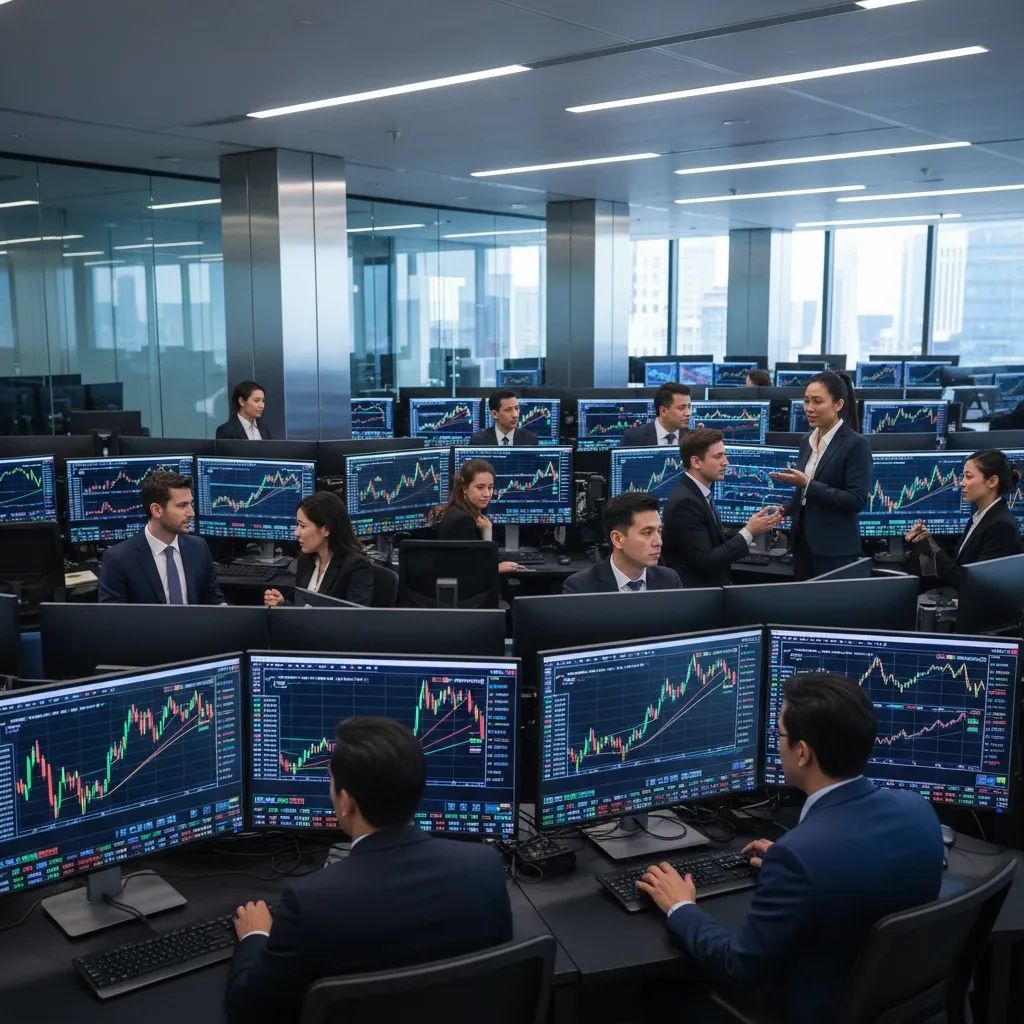
Italian stocks gained ground Friday as investors weighed improving prospects for a Middle East ceasefire against critical US inflation data due this afternoon—data that could reshape European Central Bank policy and borrowing costs across the eurozone.
Why This Matters
For people living in Italy, today's market movements have direct implications:
• Italian government bonds remain stable with the BTP-Bund spread at 78 basis points, while the 10-year Italian yield sits at 3.80%.
• Energy exposure across European portfolios is under pressure, with natural gas futures dropping 2.5% to €45.01 per megawatt-hour in Amsterdam.
• US inflation figures (due this afternoon) could reshape expectations for Federal Reserve and European Central Bank rate decisions, directly affecting borrowing costs and eurozone growth prospects.
US Inflation Data Could Shift European Outlook
Market participants across Europe are closely monitoring the release of US March inflation data, scheduled for this afternoon. Consensus estimates point to a year-over-year Consumer Price Index (CPI) increase of 3.4%, with core inflation expected at 3.7%. However, preliminary models from the Federal Reserve Bank of Cleveland suggest actual figures could come in higher, at 3.56% annually and 0.45% month-over-month.
A hotter-than-expected US inflation print would likely strengthen the dollar against the euro—currently trading at $1.1711—and could prompt the Federal Reserve to delay anticipated rate cuts. This scenario would ripple through European markets by tightening global financial conditions, potentially weighing on export-dependent economies like Italy's and reinforcing the ECB's hawkish stance.
Conversely, softer inflation figures could reignite risk appetite and support further gains in European equities, particularly in rate-sensitive sectors like real estate and consumer discretionary goods. The interplay between US monetary policy and European market dynamics has intensified in 2026, as the conflict in Iran has synchronized energy-driven inflation pressures across both continents.
Markets Climb Amid Iran Ceasefire Talks
The STOXX 600 index, Europe's benchmark equity gauge, advanced 0.5% during Friday's session, marking a positive weekly close. Milan's FTSE MIB outperformed with a 0.8% gain, mirroring strength in Frankfurt and Paris, while Madrid's IBEX 35 added 0.2%. London's FTSE 100 lagged slightly but remained in positive territory with a 0.3% uptick.
The rally comes as US Vice President JD Vance is leading American negotiators in indirect talks with Iranian officials in Islamabad, Pakistan, focusing on the Strait of Hormuz reopening—critical because the waterway handles roughly one-fifth of global oil trade. The two-week conditional ceasefire, brokered on April 8, hinges on reopening this chokepoint, which Tehran currently controls and has linked to broader regional demands, including the cessation of Israeli operations in Lebanon.
The talks are expected to address Iran's 10-point proposal, which includes sanctions relief, nuclear enrichment rights, and compensation for war damages, against Washington's 15-point counter-offer focused on nuclear and missile limitations.
Sector Performance Reflects Energy and Geopolitical Shifts
Luxury goods led sectoral gains, surging 1.4%, while automotive stocks climbed 0.8% and technology shares added 0.8%, buoyed by strong quarterly results from Taiwan Semiconductor Manufacturing Company (TSMC) and upbeat guidance for the year. The chipmaker's performance has reinforced confidence in Europe's tech-heavy indices, particularly in markets with significant exposure to semiconductor supply chains.
Conversely, utility stocks slipped 0.1% as natural gas prices retreated on the prospect of easing supply constraints. Energy equities fell 0.7% despite crude oil prices hovering just below the $100-per-barrel threshold. West Texas Intermediate (WTI) rose 1% to $98.85 per barrel, while Brent crude gained 0.9% to $96.79. The disconnect between rising oil prices and falling energy stocks reflects market skepticism about the sustainability of current crude levels should the Iran ceasefire hold and Strait of Hormuz traffic normalize.
Italian Bonds Hold Steady as Yields Edge Higher
Italian government bonds exhibited resilience, with the spread between 10-year BTPs and German Bunds holding at 78 basis points. The Italian 10-year yield ticked up to 3.80%, while the German equivalent reached 3.02%, reflecting slightly higher perceived risk in eurozone government debt.
Bond traders are weighing two opposing forces: relief over reduced geopolitical risk premium versus concerns that elevated energy costs could force the European Central Bank to maintain tighter monetary policy longer than previously anticipated. Markets have scaled back expectations for ECB rate cuts in 2026, now pricing in approximately two hikes rather than cuts, as inflation pressures resurface.
Germany's March inflation accelerated to 2.7%, the highest reading since January 2024, while the eurozone's private sector activity showed signs of slowing, with the S&P Global PMI registering the weakest expansion in nine months at the end of the first quarter.
What This Means for Italian Investors and Households
The current market environment presents a mixed picture for residents and investors in Italy. On one hand, the stabilization of Italian sovereign debt costs—evidenced by the contained BTP-Bund spread—reduces pressure on government borrowing and helps preserve fiscal room for potential stimulus measures. This is particularly relevant as Italy's GDP growth forecasts for 2026 range between 1.8% and 2.2%, requiring sustained investment to meet those targets.
On the other hand, the partial reversal of natural gas price declines and persistent crude oil prices near $100 per barrel translate into higher input costs for Italian manufacturers and elevated energy bills for households. While gas futures have dropped to €45 per megawatt-hour—down from peaks above €60 in March during the height of Iran tensions—prices remain well above historical averages, squeezing margins for energy-intensive industries like ceramics, steel, and chemicals concentrated in northern Italy. For Italian households, current gas prices translate to energy bills roughly 15-20% above pre-crisis levels from 2024, though significantly lower than the March peak during the height of tensions.
For savers and pensioners with exposure to fixed-income instruments, the uptick in Italian yields offers marginally better returns on new bond purchases. However, the ECB's current 2% inflation target means any bond yielding below 3.80% in nominal terms barely preserves purchasing power once inflation is factored in. Real returns remain challenged by inflation running above the ECB's 2% target. Equity investors with diversified portfolios stand to benefit from the technology and luxury sectors' outperformance, which are well-represented in Italian indices through names in fashion, design, and semiconductor equipment.
Currency and Commodity Markets Reflect Cautious Sentiment
The euro appreciated to $1.1711 against the dollar, gaining ground as traders assessed the relative trajectories of Fed and ECB policy. A stronger euro provides some relief for Italian importers of dollar-denominated commodities, including crude oil and industrial metals, but challenges exporters of manufactured goods competing in global markets.
Gold edged higher by 0.2% to $4,753 per ounce, reflecting persistent safe-haven demand despite the improved geopolitical backdrop. The precious metal's resilience underscores lingering investor concern about the durability of the US-Iran ceasefire and broader geopolitical risks in the Middle East, where Israeli operations in Lebanon continue to threaten the fragile truce.
Oil markets remain the primary barometer of geopolitical risk. While crude prices have retreated from March peaks above $119 per barrel, the current levels near $100 reflect continued supply uncertainty tied to the Strait of Hormuz blockage. President Donald Trump's accusation that Iran has not honored its commitment to reopen the waterway—stating emphatically, "This is not the deal we have!"—has injected fresh volatility into energy markets and raised doubts about the weekend talks yielding a durable resolution.
Outlook Remains Clouded by Multiple Uncertainties
Analysts caution that volatility is likely to persist in European markets through the second quarter of 2026, with several critical variables still unresolved. The outcome of the Islamabad negotiations will determine whether the Iran ceasefire evolves into a comprehensive de-escalation or collapses under the weight of competing demands over the Strait of Hormuz, Lebanon, and nuclear enrichment rights.
On the economic front, the trajectory of US inflation and subsequent Federal Reserve policy decisions will shape global liquidity conditions and dollar strength, both of which directly influence eurozone asset prices and credit availability. Meanwhile, the ECB faces its own balancing act: supporting still-fragile growth across southern Europe while preventing energy-driven inflation from becoming entrenched in wage expectations and core price indices.
For Italian market participants, the current environment demands careful portfolio positioning, with an emphasis on sectors less exposed to energy input costs and greater attention to sovereign debt dynamics as the government navigates fiscal constraints amid uncertain growth. The luxury and technology sectors' recent strength offers some insulation, but broader market stability will ultimately depend on factors largely beyond Italy's borders—from Middle Eastern diplomacy to Federal Reserve boardrooms in Washington.


