
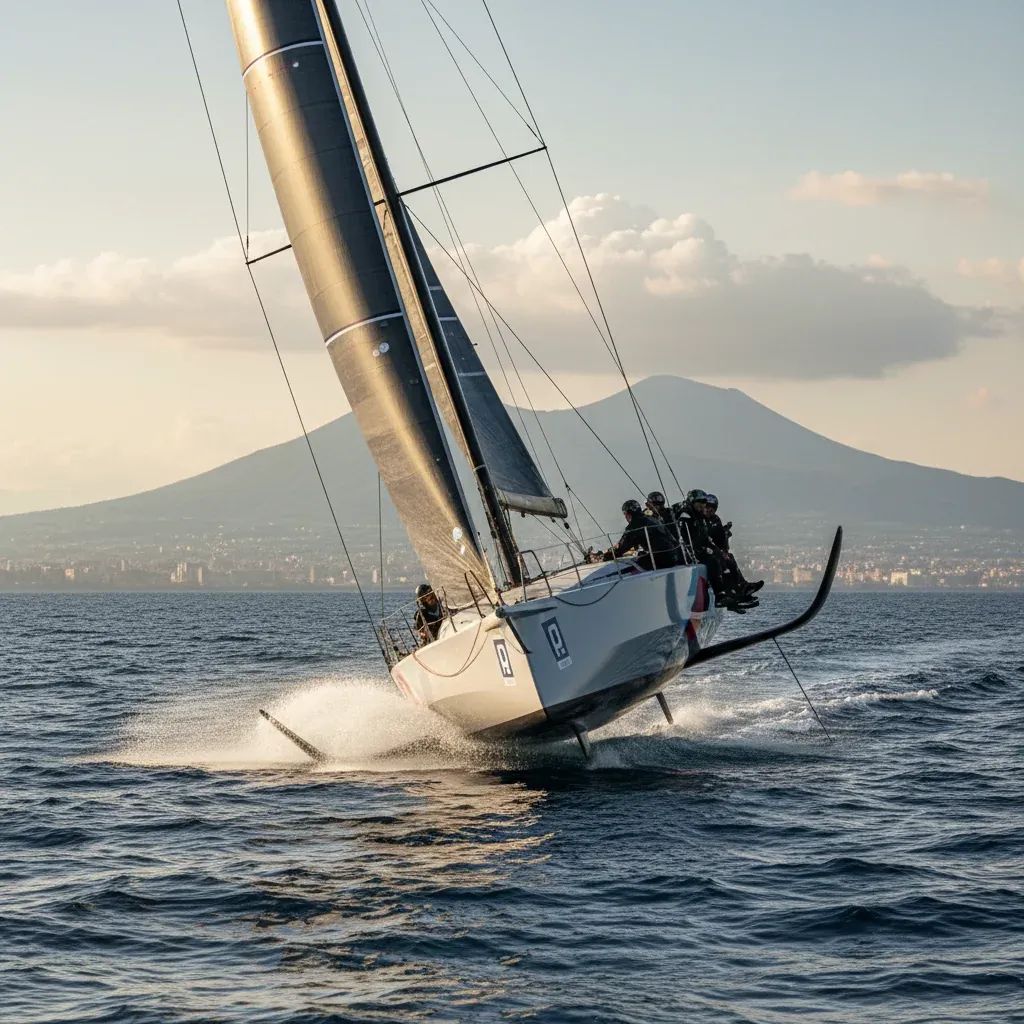
Italy Sports Minister Andrea Abodi has elevated Luna Rossa to the status of a national team, declaring that the sailing syndicate represents the country in the 38th America's Cup cycle with the same spirit and pride as the national football or Olympic squads. The statement comes after Luna Rossa's Principal Team, skippered by three-time America's Cup winner Peter Burling, secured victory at the first Louis Vuitton Preliminary Regatta in Cagliari, Sardinia—an event that ran from May 21-24, 2026, and saw Italy's sailing pride defeat Emirates Team New Zealand in the final match race.
Why This Matters
• Luna Rossa is now officially Italy's "national team" for sailing, giving the sport unprecedented political backing and visibility.
• Naples will host the second preliminary regatta from September 24-27, 2026, and the main America's Cup Match in July 2027—a first for Italy.
• The event is projected to inject €690M into Campania's economy in the short term, with long-term gains reaching €1-2B over the next decade.
• The Bagnoli waterfront, long an industrial scar on Naples, is being transformed into a state-of-the-art sailing hub as part of the hosting preparations.
Abodi's National Team Declaration
Speaking on Sky TG24, Andrea Abodi, Italy's Minister for Sport and Youth, framed Luna Rossa's performance as a demonstration of Italian competitiveness across demographics. "What happened in Cagliari shows Luna Rossa's competitiveness, even with young sailors and women," Abodi said. "It proves the model works. Luna Rossa is our national team; they wear a different jersey, the playing field is different, but the spirit they ignite is that of the national team."
This is a notable shift in rhetoric. Historically, Luna Rossa has been perceived as a private syndicate backed by the Prada fashion house, not a state-backed entity. By conferring "national team" status, Abodi signals that Italy views the America's Cup as more than a sporting competition—it is a tool of soft power and global brand positioning, comparable to hosting the Olympics or a World Cup.
The minister's remarks also underscore Luna Rossa's diversity push. The Cagliari regatta featured a Women & Youth squad that led the overall standings before a disqualification for an early start on the final day. Under new America's Cup regulations, at least one woman must be part of the five-person crew aboard the AC75 yachts in the main 2027 event—a rule that fundamentally alters team composition and training strategies.
Naples "Impazzita" for the Cup
Abodi praised Naples for its enthusiasm, saying the city has "gone crazy" for the event, a sentiment that reverberates globally. "When that happens, it's felt around the world," he noted. Sport e Salute, the Italian government's sports promotion agency, is managing the logistics around the competition.
The minister highlighted a crucial shift in America's Cup governance. "This is a new formula for the America's Cup, which was previously very focused on the defender, which is New Zealand," Abodi explained. "We hope to replace New Zealand"—a reference to Luna Rossa's ultimate ambition to wrest the Auld Mug from Emirates Team New Zealand and bring it to Italy for the first time in the trophy's 175-year history.
What This Means for Naples and Campania
The America's Cup represents the largest sporting event Italy has hosted since the 2006 Winter Olympics in Turin. The numbers are staggering:
• €1.2-1.5B in total economic impact, factoring in reputational lift and post-event tourism.
• €370M in direct tourist spending from an estimated 1.5-1.7M visitors over 60 days of racing.
• 11,000 jobs created, with 1,000-2,000 expected to be permanent in tourism, maritime services, and nautical engineering.
• €165M in infrastructure investment tied to ports, fan zones, and urban renewal projects.
Naples has been named European Capital of Sport for 2026, and the America's Cup is the crown jewel of that designation. The city's waterfront will be transformed into an open-air arena, with the Lungomare Caracciolo becoming a spectator zone. The real transformation, however, is occurring in Bagnoli, a former industrial zone west of the city center that has languished for decades.
Bagnoli will house the team bases and operational facilities for all competing syndicates. Initially, teams will dock at the Comando Logistico della Marina Militare at Nisida, before moving to the newly developed Bagnoli site. Government-backed remediation projects, already underway, aim to turn Bagnoli into a hub for sustainable tourism, innovation, and nautical excellence—echoing the revival of Valencia's waterfront after hosting the 2007 America's Cup.
The preliminary regatta originally scheduled for June 25-28, 2026, was pushed to September 24-27 due to delays in the Bagnoli works. Naples City Hall has allocated €880,000 in its 2026-2028 budget specifically for event management, a modest sum given that an estimated 70% of the €100M organizational cost will be spent locally.
The New America's Cup Formula
The 38th America's Cup introduces sweeping reforms designed to cut costs, enhance sustainability, and broaden participation:
• AC75 hull reuse mandated: Teams must recycle hulls from the 36th or 37th editions. New construction is banned, though limited modifications (up to 4 square meters of structural surface) are allowed.
• No cyclors: The human-powered hydraulic systems used in previous editions have been scrapped in favor of standardized battery packs.
• Five-person crew, including at least one woman: Down from eight sailors in the 37th edition. Two sailors plus the woman must hold the nationality of the competing country.
• Cost cap of €75M per team for the entire campaign.
• AC40 preliminary events: Smaller one-design boats will be used for fleet racing in 2026, with a separate Women & Youth division.
• Guest Racer cockpit: A dedicated seat for VIPs, media, or sponsors to experience racing firsthand—the first time since 2007.
These changes aim to democratize access to the competition and reduce the financial arms race that previously limited participation to ultra-wealthy syndicates. The new America's Cup Partnership (ACP) structure ensures all competing teams share governance, a radical departure from the defender's traditional control.
What's Next
The second Louis Vuitton Preliminary Regatta will take place in Naples from September 24-27, 2026, giving teams another critical benchmark before the main event. The Louis Vuitton Cup—the challenger selection series—will begin in May 2027, followed by the America's Cup Match in July 2027.
For Luna Rossa, the stakes are existential. The syndicate has reached the America's Cup final three times (2000, 2013, 2021) without ever lifting the trophy. With government backing, national team status, and home waters in Naples, the 2027 campaign represents Italy's best-ever shot at claiming the oldest trophy in international sport.
For Naples, the America's Cup is a bet on post-industrial reinvention. If successful, Bagnoli could become a permanent fixture on the global sailing calendar, attracting regattas, maritime innovation hubs, and sustained tourism flows. If mismanaged, the event risks becoming another case of Olympic-style white elephants—expensive infrastructure with no post-event purpose.
The Italian government, through Abodi's ministry and Sport e Salute, is betting that Luna Rossa's performance—and Naples's enthusiasm—will translate into a durable legacy. The preliminary regattas in 2026 are the first test of that ambition.


