
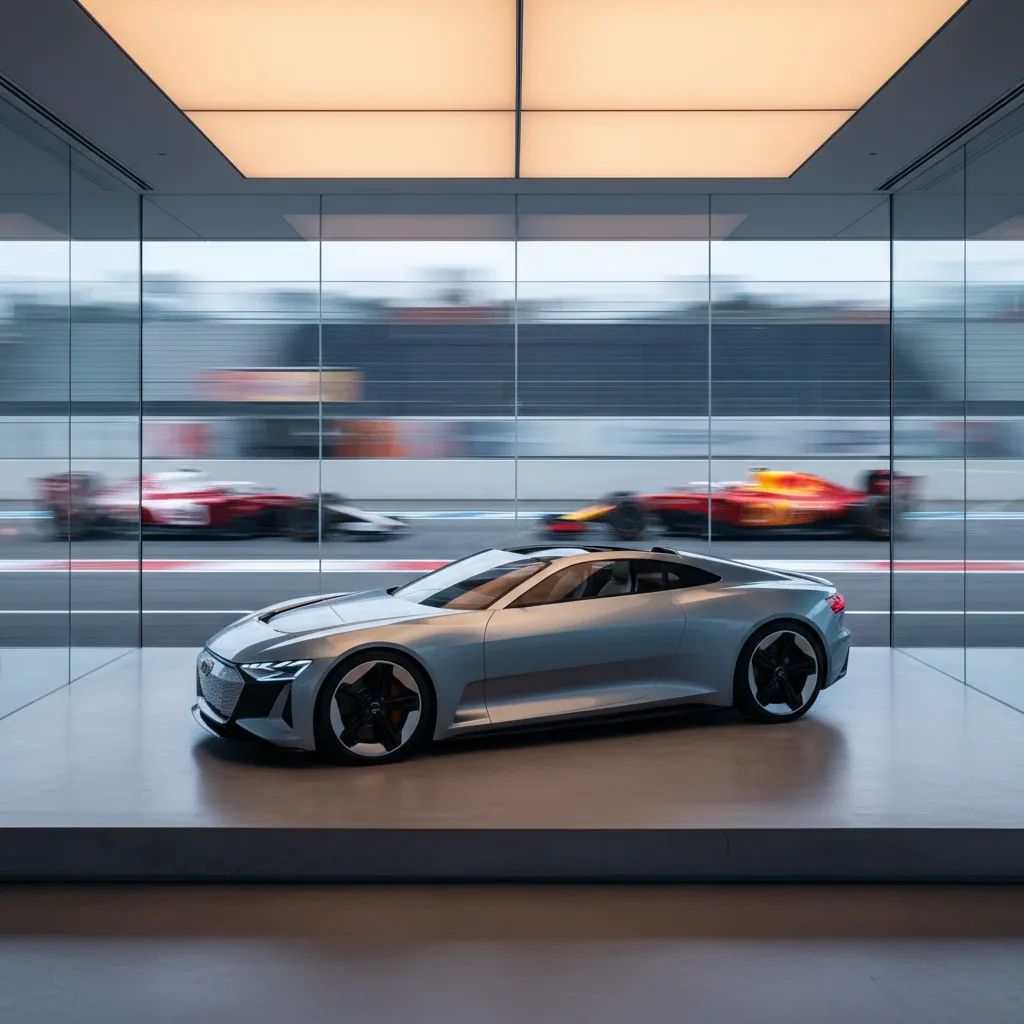
Audi Formula Racing GmbH, the German manufacturer's motorsport arm, has formally committed to a championship-contending Formula 1 program by 2030, a declaration that comes just weeks after the team secured its first-ever points in the series. CEO Gernot Döllner outlined the timeline during the brand's annual media briefing.
The announcement reflects Audi's broader strategy to position itself as a performance-driven, software-defined automaker. Beyond motorsport, the company is launching a radical electric roadster and deploying American startup technology to transform its vehicle architecture across the entire portfolio.
Why This Matters
• Timeline clarity: Audi expects to compete for the F1 championship within four seasons, not the decade-long horizons typical of new entrants.
• Technology transfer: The Rivian-Volkswagen joint venture will debut in Audi's 2028 lineup, bringing Level 3 autonomous capability and conversational AI to premium models.
• Iconic nameplate revival: The Audi Concept C, a fully functional electric roadster sharing architecture with Porsche, signals the end of the TT and R8 lineage and a shift toward "radical simplicity."
• Market positioning: Audi is leveraging F1 visibility to rebrand itself as a performance-first, software-driven automaker in Europe's increasingly competitive EV sector.
From Last Place to Points in Two Races
The Audi Revolut F1 Team made its competitive debut at the Australian Grand Prix in Melbourne on March 8, 2026. Brazilian rookie Gabriel Bortoleto finished 9th, scoring two championship points despite the team arriving with what insiders describe as an underpowered hybrid unit. German veteran Nico Hülkenberg, Bortoleto's teammate, was unable to start due to a powertrain failure—a challenging start for the manufacturer's motorsport ambitions.
Yet Döllner framed the Melbourne result as validation of Audi's three-phase competitive strategy: Challenger (2026–2027), Competitor (podium contention), and Champion (title fights by 2030). "Our squad faced a challenge in Barcelona that could have derailed them," Döllner said, referencing pre-season testing difficulties. "The progress we saw in Melbourne—transforming lessons into results—shows we're learning at high speed."
The AFR 26 hybrid powertrain, developed at Audi's Neuburg facility in Germany since spring 2022, completed its first "fire-up" in December 2025. Early dyno tests suggest the thermal component exceeds 400 kW (540 hp), though the unit is widely believed to trail Mercedes and potentially Ferrari in outright performance. Audi's decision to build its own engine from scratch—rather than customer-supply from an established manufacturer—mirrors the approach taken by Honda during its difficult 2015–2017 McLaren partnership, though Audi retains full control over chassis integration through its acquisition of the Sauber Group headquarters in Hinwil, Switzerland.
Team Principal Jonathan Wheatley, formerly of Red Bull Racing, assumed command in April 2025. Mattia Binotto, ex-Ferrari boss, oversees the powertrain project and has reportedly instituted a more structured planning culture than the one he inherited in Maranello.
A Roadster Built to Drive Today, Not Tomorrow
Döllner used the media event to unveil the Audi Concept C, a two-seat electric roadster described as a fully functional, road-legal vehicle ready for public streets. The declaration is significant: concept cars are typically design exercises with non-functional interiors and fragile bodywork. Audi's claim of production-ready status signals the company's commitment to rapid commercialization.
Scheduled for production in 2027, the Concept C replaces both the TT coupe and the R8 supercar in Audi's lineup. It rides on a central-battery platform co-developed with Porsche, intended for the next-generation 718 Boxster and Cayman EVs. That Porsche project has faced internal delays, but Döllner confirmed the platform partnership remains active.
Key Specifications
• Power: 500 hp (370 kW) in base rear-drive form; dual-motor all-wheel-drive variant planned
• Weight: Approximately 1,690 kg—lighter than the outgoing R8 Spider despite battery mass
• Range: Over 480 km (300 miles) on the WLTP cycle
• Architecture: 800-volt electrical system with batteries mounted behind the seats for low seating position
• Dimensions: 4.52 meters long, 1.97 meters wide—larger than both TT and R8
• Roof: Electrically retracting hardtop
• Price estimate: €75,000–€95,000 at launch
The design language, which Audi labels "radical simplicity," features a vertical-frame grille inspired by the 1936 Auto Union Type C Grand Prix car. The interior eliminates traditional switchgear in favor of a retractable 10.4-inch touchscreen and milled aluminum controls. Audi's chief creative officer, Massimo Frascella, described the approach as "reducing everything to the essential" in response to markets that feel "congested, noisy, and overcomplicated."
For residents of Italy, where the TT enjoyed a loyal following among design-conscious buyers, the Concept C represents a sharp pivot toward minimalism and electrification. The car will compete against the Porsche 718 EV (same platform) and the BMW i4 M50 (sedan form factor) in the premium electric roadster segment.
Software-Defined Vehicles Arrive in 2028—Powered by Rivian
Perhaps the most consequential announcement concerned software-defined vehicle (SDV) architecture, the industry shorthand for cars whose core functions—navigation, driver assistance, entertainment—are controlled by centralized computing platforms rather than dozens of isolated modules.
In November 2024, Volkswagen Group and American EV startup Rivian formed a joint venture called RV Tech, backed by up to $5.8 billion in VW funding. The goal: create a unified electrical and software architecture for all future VW Group EVs. Audi will be the first brand to deploy the full stack in 2028, two years ahead of mass-market siblings like Volkswagen and Škoda.
During the briefing, Döllner staged a demonstration with an SQ6 prototype equipped with early SDV functions. The vehicle responded to voice commands, anticipated navigation requests, and displayed Level 3 autonomous capability during highway testing scenarios. This advancement allows the driver to fully disengage from steering and pedal control during traffic jams below 60 km/h, with the system assuming legal liability during operation—a feature already offered by Mercedes-Benz in the S-Class but not yet widespread in the premium segment.
What This Means for Residents
• Safety and liability: Level 3 systems shift accident responsibility to the manufacturer during autonomous operation. While legal in Germany and certain EU jurisdictions, Italy's regulatory framework for autonomous driving remains fragmented, and buyers should clarify coverage before purchase.
• Upgrade cycles: SDV architecture enables over-the-air feature updates, meaning a 2028 Audi could gain new capabilities years after purchase—similar to Tesla's model but with traditional dealer service networks.
• Data privacy: Conversational AI requires continuous server connectivity. Audi has not publicly disclosed where Italian customer data will be stored or whether buyers can opt out of cloud services without losing core features. This warrants clarification for privacy-conscious consumers.
Volkswagen's partnership with Qualcomm for high-performance chips and Bosch for sensor integration underpins the project, though reports suggest integration challenges have delayed some timelines. The first partial deployment will appear in the budget-oriented Volkswagen ID.1 in 2027, but Audi's 2028 models will showcase the complete architecture, including predictive maintenance alerts and advanced driver interaction capabilities.
A Formula for Speed—On Track and in Boardrooms
Döllner repeatedly framed the F1 program as a cultural catalyst for Audi's broader transformation. "This mindset—bold decisions, high development speed, continuous focus on efficiency and results—is nowhere more tangible than on the racetrack," he said. The implication: the urgency and iterative problem-solving required in motorsport must now define how Audi designs road cars, negotiates supplier contracts, and launches products.
The company employs 88,000 people globally, many in Germany where the automotive sector faces mounting pressure from Chinese EV makers like BYD and Nio, both of which have entered Europe with aggressive pricing. Audi's bet is that performance credibility—demonstrated in F1—and software sophistication—delivered via Rivian—will justify premium pricing in a market growing skeptical of legacy brands.
For Italian consumers, Audi's moves carry particular resonance. The brand has historically competed with Alfa Romeo and Lancia for the affection of drivers who value styling and handling over outright luxury. The Concept C's design nods to pre-war Auto Union, a period when Italian and German marques defined motorsport. The F1 entry, meanwhile, pits Audi directly against Ferrari, Italy's national icon, in a domain where German manufacturers have long struggled for acceptance.
Impact on Italian Residents and Expats
Automotive sector employment: Audi's rapid hiring for the F1 program and SDV development creates openings for engineers, software developers, and supply chain managers across Italy's automotive clusters, particularly in the north.
Dealership networks: Italian Audi dealers will need to retrain service staff on 800-volt architecture and SDV diagnostics by 2028. Expect investment in charging infrastructure at showrooms, particularly in Lombardy and Lazio regions where EV adoption is highest.
Vehicle transition: The TT and R8 are now officially discontinued. Late-model R8 V10 variants may hold value for collectors, but TT market values could soften as the Concept C launches.
Insurance considerations: Level 3 autonomy operates under evolving Italian regulations. Buyers should confirm coverage explicitly includes autonomous-mode operation before purchase, as many existing policies remain unclear on this point.
The 2030 Question
Audi's championship timeline is aggressive. Mercedes required seven seasons to win a constructor's title after returning as a works team in 2010. Honda spent 15 years in its most recent stint without a championship. Toyota invested over $400 million across eight seasons and never reached the top step. Yet Audi benefits from stable regulations through 2030, a luxury denied to most new entrants, and the integration advantages of controlling both powertrain and chassis.
The next test arrives at the Emilia Romagna Grand Prix at Imola in late April, a home race for Italian motorsport fans and a critical benchmark for Audi's stated trajectory. Whether the 2030 goal proves realistic or aspirational will depend largely on how quickly the Neuburg powertrain team closes the performance gap—and whether the lessons learned on track truly translate to the showroom floor.


