
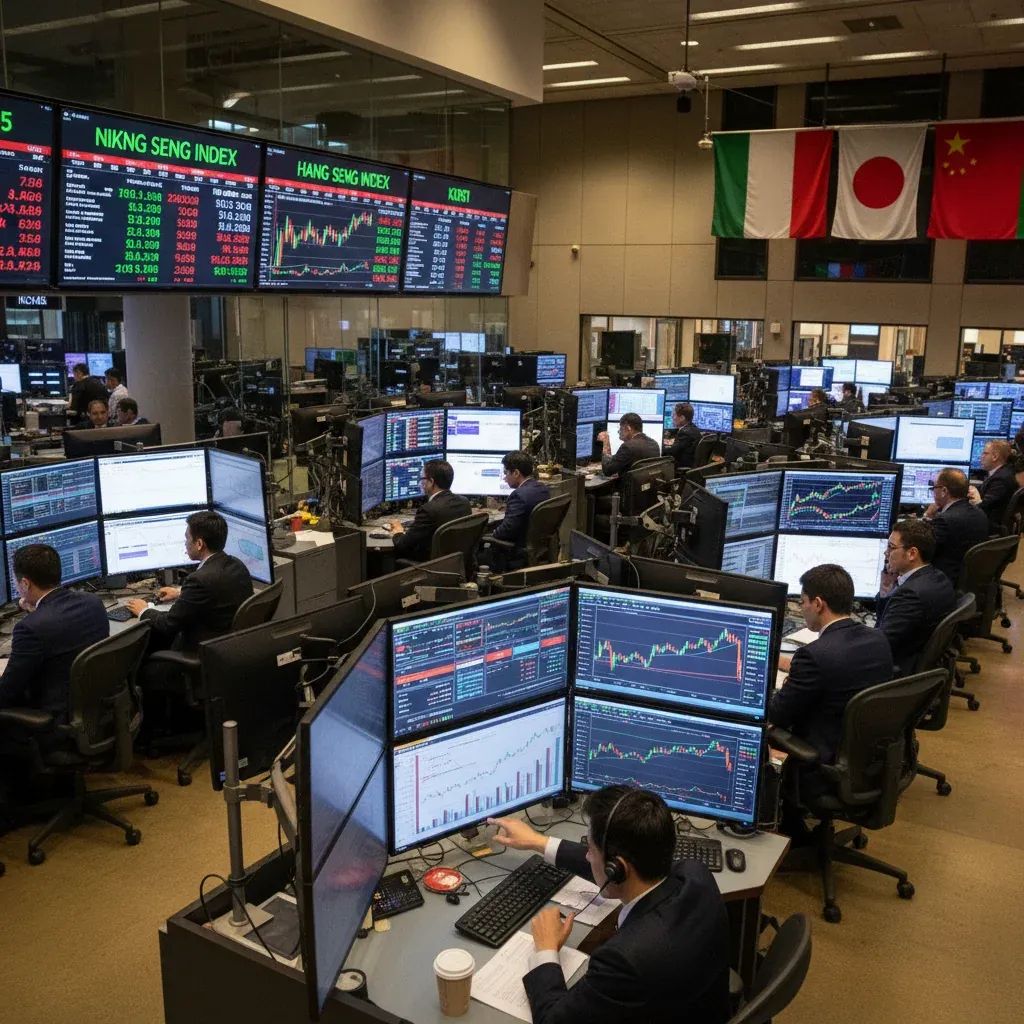
The Asia-Pacific financial markets plunged sharply in early trading today, with investors spooked by Iran's dynastic succession amid an escalating regional war—a move signaling the conflict could grind on far longer than hoped. The ripple effect hit European and U.S. futures hard, raising immediate concerns about energy costs, inflation, and the resilience of global supply chains.
Why This Matters:
• Tokyo's Nikkei crashed 5.2%, dragging semiconductor giants like Advantest down 11% as geopolitical uncertainty hammered tech exporters.
• Oil prices surged past $107 per barrel (Brent), directly threatening Italy's energy import bill and consumer inflation.
• European futures tumbled over 2.25%, signaling a brutal opening for Milan's FTSE Mib and other continental indices.
• Succession in Tehran raises the specter of prolonged instability, potentially disrupting 20% of global oil flows through the Strait of Hormuz.
Iran's Power Transfer Sends Shockwaves Through Trading Floors
On March 8, Iran's Assembly of Experts appointed Mojtaba Khamenei—son of the late Ayatollah Ali Khamenei—as the nation's new Supreme Leader. The elder Khamenei died on February 28 following joint U.S.-Israeli strikes on Tehran, ending a 37-year reign and opening a fraught chapter for the Islamic Republic. The 56-year-old Mojtaba, long rumored as heir apparent, has deep ties to the Revolutionary Guard Corps (IRGC) but no formal government title, making his ascent the first father-to-son transfer of supreme power since the 1979 revolution.
Markets interpreted the appointment as a hardline signal: continuity of confrontation with Washington and Tel Aviv, not compromise. President Donald Trump had publicly called Mojtaba "unacceptable" as leader, and the son's elevation reads as defiance. With Tehran already at war with the U.S. and Israel, traders priced in a conflict measured in months, not weeks—hence the violent repricing of risk across asset classes.
Semiconductor Stocks Bear the Brunt in Tokyo
Japan's technology sector led the selloff. Advantest Corporation, the test-equipment maker vital to chip production, shed 11% of its value, while Sico Global, a specialist in semiconductor furnace materials, dropped 9.54%. The broader Nikkei 225 gave up 5.2%, its steepest one-day decline in months.
Taiwan's benchmark index fell 4.43%, a worrying signal given the island produces over 60% of the world's chips and more than 90% of advanced nodes below 7 nanometers. Any sustained disruption—whether from Middle Eastern chaos choking energy supplies or a separate crisis in the Taiwan Strait—could paralyze global manufacturing. Seoul's KOSPI surrendered 5.96%, Sydney's ASX 200 declined 2.85%, and even Shanghai's more cautious CSI 300 slipped 0.67%. Hong Kong, Mumbai, and Singapore remained open but firmly in the red, down 1.78%, 2.44%, and 2.25% respectively.
European and U.S. Futures Signal Pain Ahead
European equity futures dropped an average of 2.25%, telegraphing steep losses when Milan, Paris, Frankfurt, and Madrid open. Italy's FTSE Mib, which fell 3.9% during the initial phase of the Iran crisis earlier this month, faces renewed pressure. U.S. futures fared slightly better but still slid roughly 1.5%, with the Dow, S&P 500, and Nasdaq all pointed lower.
The divergence reflects geography: European economies depend more heavily on Middle Eastern energy, and the continent has limited domestic gas reserves. Italy imports substantial volumes of liquefied natural gas, much of it transiting regions now shadowed by military escalation. A sustained spike in energy costs translates directly into higher electricity bills, transport expenses, and manufacturing input prices—inflationary pressures that complicate the European Central Bank's policy calculus.
Oil Surge Threatens Italy's Energy Budget
Brent crude climbed to approximately $107.80 per barrel, while West Texas Intermediate settled near $103.85. That is a sharp jump from levels below $80 just weeks ago, driven by what analysts call the "geopolitical risk premium." The Strait of Hormuz, through which roughly 20% of global oil and significant LNG cargoes pass, sits at the heart of investor anxiety. Iran has the means and motive to threaten that chokepoint, and any sustained closure would compress supply and send prices toward $150, according to some forecasts.
For Italians, this matters immediately. Higher crude prices feed through to gasoline at the pump, heating oil, and industrial energy costs. The knock-on effect hits food prices—transport and fertilizer costs rise—and erodes household purchasing power. Inflation in the Eurozone, which the ECB had hoped to hold near its 2% target, could spike by a full percentage point in coming months if energy stays elevated, Commerzbank estimates. That would delay or reverse anticipated interest-rate cuts, keeping mortgages and business loans expensive.
What This Means for Residents
Energy bills: Expect upward pressure on electricity and gas tariffs if wholesale prices remain high. Italy's regulator typically adjusts consumer rates quarterly, and the next review will capture much of this surge.
Inflation and groceries: Transport-intensive goods—fresh produce, imported staples—will likely cost more. Bakeries and restaurants, already squeezed by previous energy shocks, may raise menu prices.
Investment portfolios: Italian pension funds and retail investors with equity exposure face mark-to-market losses. Technology funds holding Asian semiconductor stocks took particularly severe hits today.
Business costs: Manufacturers reliant on imported components or energy-intensive processes will see margin compression. Small and medium enterprises, the backbone of Italy's economy, have less pricing power and may struggle to pass costs downstream.
Interest rates: If inflation resurges, the ECB will be slower to ease. Mortgage holders hoping for relief on variable-rate loans may wait longer, and corporate borrowing costs could stay elevated, dampening investment.
Stagflation Risk Looms Over Eurozone
Economists worry the combination of weak growth and rising prices could push Europe toward stagflation—a toxic mix last seen in the 1970s. Italy, with its sluggish productivity growth and high public debt, is especially vulnerable. The World Economic Forum's 2026 Global Risks Report flagged geo-economic confrontation and armed conflict as top short-term threats, with half of surveyed experts forecasting turbulence through 2028.
Goldman Sachs has sketched downside scenarios for the Eurozone with oil between $80 and $100 per barrel and European gas at €70 to €100 per megawatt-hour. Under those conditions, GDP growth slows by 10 to 20 basis points, and inflation climbs 20 to 40 basis points for every sustained 10% rise in crude. Milan's stock exchange, which has already shed billions in market capitalization this month, could face prolonged volatility.
Iran's Succession: Continuity, Not Compromise
Mojtaba Khamenei's appointment consolidates the theocratic establishment's grip. Unlike his father, who navigated the chaotic early years of the revolution and the brutal Iran-Iraq War, the younger Khamenei inherits power in a digital, interconnected era where sanctions, cyber operations, and drone warfare define conflict. His reported links to the IRGC suggest operational continuity: missile strikes, proxy engagement, and a refusal to back down despite economic pain.
For traders, this translates into uncertainty priced at a premium. The longer the conflict drags on, the higher the tail risk of supply disruptions, refugee flows, and spillover instability. Asian economies—China, India, Japan—are among the largest importers of Gulf crude and will bear acute costs if the Hormuz route closes.
Outlook: Volatility to Persist
Historically, equity markets absorb geopolitical shocks and recover over months. Yet the intersection of Middle Eastern war, semiconductor supply fragility, and Europe's energy dependence creates a uniquely combustible mix. Analysts recommend portfolio rebalancing rather than panic selling, but caution that the Cboe Volatility Index (VIX) remains elevated in the mid-20s, signaling continued unease.
Italy's FTSE Mib will likely follow Europe's broader trajectory when trading resumes. Defensive sectors—utilities, staples—may outperform, while banks and industrials face headwinds. For now, the market's message is clear: geopolitical risk is no longer an abstract tail event but a tangible drag on growth, profits, and confidence.
President Trump indicated the U.S.-Iran conflict could last four to five weeks, possibly longer. Until a ceasefire materializes or supply fears ease, investors should brace for choppy seas and keep a close eye on the energy complex, currency moves, and central bank signals. The cost of this crisis will be measured not just in market indices, but in Italian wallets, factory margins, and the ECB's policy room to maneuver.


