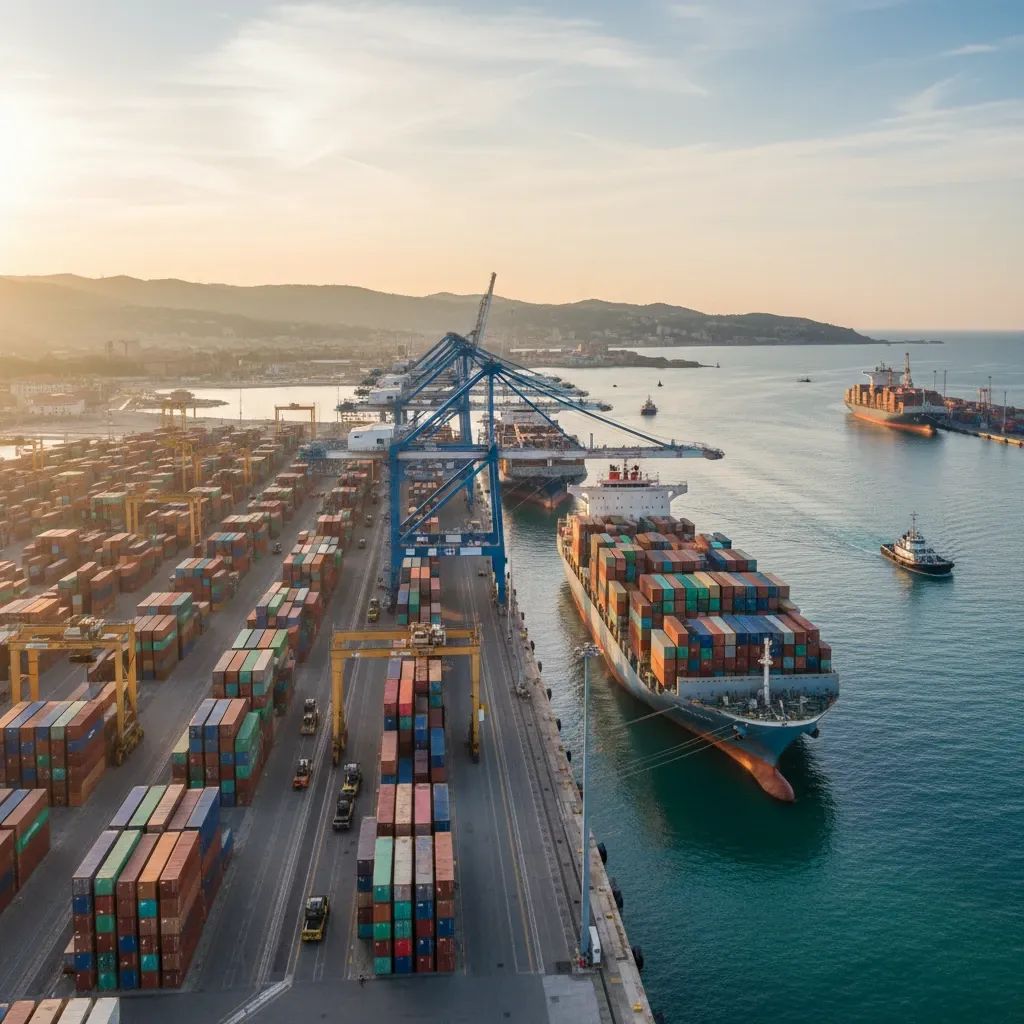
Trieste's port enjoys a unique advantage dating to 1947: goods can enter, be stored, and processed without paying EU customs duties or VAT—a privilege that no other Italian port holds. Now, as Italy overhauls its entire port system, that advantage is at risk unless Parliament adopts new amendments to explicitly protect it.
The Italy Parliament is reviewing amendments designed to safeguard this free-port status as a sweeping ports reform advances through the legislative process. The measures, introduced by members of the Partito Democratico (PD), aim to protect the extraterritorial customs regime that has underpinned the Adriatic gateway's competitive edge since 1947, ensuring that a national restructuring of port governance does not strip away advantages worth millions annually and jeopardize thousands of jobs.
Why This Matters for Trieste
Concrete benefits under threat:
• Tax exemptions: Businesses operating in Trieste's free zone avoid EU customs duties and VAT on goods in temporary storage—a privilege worth roughly €13M annually in reinvestable revenue for the port authority and the local economy.
• Payment flexibility: Importers using the zone enjoy 180-day deferrals on VAT and duties at below-market interest rates, critical for small and mid-sized freight forwarders and manufacturers.
• Jobs and employment: Trieste's free-port status supports direct employment in warehousing, freight forwarding, and light manufacturing—sectors that depend on the customs advantages to compete with major European hubs like Antwerp and Rotterdam.
• Investment timeline: Parliament is expected to finalize the reform by spring 2027, locking in the governance framework for decades.
• Infrastructure at stake: If the port loses reinvestable revenue, upgrades to rail terminals and container handling facilities—projects already funded through Italy's pandemic recovery program—could be delayed or scaled back.
A 300-Year Privilege Under Pressure
Trieste's free-port designation dates to 1719, making it one of Europe's oldest continuously operating extraterritorial zones. After World War II, the Treaty of Paris (1947) and the London Memorandum (1954) formally re-affirmed this status in international law. This means goods entering the free zone are treated as outside the EU's customs territory—they can be unloaded, processed, stored, and reloaded with zero duty or VAT liability until they formally enter the Italian or EU market.
What this means in practice for businesses:
• Goods can remain in storage for unlimited periods with no declarations required, making Trieste ideal for companies managing complex supply chains across Europe.
• Manufacturers can process components within the zone without paying VAT on the added value if the finished product leaves the EU.
• Export shipments are immediately classified as "cleared" once they cross the free-port perimeter, streamlining customs procedures for Central and Eastern Europe-bound cargo.
These advantages have positioned Trieste as a preferred transshipment hub for manufacturers serving Central and Eastern Europe, bypassing bottlenecks at ports in Germany and the Netherlands. A ministerial decree in 2017 delegated administration to the Port System Authority of the Eastern Adriatic Sea (AdSPMAO)—the body that currently manages the free zone—granting it the power to authorize industrial activities, reassign warehouse spaces, and market the regime internationally.
The Restructuring at Issue
The ports reform bill, signed by President Mattarella in May 2026 and now under committee review, proposes creating Porti d'Italia S.p.A., a state-owned company charged with coordinating investments and managing port contracts across Italy. Originally budgeted at €500M, the funding was slashed to €10M after the State Audit Office flagged budget constraints.
The core problem for Trieste: the reform text makes no explicit mention of the free-port status. This creates legal uncertainty. When Parliament passes implementing regulations for the new national company, standardized procedures could inadvertently override the treaty-based exemptions that make Trieste unique. For businesses relying on the customs regime, this ambiguity is a major concern—multinational logistics operators budget years in advance, and uncertainty could push them toward competing ports in Germany or Poland.
What the Amendments Would Do
Deputies Debora Serracchiani and Valentina Ghio, working with Senator Tatjana Rojc—all from the PD—filed amendments that would:
Explicitly enshrine Trieste's extraterritorial customs status in Italian law, referencing the Treaty of Paris and the 1954 Memorandum.
Direct the Italian Cabinet to formally request the European Commission to amend the EU Customs Code, officially confirming that Trieste's free zone is excluded from EU customs territory.
Serracchiani emphasized that this move protects what Italy is already legally obligated to honor. "The treaty commitments are fixed," she noted. "These amendments simply ensure that domestic regulations cannot override them."
The amendments would not alter Trieste's substantive privileges—those are locked in by international treaty—but would embed them firmly in Italian statute. This prevents future implementing rules from conflicting with the free-port regime. The request to the Commission is also significant: while Brussels already tolerates Trieste's arrangement as a historical exception, formal exclusion from the Customs Code would eliminate recurring compliance audits and reduce bureaucratic friction for exporters.
Impact on Local Businesses and Workers
For residents, the immediate concern is job security and industrial competitiveness. Warehousing, freight forwarding, and light manufacturing—sectors directly tied to the free-port status—employ hundreds of workers across Trieste. Manufacturers in the free zone also benefit from discounted energy tariffs for processing, a concession tied to extraterritorial treatment.
If the reform proceeds without explicit protections, legal uncertainty could deter new investment. Companies evaluating Trieste as a European distribution hub might relocate feasibility studies to German or Polish ports instead. Existing employers have already alerted the Regional Council and the Chamber of Commerce, stressing that the free-port regime is not a luxury subsidy but a treaty obligation that Italy cannot unilaterally abandon.
On the fiscal side, loss of reinvestable port revenue would slow critical infrastructure projects. Trieste is planning €200M for a new rail terminal at Servola—designed to handle 25,000 trains annually by 2031 and funded through Italy's pandemic recovery program (PNRR)—plus electrification upgrades for cruise and ferry berths. The port recorded a 26% surge in container throughput beginning April 2026, making these infrastructure investments urgent. A shortfall in revenue would mean delays that jeopardize the PNRR delivery deadline of 2031.
Financial Stakes
Trieste closed 2025 with an administrative surplus exceeding €277M, roughly €266M of which is earmarked for infrastructure. Under the ports reform's revenue-sharing formula, estimates suggest that more than €13M annually would be redirected from Trieste's control to a national holding company. While proponents of centralization argue this enables cross-port investment coordination and faster dredging contracts, local stakeholders argue that standardized allocation formulas ignore each port's unique economic contribution.
European Context
About 80 free zones operate across 20 EU member states, governed by Article 243 of the EU Customs Code. Most are subject to Brussels' state-aid scrutiny: the Commission permits duty suspension but prohibits VAT rebates or corporate tax holidays that distort the single market. Trieste's regime predates the Treaty of Rome, giving it grandfathered status that newer zones cannot claim.
Latvia's Riga and Ventspils ports offer partial parallels, blending special tax zones with customs duty suspension. Ireland's Shannon Free Zone, established 1959, survived EU accession by shifting toward infrastructure grants rather than tax breaks. The United Kingdom, post-Brexit, has relaunched Liverpool and Southampton as full free ports with corporate tax cuts—an option unavailable inside the customs union. Italy's request to formally protect Trieste will signal whether the Commission views legacy treaty zones as unique historical exceptions or as models other member states might pursue.
Political Timeline
The Chamber of Deputies is scheduled to conclude first reading by December 2026, with final Senate approval targeted for spring 2027. Amendment voting typically occurs in committee. If the governing coalition backs the PD language, the bill should pass with broad support. If rejected, floor debates could delay implementation into 2028, freezing €200M in pandemic recovery funding tied to the rail project and carrying a 2031 delivery deadline.
Politically, Friuli-Venezia Giulia leans center-right, and Trieste's business community has traditionally backed moderate conservative candidates. A divided coalition vote would provide opposition parties with a potent regional campaign issue ahead of municipal elections.
What Residents and Businesses Should Know
Monitor committee sessions scheduled for late summer. The AdSPMAO has committed to publishing a white paper by August detailing revenue scenarios under various amendments. Trade associations recommend that importers currently using the 180-day deferral confirm with their customs brokers whether contingency plans exist for a potential reclassification event.
For investors evaluating Trieste as a European distribution hub, the safest approach is modeling both scenarios: continuation of the current treaty regime and a potential shift to a standard free zone, which would preserve duty suspension but eliminate simplified customs procedures.
Legal counsel in Brussels notes that Italy's Treaty of Paris obligations would ultimately prevail in any dispute—but protracted litigation itself is a business deterrent. The amendments are live, the debate is real, and the outcome will shape not only Trieste's competitive position but also the balance between national coordination and regional autonomy across Italy's entire maritime network.