
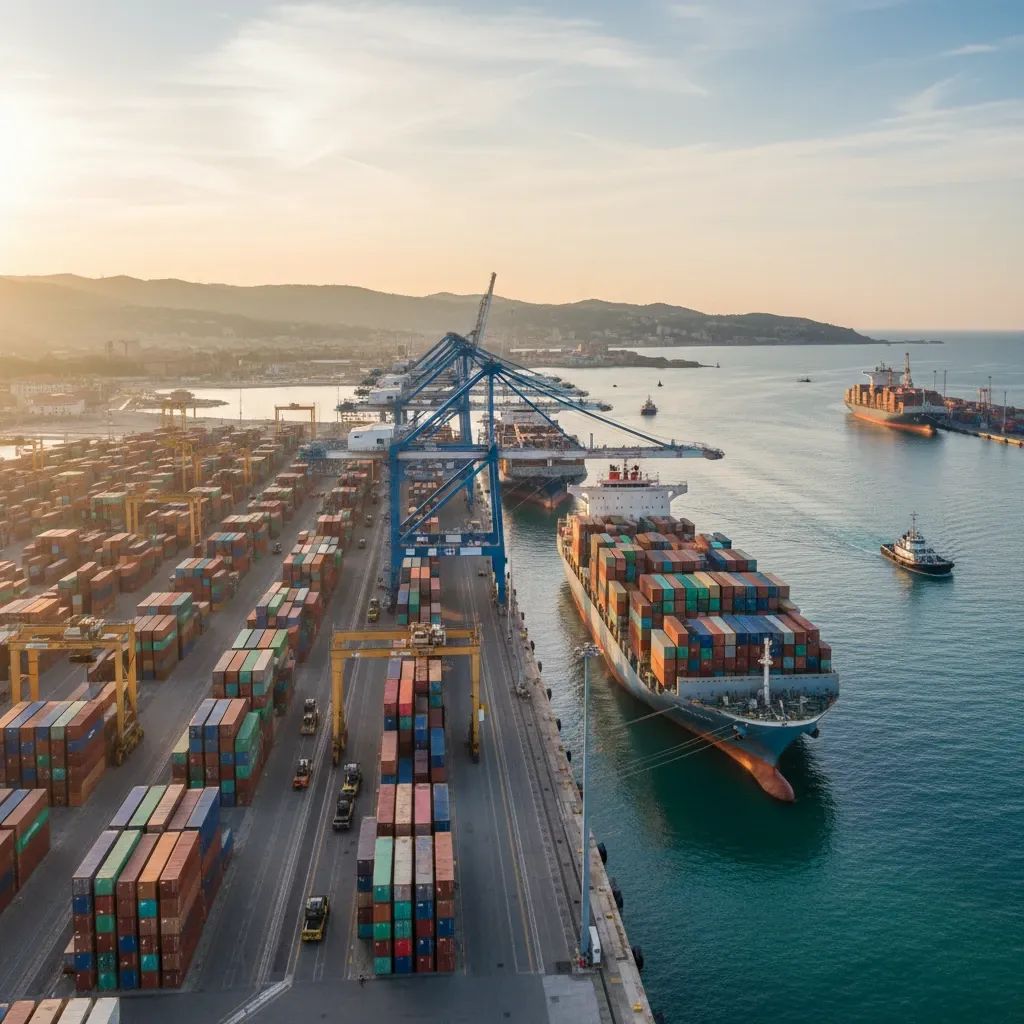
The Italy Port Authority of the Eastern Adriatic Sea is positioning Trieste as a strategic logistics gateway between central Europe and the Mediterranean, leveraging a combination of rail infrastructure, energy supply capacity, and competitive advantages that distinguish it from rival hubs across the continent. As global supply chains reconfigure and geopolitical tensions reshape maritime routes, the Adriatic basin is regaining its historic role as a connective corridor linking the Mitteleuropa, the Balkans, and the wider Mediterranean.
Why This Matters
• Economic positioning: Trieste's growth is tied to the broader Adriatic system — when the region thrives, Italy's strategic footprint in European logistics expands.
• Infrastructure push: Over €180 M is allocated to new rail terminals at Servola, with the goal of doubling annual train traffic from 12,000 to 25,000 by 2028.
• Energy security angle: The port's role in energy supply chains for central Europe adds a layer of geopolitical relevance beyond cargo volumes alone.
• Competitive urgency: The next 3 years are considered decisive for proving the port's ability to withstand rivalry from Rijeka, Koper, Venice, and Ravenna.
Marco Consalvo, president of the Italy Eastern Adriatic Port Authority, emphasized in analysis published by geopolitical journal Limes that the most significant development is not competition between individual ports, but the resurgence of the Adriatic as an integrated system. "When this space grows, Italy's role grows with it," he stated, according to Limes reporting, framing the narrative around collective regional strength rather than zero-sum rivalry.
The Return of the Upper Adriatic
Trieste has reclaimed its status as a threshold point — a term historically used to describe its Cold War-era position at the edge of the Iron Curtain. Today, the port serves as a critical node for commercial traffic and energy provisioning to Austria, Germany, the Czech Republic, Slovakia, and Hungary. Germany remains the port's leading trade partner, followed by Austria and Hungary in terms of rail-bound cargo.
The port's international free port status — a legacy of the 1947 peace treaty — exempts goods from customs duties and guarantees, offering operational conditions not available elsewhere in the European Union. However, full implementation of this regime remains a point of legal and political contention, with advocates arguing that maximizing this framework could further enhance competitiveness.
Trieste's renewed importance is not occurring in isolation. The Alto Adriatico cluster — comprising Ravenna, Venice, Trieste, Koper (Slovenia), and Rijeka (Croatia) — collectively handled approximately 3.25 M TEU (Twenty-Foot Equivalent Units, the standard container measurement) in 2024, according to Limes analysis. Yet the threshold for competing effectively with mega-container vessels arriving from Asia is estimated at a minimum of 6 M TEU, a figure no single port in the region can achieve alone. This has sparked discussion about whether an inter-state coordinated authority could prevent "cannibalization" and enable the region to present a unified front against northern European giants like Rotterdam, Antwerp, and Hamburg.
What This Means for Residents and Businesses
For companies operating in Italy or considering logistics investments in the Adriatic, the next three years will define whether Trieste can sustain its momentum or lose ground to competitors. The port recorded a significant decline in container traffic during 2024, largely due to the dissolution of the 2M Alliance between Maersk and MSC, which resulted in Maersk redirecting operations to Rijeka. However, the hinterland traffic — cargo destined for European markets rather than transshipment — remained stable, and projections for 2026 estimate traffic at between 600,000 and 650,000 TEU.
This distinction matters for Italy-based importers and exporters: if you are shipping goods to or from central Europe, Trieste's rail connectivity and free port advantages remain highly competitive. If you rely on transshipment services, the picture is more uncertain, as larger shipping alliances continue to consolidate operations in fewer hubs.
The port's Ro-Ro traffic (roll-on/roll-off cargo, typically trucks and trailers) continues to expand, driven by new maritime lines to Turkey and growing demand for overland "motorways of the sea" that bypass congested Alpine road corridors. For freight forwarders and logistics managers, this segment offers a relatively stable growth trajectory compared to the volatile container market.
Employment and Economic Opportunities for Italian Residents
The massive infrastructure investments planned through 2028 represent significant job creation potential for Italy's workforce. Construction projects at Servola, Molo VII, and the Noghere terminal will generate demand for skilled laborers, engineers, and project managers over the coming years. Additionally, the expansion of rail operations, cold ironing systems, and digital infrastructure will create permanent positions in port operations, maintenance, logistics coordination, and technical support roles. For workers in the Trieste region and northern Italy more broadly, these developments offer tangible career opportunities in one of Europe's most strategically important logistics hubs.
Infrastructure Investments Through 2028
The Italy Eastern Adriatic Port Authority is executing a multi-year capital plan anchored by financing from the National Recovery and Resilience Plan (PNRR) — Italy's €191.5 billion EU recovery fund — and the European Union's Connecting Europe Facility (CEF). Key projects include:
• Servola Rail Station: A new €180 M terminal designed to handle the anticipated doubling of rail traffic, separating port-bound trains from urban and regional networks.
• Molo VII Extension: Expansion of the wharf by 100 meters and installation of new cranes, budgeted at €100.5 M.
• Noghere Terminal Development: Banchinamento (quay construction) and dredging for a new terminal estimated at €45 M, with an additional €60 M for preparatory logistics and production facilities. The Hungary state-owned Adria Port is developing a dedicated terminal in the former Aquila area, currently under construction and expected to be operational by 2028, with approximately €45 M allocated for quay work and dredging, plus another €10 M for completion.
• Cold Ironing Infrastructure: Electrification of berths at Moli Bersaglieri, Molo VII, Molo V, Riva Traiana, and the logistics platform, totaling €29 M from PNRR funds, extending to the nearby port of Monfalcone. This will allow docked vessels to shut down engines and connect to shore power, significantly reducing emissions and noise.
• Digital and Environmental Projects: Two EU-funded initiatives — VERKKO and PRESPORT — worth €1.7 M combined, will introduce digital solutions for managing oversized cargo transit, optimizing gate access, upgrading LED lighting on port towers, enhancing surveillance systems, and deploying a circular economy digital platform.
The total committed investment package for these initiatives exceeds €470 M when combining PNRR allocations, CEF funding, and additional state contributions. The deadline for major PNRR-funded works is set for June 2026, though extensions are anticipated given the scale and complexity of the projects.
Geopolitical Headwinds and Route Reconfiguration
The broader maritime environment is under strain. Disruptions in the Red Sea have reduced traffic through the Suez Canal, forcing carriers to reroute via the Cape of Good Hope. This detour adds 15-20 days to transit times between Asia and Europe and increases fuel costs significantly. Insurance premiums have spiked, and variability in schedules has become the norm.
Simultaneously, drought conditions in the Panama Canal have reduced daily container transits, further disrupting global supply chains. These disruptions are accelerating a shift toward regionalization — trade flows within closer geographic clusters — which has grown substantially between 2021 and 2024.
For Trieste, the implications are mixed. Maritime disruptions have contracted Italian port traffic in recent months, and Trieste was particularly affected by adjustments to Russian crude oil imports. However, the port's role in serving landlocked central European markets via rail provides a degree of insulation from purely maritime volatility. As long as hinterland demand holds, Trieste can maintain relevance even if transshipment volumes fluctuate.
The emerging India-Middle East-Europe Economic Corridor (IMEC) represents a potential opportunity. Though still in early planning stages, IMEC aims to create an alternative to Chinese-dominated Belt and Road routes by linking South Asia and the Gulf to Europe via a combination of rail, port, and pipeline infrastructure. Trieste's geographic position and existing ties to the Middle East and Balkans could position it as a beneficiary of this corridor, though much depends on political will and investment commitments from participating states.
The Competitive Landscape
Trieste is not alone in its ambitions. Ancona, further south on the Adriatic, moved 9.6 M tonnes in 2025, a 2% increase year-over-year, and handled 154,868 TEU with a 2% gain despite recent maritime disruptions. Ancona's dual role as a hub for both deep-sea routes (China, India, the United States) and short-sea shipping (Balkans, Eastern Mediterranean) gives it flexibility that Trieste, more focused on central European hinterland traffic, does not fully replicate.
The Italy Southern Adriatic Port Authority (Bari, Brindisi, Manfredonia) moved over 12 M tonnes in the first nine months of 2025, with a 30% surge in solid bulk commodities and a 35% jump in container units. Cruise traffic also continues to consolidate in southern ports, drawing passengers who might otherwise transit through Venice or Trieste.
Meanwhile, Koper and Rijeka benefit from their positions within Slovenia and Croatia, respectively, offering access to similar central European markets but with different regulatory and labor cost structures. The decision by Maersk to shift operations from Trieste to Rijeka after the 2M Alliance breakup is a stark reminder that shipping alliances can reconfigure port hierarchies overnight.
The Three-Year Proving Ground
Consalvo's public statements reflect both confidence and urgency. "The Adriatic is a space that is returning to centrality, and a decisive game is being played here," he said. "We have the conditions to be protagonists, and we must prove it in the next three years," according to Limes reporting.
That timeframe is not arbitrary. By mid-2026, the major PNRR-funded infrastructure projects should be nearing completion or operational. By 2028, the Hungarian terminal at Noghere and the Servola rail hub should be fully integrated into the port's operations. If Trieste can demonstrate a sustained increase in rail volumes, stabilize or grow its container throughput, and maintain its Ro-Ro and energy supply roles, it will have a strong case for continued investment and strategic relevance.
If, however, container traffic continues to bleed to Rijeka, rail projects face delays, or geopolitical shocks further disrupt supply chains, the narrative could shift. Northern European ports, despite their distance, continue to benefit from economies of scale enabled by vessels carrying over 18,000 TEU — a capacity level that makes door-to-door costs from Asia competitive even with longer sea routes. Trieste and its Adriatic peers cannot match that scale individually, which is why the push for a coordinated regional strategy is gaining traction.
Outlook: Strategic Patience or Urgent Action?
For businesses and policymakers in Italy, the resurgence of the Adriatic as a logistics corridor is both an opportunity and a test. The infrastructure investments are substantial, the geopolitical context is favorable for diversifying away from over-reliance on northern European gateways, and the port's free port status offers tangible cost advantages.
But the window is narrow. The combination of alliance reshuffling, geopolitical instability, and climate-driven disruptions to traditional routes means that the next few years will determine whether Trieste becomes a cornerstone of European logistics or a secondary player overshadowed by larger, more flexible competitors.
Consalvo's framing — that the Adriatic's success lifts Italy's strategic position — is a call for coordinated action, not just among ports within Italy, but across national borders in the Upper Adriatic. Whether that vision translates into operational reality will depend on investment execution, political alignment, and the ability to navigate an increasingly unpredictable global shipping environment.


