
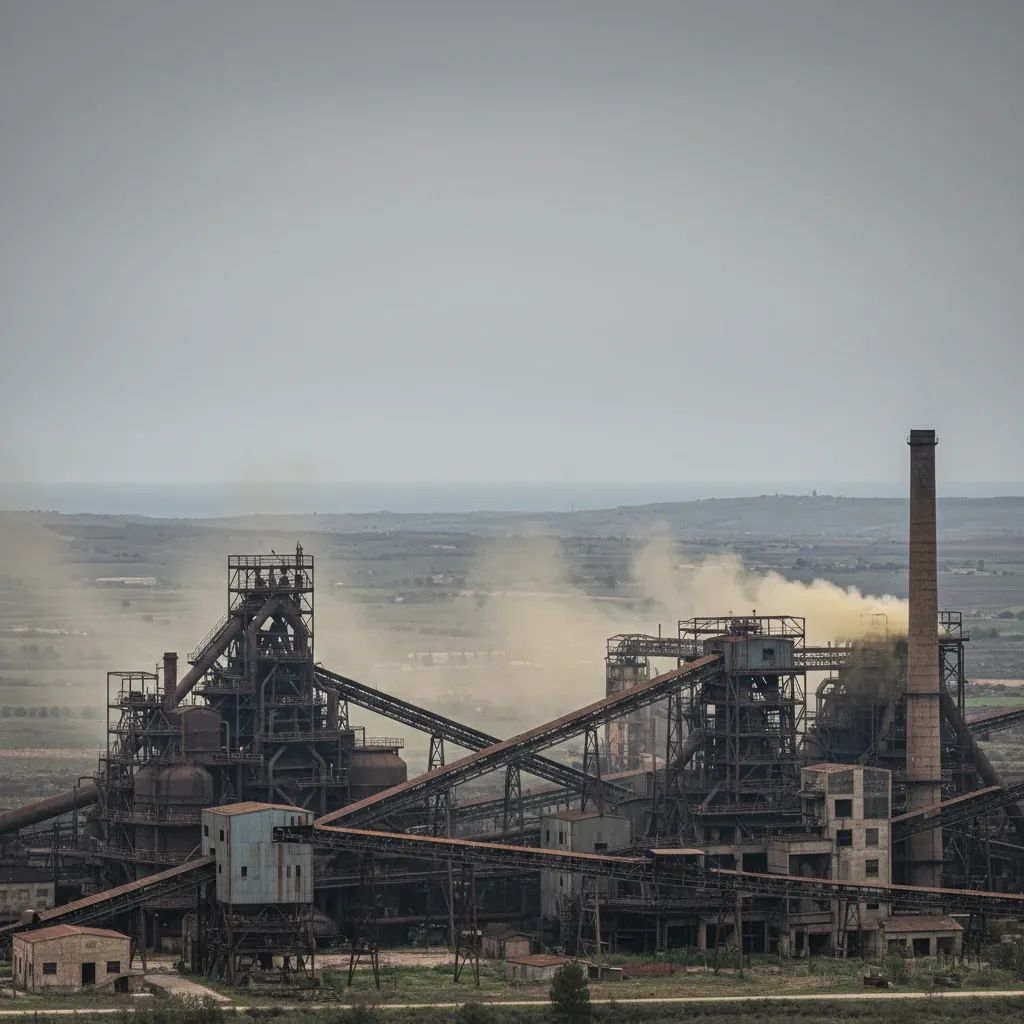
Acciaierie d'Italia in Taranto has recorded its second workplace fatality in under two months, intensifying pressure on management and government officials to address what unions call a "systemic collapse" of safety protocols at the former Ilva steel plant. Loris Costantino, a 26-year-old employee of Gea Power, a contracted cleaning firm, died after falling approximately 10 to 12 meters from a grated walkway that gave way beneath him during routine maintenance in the Agglomerato department on Monday morning.
Why This Matters
• Second death in 2026: Costantino's fall follows the January 12 death of Claudio Salamida, killed under nearly identical circumstances—a failed grating structure.
• Structural failure confirmed: The walkway "completely disintegrated," according to union officials, pointing to neglected maintenance.
• Government meeting imminent: Worker representatives have scheduled a self-convened session at Palazzo Chigi on March 9, citing the government's failure to address urgent safety demands.
• Judicial scrutiny: The Taranto Public Prosecutor's Office has opened an involuntary manslaughter investigation involving 17 individuals, including senior plant managers and contractors.
The Incident and Immediate Aftermath
Costantino was performing cleaning operations on a conveyor belt system early Monday when the metal grating beneath his feet collapsed. He plummeted more than 10 meters, suffering severe chest and arm trauma. Emergency responders transported him to Santissima Annunziata Hospital in Taranto, where medical teams could not stabilize his condition. Regional health authority sources confirmed his death within hours of the accident.
Acciaierie d'Italia in Extraordinary Administration issued a statement expressing "profound condolences" and pledged "full cooperation with competent authorities" to reconstruct the dynamics of the incident. Inspectors from SPESAL, the workplace safety arm of Italy's public health system, have sequestered the accident site and launched a technical investigation to determine whether the failure resulted from design flaws, deferred maintenance, or inadequate contractor oversight.
Pattern of Preventable Tragedies
Costantino's death is not an isolated event but part of a disturbing pattern. Just seven weeks earlier, Claudio Salamida, a 46-year-old direct employee of Acciaierie d'Italia, died after falling from the fifth to the fourth floor of the Steelworks 2 facility when another grated platform gave way during valve inspections. Both incidents share a common element: structural collapse of load-bearing walkways, suggesting widespread deterioration of plant infrastructure.
Michele De Palma, national secretary of Fiom-CGIL, told reporters the union movement is "devastated" and called for immediate resignations of those responsible. "The walkway on which the worker was standing collapsed—it's completely destroyed. For us, it's entirely evident that those who bear responsibility must step aside. Enough," De Palma said. He added that unions had repeatedly warned that insufficient investment in health, safety, and maintenance was creating lethal conditions, but management and government officials failed to act.
What This Means for Workers and Contractors
The repeated failures expose a precarious reality for the estimated 8,000 direct and indirect workers employed at the Taranto complex. Subcontracted personnel—like Costantino—are particularly vulnerable, often performing high-risk tasks in deteriorating sections of the plant without the same bargaining power or oversight afforded to direct hires.
Legal liability is also in question. The Taranto prosecutor has opened separate investigations into both deaths, with 17 individuals already on the register for Salamida's case. Charges typically include negligence, failure to maintain safety equipment, and violations of Legislative Decree 81/2008, Italy's comprehensive workplace safety law (equivalent to OSHA-type regulations in other jurisdictions). If convicted, responsible parties face prison terms and substantial fines. Companies can also be held liable under Legislative Decree 231/2001, which extends criminal responsibility to corporate entities for safety failures.
For contractors like Gea Power, the risk is twofold: criminal exposure for individual managers and potential suspension of business licenses if safety certifications are revoked. Yet no specific legal proceedings against Gea Power have surfaced in public records, raising questions about the adequacy of enforcement.
Union Mobilization and Political Deadlock
Union leaders argue that the root cause is not individual negligence but a chronic underfunding of maintenance tied to the plant's prolonged financial and legal limbo. The facility, once Europe's largest steelworks, has cycled through multiple ownership structures, bankruptcy proceedings, and stop-gap state interventions since environmental and health scandals forced Ilva into extraordinary administration.
On February 26, the Milan Civil Tribunal ordered a shutdown of the hot area production lines starting August 24 unless the company meets strict environmental compliance deadlines. The ruling, focused on public health risks for surrounding neighborhoods, indirectly underscores the plant's infrastructural decay—the same decay that unions say is killing workers.
Self-Convened Meeting and Escalating Actions
Frustrated by what they view as government inaction, Fiom, Fim, and Uilm have scheduled a self-convened meeting at Palazzo Chigi on March 9. "We had to summon ourselves, as usual, because if it were up to those managing the company so well, there would be no need," De Palma said. "They don't need workers, they don't need unions, they don't need anyone."
The unions are now consulting on further action, including potential plant-wide strikes and legal challenges to force immediate remediation work. De Palma told reporters that "words are no longer acceptable," signaling a hardening stance that could disrupt production in the coming weeks.
Government Response and Financial Lifelines
The Italian government has repeatedly pledged support for the plant's survival, citing its strategic importance to the national steel industry and the regional economy of Puglia. In January, Parliament converted a decree releasing €108M in residual funds from the Ilva bankruptcy estate to ensure continuity. An additional €149M was authorized if the sale to a new operator drags past January 30.
In February, the European Commission approved a €390M bridge loan to cover operational costs until ownership transfer. However, no credible buyer has emerged, and unions argue that stopgap financing without a binding commitment to capital expenditure on safety and maintenance merely postpones catastrophe.
Prime Minister Giorgia Meloni's administration has faced mounting criticism for delegating oversight to commissioners and failing to impose binding safety benchmarks. In a November 2025 meeting, the government promised to "concentrate resources on maintenance for worker safety," but subsequent fatalities suggest those assurances were hollow.
Broader Implications for Industrial Safety in Italy
The Taranto tragedies spotlight a systemic challenge across Italy's aging industrial base. Many facilities built in the 1960s and 1970s are now approaching end-of-life, and deferred maintenance driven by financial distress has turned them into hazard zones. Workplace deaths in Italy rose 4.1% in 2025 compared to the prior year, with construction and heavy manufacturing accounting for the majority.
Legal scholars note that Italy's workplace safety regime, while comprehensive on paper, suffers from inadequate enforcement capacity. SPESAL inspectors are chronically understaffed, and penalties for violations are often too low to deter cost-cutting by financially strained firms. Legislative Decree 81/2008 mandates detailed risk assessments, training, and equipment maintenance, but compliance is inconsistent, particularly among subcontractors operating on thin margins.
For residents of Taranto, the plant's dual legacy—environmental contamination and workplace fatalities—has become a symbol of institutional failure. Community activists have long argued that the same disregard for environmental standards that poisoned local air and water is now killing workers inside the gates.
What Happens Next
Investigators will spend the coming weeks reconstructing the precise failure mode of the walkway, examining metallurgical records, maintenance logs, and contractor oversight documents. If negligence is established, criminal trials could begin by late 2026, though Italy's judicial system is notoriously slow, and final verdicts may take years.
Meanwhile, union leaders say they will press for immediate independent safety audits of all elevated walkways and load-bearing structures across the Taranto site, with mandatory remediation before resumption of work in affected areas. They are also demanding that the government appoint a special commissioner for workplace safety with authority to halt production in zones deemed unsafe.
The March 9 meeting at Palazzo Chigi will test whether the Meloni administration is willing to impose stricter conditions on continued state financing or whether it will continue the pattern of reactive statements followed by inaction. For the families of Loris Costantino and Claudio Salamida, and for the thousands of workers who still clock in at the rusting gates each day, the answer will determine whether the plant's future includes basic protections or more preventable deaths.


