
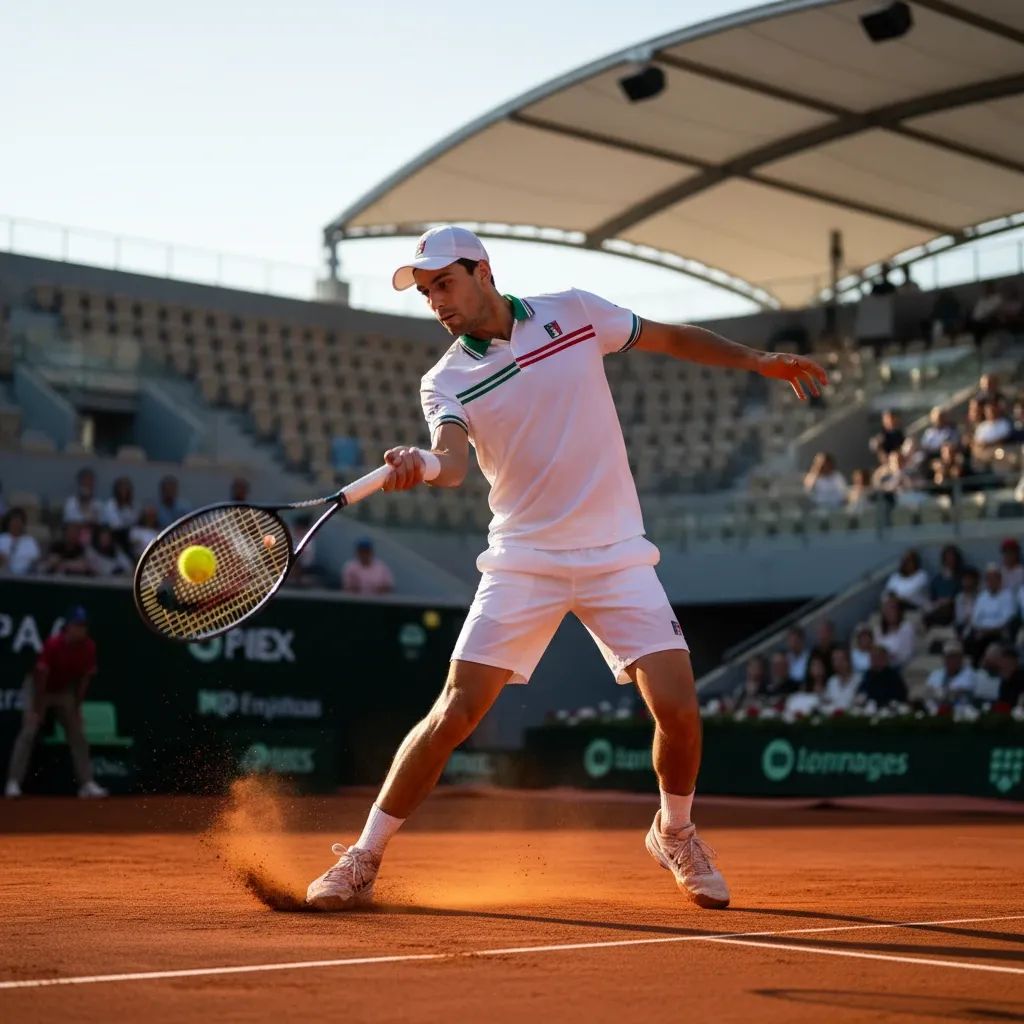
Jannik Sinner has just claimed his first Indian Wells title—the missing piece in an already historic hard-court résumé. By defeating Daniil Medvedev 7-6, 7-6 in a ruthless display of precision, the Italian secured something only Roger Federer and Novak Djokovic have managed: a complete collection of all six Masters 1000 titles on hard courts. At 24, Sinner is now the youngest player ever to achieve this feat, and the implications ripple far beyond California.
Why This Matters
• Tactical mastery at peak moments: Sinner faced zero break points across two hours of play, losing just five points on his first serve out of 47 attempts—a conversion rate of 89% that reflects both technical excellence and emotional control.
• Ranking momentum accelerates: The 1,000-point haul narrows his gap behind Carlos Alcaraz from 3,150 to 2,200 points, with Sinner holding zero ranking points to defend until May's Rome event while Alcaraz must protect significant gains across Monte-Carlo, Barcelona, and Miami.
• Italian tennis reaches historic high: For the first time in the sport's modern era, Italy now has four men inside the ATP Top 20—a benchmark achieved just this week with Luciano Darderi's entry at No. 18.
The Mental Edge That Closed Out Indian Wells
What distinguished Sinner's performance was less about raw power and more about when and where he applied force. Against a resurgent Medvedev—who had just eliminated world No. 1 Alcaraz—Sinner never surrendered a single set across the entire tournament. The second set's tie-break encapsulated his mettle: trailing 0-4, he calmly reeled off seven consecutive points to secure the trophy, a sequence that left observers questioning whether Medvedev had ever truly possessed control.
Renzo Furlan, the ex-Italian pro and longtime coach of Jasmine Paolini, was precise in his analysis during an interview with Rai Radio 1. "Jannik is serving at the absolute peak of his powers," Furlan observed. "When the moment becomes difficult, he escapes through the first serve. That's his trademark—he constantly refines these small, almost invisible improvements that keep him at championship level."
The serve, in fact, represents Sinner's most glaring evolution. Across 57 service games throughout the tournament, he surrendered his delivery just twice. Ten aces in the final alone showcased an attacking dimension that had previously lagged behind his superior court coverage and baseline consistency. On hard courts—where pace compounds and reaction time compresses—this weapon transforms into a psychological asset.
Italy's Tennis Moment Goes Beyond One Player
The timing of Sinner's breakthrough is inseparable from Italian tennis's broader surge. Lorenzo Musetti holds steady at No. 5, while Flavio Cobolli just clinched a career-high ranking of No. 14 following his mixed doubles victory at Indian Wells alongside Switzerland's Belinda Bencic. Then came the symbolic moment: Luciano Darderi, a South Tyrolean who represents Italy, ascended to No. 18, becoming the 14th Italian man to crack the ATP's elite echelon since rankings began in 1973.
This convergence matters commercially and culturally. Italian broadcasters Rai and Sky Sport Italia have expanded court time for tennis; stadium viewings in Milan, Rome, and Turin now routinely draw thousands during majors. Tennis academies across the peninsula report waiting lists driven explicitly by the "Sinner effect," with families eager to enroll children into junior programs. Sponsorship from Italian luxury brands—from Lavazza to major fashion houses—has surged, embedding racquet sports into a cultural identity that hasn't seen this level of enthusiasm since the 1970s.
For the Davis Cup, Italy's prospects have sharpened considerably. With Sinner anchoring a squad of Top 20 depth, plus Paolini thriving at No. 7 on the women's circuit, the federation possesses genuine title credentials and unmatched home-crowd advantage if hosting duties arise.
The Clay Season: Where Real Supremacy Is Decided
But Indian Wells, for all its prestige, remains merely a waypoint. Sinner himself acknowledged this during the post-match press conference: "I have a couple of days to rest, but Miami is coming immediately—another equally important event. When you have this rhythm, you absolutely cannot lose it." His tone suggested not relief but preparation for the next campaign.
The genuine battle for the world No. 1 ranking will unfold on European clay starting in April. Here, Sinner enters with a structural advantage: he carries no points to defend until Rome's Internazionali d'Italia in May. In contrast, Alcaraz must shield 1,000 ranking points from his Monte-Carlo title, 330 from Barcelona, and 10 from Miami. By April 6, Alcaraz will equalize Sinner's record of 66 weeks at world No. 1—a milestone approaching fast. Yet the momentum dynamic shifts immediately after, particularly if Sinner performs across Monte-Carlo (April 13–20), Barcelona (April 19–27), and Madrid (May 1–11).
Furlan voiced cautious optimism about the red-clay prospects. "I'm genuinely curious how Sinner navigates the clay season. He possesses the weaponry to capture one or even multiple Masters 1000 titles on this surface. He's intensely driven, particularly after the Roland Garros disappointment from 2024. The only genuine threat? Always the same—Alcaraz."
That caveat carries weight. While Sinner reached the Roland Garros semifinals in 2024, he hasn't yet won a clay Masters 1000, let alone competed for a major on dirt. Alcaraz, by contrast, has proven his versatility across all terrains. Yet Sinner's recent trajectory—calmness under duress, tactical flexibility, enhanced serve—suggests the gap is narrowing.
The Clostebol Chapter: Symbolism of a Comeback
Adding layered significance to this Indian Wells victory is its immediate historical context. Exactly one year ago, Indian Wells was the tournament Sinner couldn't attend. The Clostebol contamination case—in which trace quantities of the banned anabolic steroid were detected in his system, later attributed to his physiotherapist's massage treatment—forced his withdrawal and sparked a season-long investigation. Although ultimately cleared of intentional wrongdoing, the episode carved into his momentum and narrative.
Furlan reflected on the symbolic weight. "The fact that he won Indian Wells after all those Clostebol complications makes this victory feel that much sweeter. I genuinely believe that wound is fully healed now. Jannik remains elite, and one of his greatest assets is that he's an extraordinarily intelligent and deeply motivated individual." The win, in other words, transcends tennis—it signals restoration and resilience to a player who endured months of uncertainty.
Immediate Horizon: Miami, Then the Clay Gauntlet
The compressed schedule offers no breathing room. Miami begins imminently, dangling another 1,000 ranking points. Sinner faced California's crushing heat—temperatures surpassed 35°C during several matches—without apparent struggle. "I felt exceptionally prepared, so I didn't encounter major climatic challenges, which is tremendously positive for me," he reported, underscoring the consistency of his physical conditioning and mental equilibrium.
Miami's outcome will determine the psychological tenor entering clay season. A victory there would furnish momentum; an early loss might necessitate rapid recalibration. Either way, Rome awaits in May as the season's defining moment—a Masters 1000 on home soil where Italian expectations surge. Beyond Rome lies Roland Garros, where Sinner's capacity to sustain five-set intensity on a surface demanding aggressive sliding will define whether 2026 becomes his breakthrough year on clay or merely a year of hard-court consolidation.
Endurance and the Year Ahead
Sinner's ability to perform across surfaces and sustain elite output remains the open question. While he now holds nine major hard-court titles including the Australian Open, US Open, and ATP Finals, clay introduces variables his relatively lean physique hasn't yet mastered. Five-set matches demand explosive power and precise sliding—elements that separate champions from runners-up.
Yet the evidence points toward readiness. Those five lost points on first serve from 47 attempts? Not mere statistics but reflections of a player operating at peak calibration. Furlan crystallized it: "He's the most mentally acute player competing today. He understands that the toughest matches, against the strongest rivals, hinge on perhaps three or four decisive moments."
As Sinner departs Indian Wells with another trophy secured and a place alongside tennis immortals, the sport watches to see whether this generation can challenge the Alcaraz-led order. For Italy, the answer crystallizes weekly: the nation possesses not merely a champion but a generation inspired and equipped to win anywhere, regardless of surface or opponent.


