
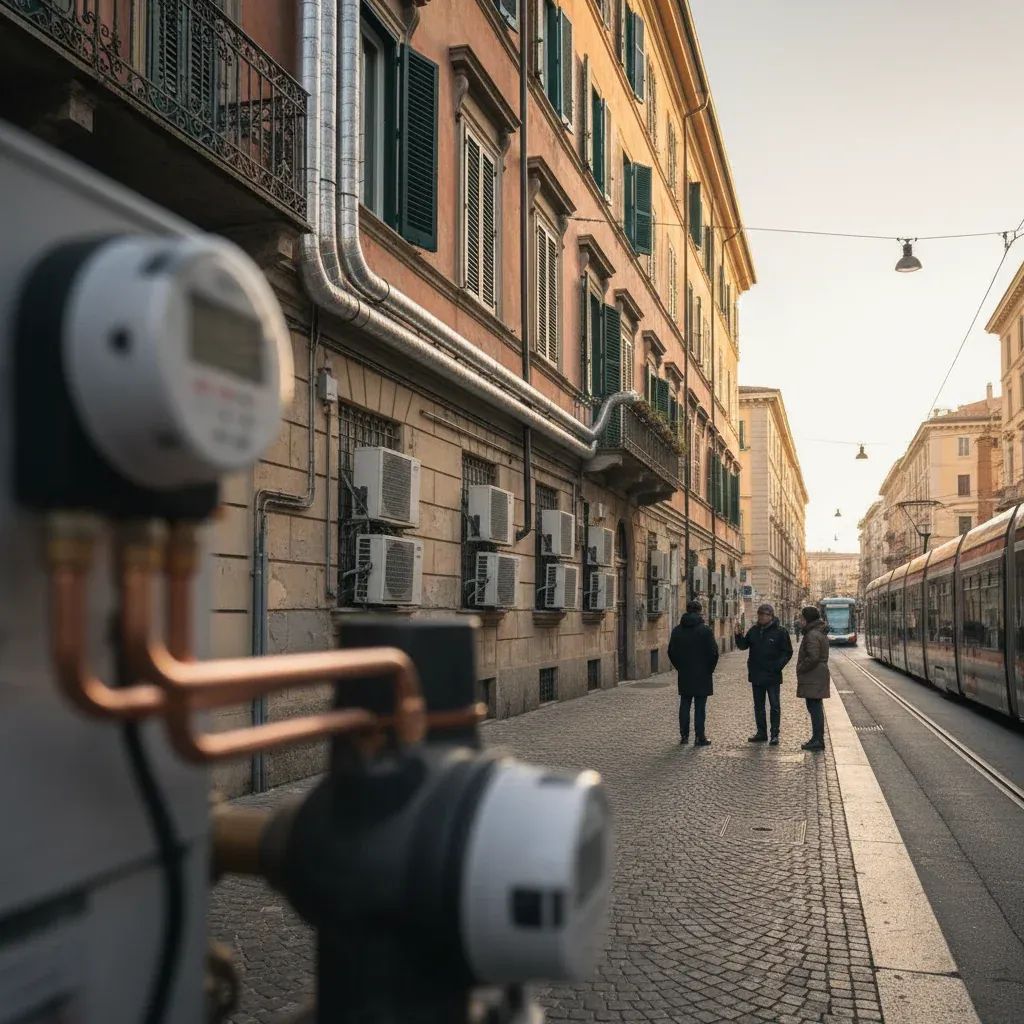
Italy's household energy bills face a sharp climb as tensions in the Middle East threaten to erase months of relief at the pump and on heating costs. Drone strikes on Qatar's liquefied natural gas (LNG) facilities and looming restrictions at the Strait of Hormuz have sent European gas futures rocketing past €43 per megawatt-hour—the highest level in 13 months—while crude oil breaches $78 per barrel.
Why This Matters
• Immediate bill impact: Wholesale gas price jumps are expected to translate into higher monthly energy bills for Italian households in the coming weeks, according to energy market analysts.
• Strategic vulnerability: Europe's gas storage sits at just 31% capacity, well below the 40% recorded at this time last year, leaving Italy exposed to supply shocks.
• Inflation risk: Analysts estimate prolonged disruption could push core inflation up by 0.3% to 0.7% across the eurozone, hitting groceries, transport, and manufactured goods.
• Industrial production threat: If prices breach €100/MWh for more than two months, energy-intensive Italian factories—including steel, glass, and ceramics—may be forced to scale back or halt operations.
What Happened in Qatar
The world's largest LNG production complex at Ras Laffan in Qatar went offline following military drone strikes, a development that sent tremors through global energy markets. QatarEnergy, the state-owned producer responsible for roughly one-fifth of global LNG exports, confirmed it had halted output at both Ras Laffan and the Mesaieed facility. The company has not specified when production will resume.
Qatar draws its gas from the North Field, the planet's largest non-associated natural gas reserve, which it shares with Iran. Before the attack, the Gulf state was on track to expand annual LNG production from 77 million tonnes to 142 million tonnes—an 85% increase—cementing its role as a cornerstone supplier to Europe, which has leaned heavily on seaborne LNG since cutting Russian pipeline imports in 2022.
The timing could not be worse. Europe's gas inventories are running thin after a colder-than-expected winter, and Italy's reliance on imports—primarily via pipeline from North Africa and LNG terminals—makes it particularly vulnerable to disruptions in the Middle East supply chain.
Markets React with Historic Surges
At the Amsterdam TTF hub, the European benchmark for natural gas, futures for April delivery soared 36% to €43.80/MWh. That marks the steepest single-day gain since the early weeks of the Russia-Ukraine conflict and eclipses levels seen at any point in the past year. In London, the equivalent UK market jumped 37.7% to 109.24 pence per British thermal unit (Btu).
Crude oil markets mirrored the reaction. West Texas Intermediate (WTI) crude climbed 7.1% to $71.79 per barrel, while Brent crude—the global benchmark—hit $78.12, up 7.2%.
Yet it is natural gas, not oil, that poses the most immediate threat to Italian consumers. Unlike crude, which has alternative supply routes and strategic reserves, LNG relies on a fragile web of liquefaction terminals, shipping lanes, and regasification infrastructure. A single chokepoint—like the Strait of Hormuz—can disrupt the entire system.
The Strait of Hormuz: Europe's Vulnerable Chokepoint
Roughly 20% to 30% of the world's seaborne oil and a comparable share of LNG pass through this narrow waterway between Iran and Oman. Military analysts warn that heightened tensions in the region have already slowed tanker traffic, with several shipping companies rerouting vessels to avoid potential conflict zones.
Goldman Sachs has modeled a scenario in which a month-long closure of the strait would push TTF gas prices to €74/MWh—a significant 130% increase from pre-crisis levels. If disruptions last beyond two months, prices could exceed €100/MWh, a threshold that historically triggers reduced industrial demand, meaning factories and power plants curb consumption to avoid unsustainable fuel costs.
In such an extreme scenario, Italian household energy bills could rise substantially compared to early 2026 baseline levels, though the actual impact would depend on how long disruptions persist and energy storage levels.
What This Means for Italian Residents
Italy's vulnerability stems from a combination of depleted gas storage, dependence on LNG imports, and limited pipeline diversity. The PSV (Punto di Scambio Virtuale), Italy's virtual exchange point for natural gas trading, tracks closely with TTF movements, meaning price shocks in Amsterdam are reflected in Italian consumer bills relatively quickly.
For the average Italian household, a sustained increase in wholesale gas prices translates to higher energy bills under the regulated tariff system, which still covers millions of residential customers. Even those on free-market contracts will feel the impact, as suppliers adjust rates based on commodity costs.
Beyond heating and electricity, rising energy costs affect prices across the economy—from bread, as bakeries rely on gas ovens, to transportation, as diesel and gasoline prices track crude oil. Small and medium enterprises, the backbone of Italy's economy, face difficult choices: absorb higher costs and sacrifice margins, or pass them on to consumers and risk losing business.
Insurance Markets Freeze, Complicating Recovery
Adding to supply concerns, several major maritime insurers have suspended war-risk coverage for vessels operating in the Persian Gulf. This decision effectively raises the cost of shipping LNG out of Qatar, even if production resumes, and may deter operators from risking expensive tankers in contested waters.
The insurance restrictions compound supply fears. Even if QatarEnergy restarts its facilities within days, the logistical bottleneck at sea could keep spot prices elevated for weeks. European buyers may be forced to compete more aggressively for cargoes from the United States and Australia, driving up costs across the board.
Long-Term Outlook: Will Prices Stay High?
Before the crisis erupted, forecasters had predicted a relatively stable year for European gas. Goldman Sachs projected TTF would average around €36/MWh in March 2026, while the U.S. Energy Information Administration expected modest increases tied to growing LNG export capacity and data center demand.
Those forecasts now face significant uncertainty. If the Middle East situation stabilizes quickly—meaning Qatar resumes output and the Strait of Hormuz remains open—prices could retreat toward the €35–€40/MWh range by late spring. However, if tensions escalate or additional infrastructure is targeted, Europe could face a summer supply crunch, especially if utilities fail to refill storage ahead of next winter.
For Italy, the message is clear: energy security remains a concern. The country's ambitious plans to expand renewable capacity and reduce fossil fuel dependence remain years away from full implementation, leaving households and businesses exposed to geopolitical risks affecting distant but critical energy sources.
Italian consumers should monitor their energy usage and consider practical efficiency measures—installing smart thermostats, improving insulation, and shifting electricity use to off-peak hours—to manage costs during this period of market uncertainty. Policymakers face difficult decisions about price supports and accelerating the transition away from gas dependence.


