
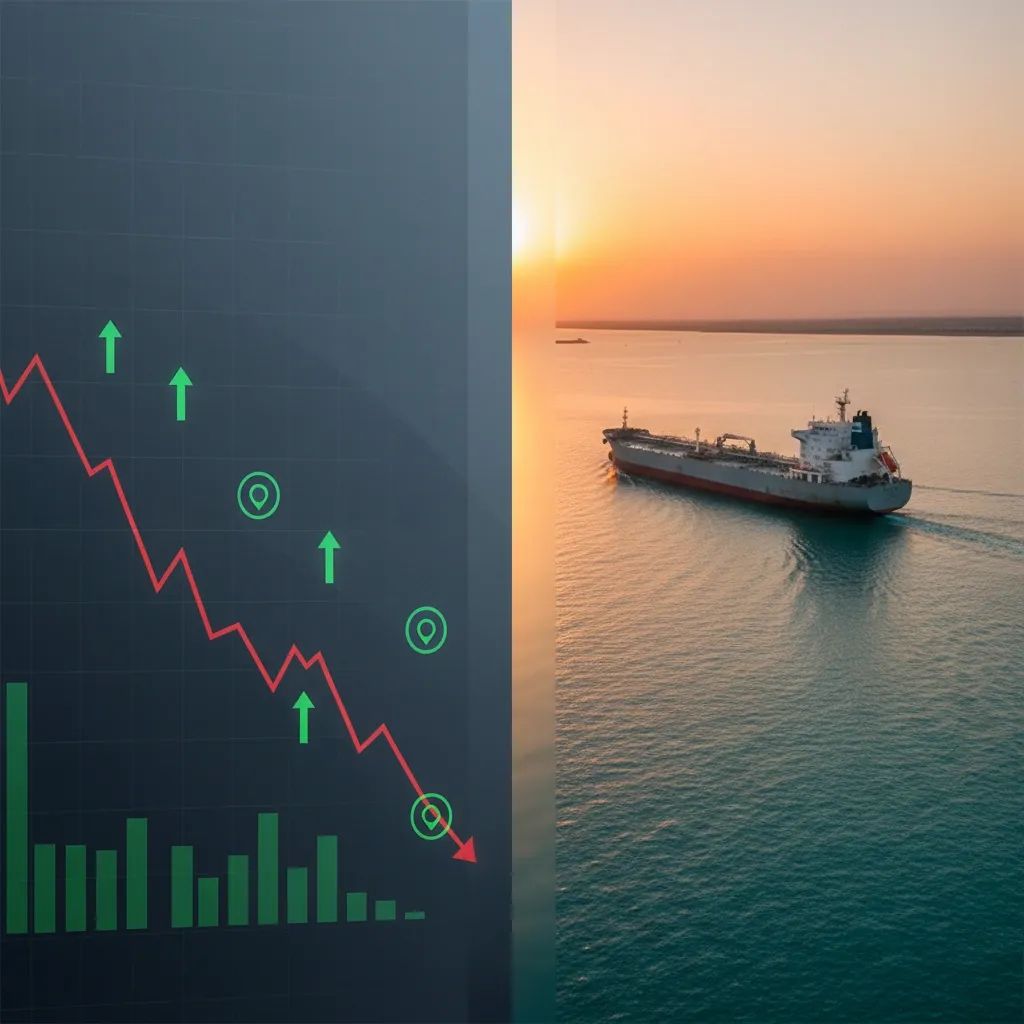
The U.S. Energy Department has triggered a dramatic collapse in global energy prices after announcing—then deleting—a statement about military escorts through the Strait of Hormuz, sending oil futures into a 15% freefall within minutes and pulling natural gas prices down in its wake. The whipsaw reversal offers temporary relief to Italian households and businesses bracing for surging fuel costs, but the abrupt policy communication has left markets uncertain whether Washington can genuinely secure the world's most critical oil chokepoint.
Why This Matters
• Fuel costs in flux: Crude plunged from above $100 per barrel to roughly $80, potentially easing pressure on Italian diesel and heating bills—though pump prices remain sticky due to 69% tax burden.
• European gas down 16%: Amsterdam TTF futures closed at €47/MWh, retreating from the €70 spike driven by Middle East conflict fears.
• Milan stock exchange surged 2.6% on the energy price relief, with banking stocks leading gains as inflation concerns temporarily eased.
The Deleted Post That Moved Markets
U.S. Energy Secretary Chris Wright announced that the American Navy had successfully escorted a tanker through the Strait of Hormuz, declaring it proof that "oil will continue flowing to global markets." He subsequently removed the message, offering no public explanation. Neither the White House nor the Pentagon confirmed the operation, and Iran's Revolutionary Guards flatly denied any U.S.-escorted vessel had passed through the waterway, which handles roughly one-fifth of the world's crude supply.
Wright's inconsistent public communications followed escalating rhetoric about tanker transits through the strait. He announced moves signaling that American military protection could facilitate passage and predicted energy price spikes would last "weeks, not months," assuring that American retail gasoline would drop below $3 per gallon. He subsequently reiterated that vessels were transiting the passage—though only a fraction of the typical 80 to 90 daily tankers—and signaled regular traffic could resume under potential military protection.
The uncertainty over whether the escort actually occurred, combined with Wright's swift deletion, left traders scrambling to interpret Washington's ability—or willingness—to guarantee safe passage. Markets chose optimism, at least for now.
Impact on Italian Energy Bills and Inflation
For Italy, which imports the vast majority of its oil and natural gas, the energy price reversal offers potential relief from rising costs that consumer groups and industry analysts have warned about. Consumer advocates have raised concerns about increased household expenses from fuel, utilities, and grocery inflation, while industrial groups had warned of substantial additional energy expenses in 2026. The sharp drop in wholesale prices should eventually filter through to electricity and heating bills, though the lag can stretch weeks.
Italy's retail fuel market remains heavily taxed, meaning pump prices for diesel and gasoline drop more slowly than crude benchmarks. Consumer groups have renewed calls for an immediate 20-cent per liter cut in fuel excise duties to prevent speculation and ensure consumers see tangible relief.
Lower energy costs also ease pressure on the European Central Bank to keep rates elevated, potentially giving Italian borrowers—both sovereign and private—more breathing room. The Italy–Germany bond spread tightened modestly as markets reacted to the energy news, reflecting reduced near-term inflation risk.
Italian Markets Lead European Rally
European equity markets surged on the energy price collapse, with Milan leading the charge. Milan's FTSE MIB climbed 2.6%, led by Unicredit, STMicroelectronics, and Mediobanca, each up more than 5%. The strong Milan performance reflected investor confidence that energy relief would particularly benefit Italy's energy-intensive manufacturing sector.
Across Europe, Spain's IBEX gained 2.9%, Frankfurt's DAX rose 2.3%, and Paris added 1.8%. Energy-sensitive sectors benefited most, though Italy's Eni slipped 0.6% as lower crude prices squeeze upstream margins.
Wall Street remained subdued, trading barely above flat for most of the session. Traders appeared less convinced that the Strait of Hormuz situation had genuinely stabilized, especially given the lack of official confirmation and Wright's retraction.
The euro held steady against the dollar, reflecting a market still waiting for clarity on whether energy supply disruptions have truly eased or merely paused.
Middle East Production Cuts Complicate the Picture
Complicating the price moves, several Gulf producers have sharply curtailed output. According to Bloomberg, Saudi Arabia reduced production by 2 to 2.5 million barrels per day, while the United Arab Emirates cut between 500,000 and 800,000 barrels daily. Kuwait trimmed output by half a million barrels, and Iraq slashed a massive 2.9 million barrels per day.
These cuts, likely intended to stabilize prices amid geopolitical chaos, are now amplifying the downward pressure as traders bet on reduced demand risk if the Strait of Hormuz remains open. The dynamic mirrors early pandemic-era volatility, when supply and demand shocks collided unpredictably.
G7 Coordination and Strategic Reserves
Finance ministers from the G7 nations—meeting amid the energy turmoil—pledged to deploy "any tool available," including tapping strategic petroleum reserves, to cap crude prices. Energy ministers followed up with more detailed contingency planning during a session in Paris chaired by French Economy Minister Lescure.
The coordinated stance signals concern that prolonged high energy costs could derail fragile post-pandemic recoveries across advanced economies. Italy, particularly exposed due to its manufacturing base and lack of domestic fossil fuel production, stands to benefit disproportionately if G7 reserve releases materialize.
Volatility Far From Over
Despite the dramatic one-day reversal, energy analysts caution that the Strait of Hormuz remains a flashpoint. A single escorted tanker—if it even occurred—does not constitute a reopened chokepoint. Iran retains the military capacity to interdict shipping, and the broader U.S.–Iran confrontation shows no signs of resolution.
European natural gas prices, while down sharply, remain well above pre-crisis norms. The Amsterdam TTF benchmark at €47/MWh is still elevated compared to the 2024 average, and any renewed supply threat could send prices spiking again. The European Commission continues monitoring gas storage levels, which are currently stable but could tighten if the conflict drags into spring and summer refilling season.
What Italy Needs to Watch
Italian policymakers and consumers should track several indicators in the coming weeks:
• Confirmed tanker traffic through Hormuz: One vessel does not restore normal flows. Look for shipping data showing sustained crossings.
• U.S. military posture: Whether Washington formalizes escort operations or deploys additional naval assets will signal commitment to keeping the strait open.
• Retail fuel lag: Wholesale crude drops take time to reach Italian gas stations. Pressure on the Italy Revenue Department to cut excise duties may accelerate pass-through.
• Electricity tariff adjustments: Italy's regulated energy pricing mechanisms update quarterly; April revisions will be critical.
• European reserve releases: G7 talk is cheap until barrels actually hit the market. Watch for announcements from the International Energy Agency coordinating reserve drawdowns.
Political and Regulatory Angles
Italy's government faces renewed calls to intervene directly in fuel markets. Consumer advocates argue that without immediate excise cuts, Italians will not see meaningful relief despite the crude collapse. The proposal for a "mobile excise tax" that adjusts automatically with crude prices remains a subject of debate, with successive governments resisting due to revenue concerns.
On the EU level, Italy has been pushing for reforms to decouple electricity prices from natural gas costs, a structural issue that magnified the 2022 energy crisis. The current volatility may strengthen Rome's hand in Brussels, especially if other member states grow weary of repeated price shocks.
Market Psychology and the Road Ahead
The deleted tweet, the lack of official confirmation, and the mixed signals from Washington underscore how fragile market sentiment remains. Energy prices are being driven less by fundamental supply-demand balance and more by geopolitical headline risk. That makes forecasting difficult and leaves Italian businesses and households vulnerable to sudden reversals.
For now, the drop offers breathing room. Whether it lasts depends on facts still unfolding in the Persian Gulf—and whether Chris Wright's next post stays online long enough for markets to believe it.


