
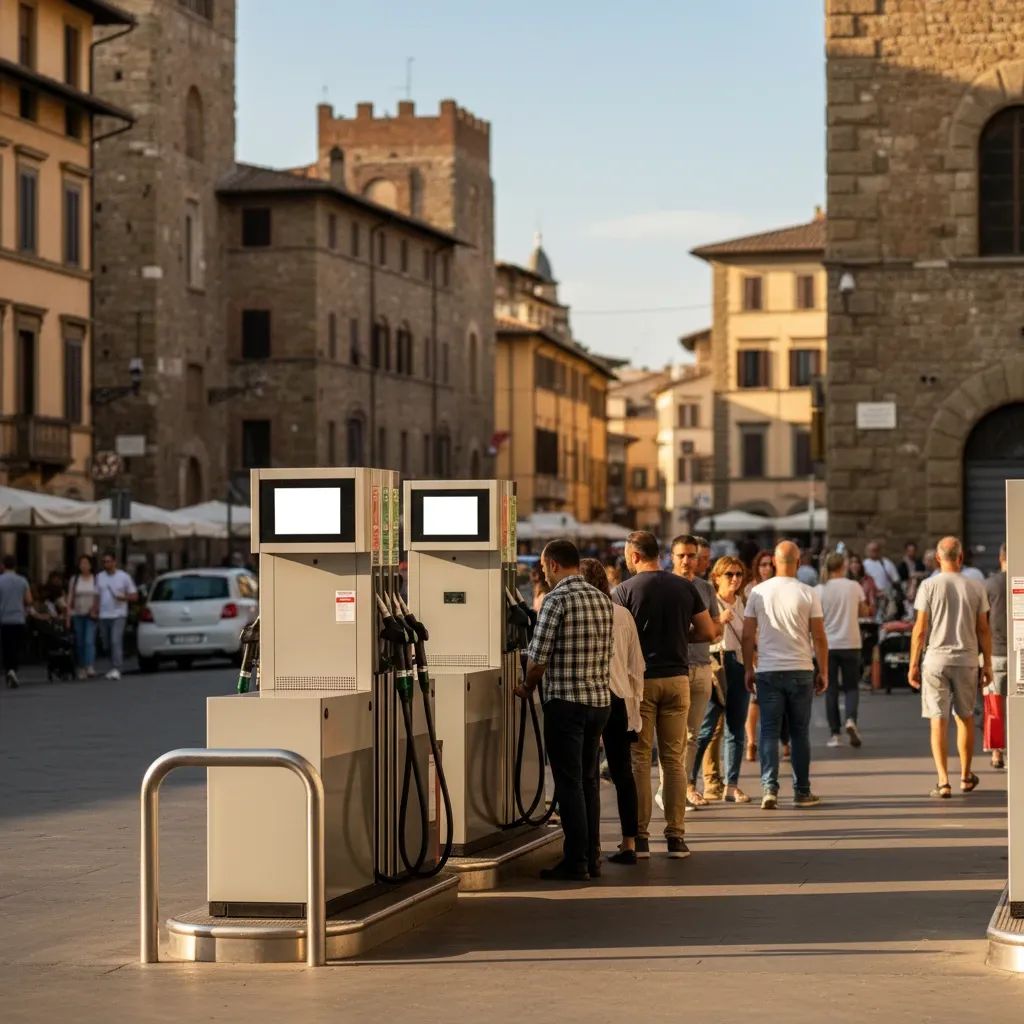
The Italy Oil Market is experiencing sharp volatility as crude benchmarks swing between triple-digit levels and sudden retreat, driven by conflicting signals from U.S.-Iran diplomatic talks that are reshaping global energy flows and threatening the budgets of Italian households and businesses.
Why This Matters
• Brent crude has dipped below $110/barrel after briefly touching $115, while WTI fluctuates near $115, with traders reacting to every diplomatic rumor.
• A prolonged closure of the Strait of Hormuz has already driven a $20/barrel spike since late February, adding risk premiums that translate directly to pump prices across Italy.
• Bank of Italy warns that sustained high oil costs could push Italian inflation to 2.6% this year and trigger zero growth in 2026, with recession risk looming in 2027.
• Motorists and logistics firms face mounting costs as jet fuel, diesel, and gasoline prices climb in tandem with crude swings.
The Diplomatic Whiplash Driving Price Swings
North Sea Brent crude dropped 0.07% to $109.6/barrel on Tuesday, retreating from recent highs as markets digested mixed signals about progress in negotiations between Washington and Tehran. West Texas Intermediate (WTI), the U.S. benchmark, surged as high as 5% earlier in the session before settling at $114.6/barrel, up 1.97%.
The sudden reversal reflects the hair-trigger sensitivity of energy markets to geopolitical news. Traders are pricing in both the possibility of a diplomatic breakthrough that could ease sanctions on Iranian oil exports and the risk of further escalation that would tighten supply even more. Each rumor of progress sends futures sliding; every hint of breakdown triggers panic buying.
The volatility stems from a deadline imposed by U.S. President Trump for a resolution to the talks, which have been underway since the outbreak of armed conflict on February 28, 2026. That confrontation involved joint U.S.-Israeli strikes on Iranian targets and subsequent Iranian retaliation, effectively shutting down transit through the Strait of Hormuz—a chokepoint responsible for roughly 20% of global oil and liquefied natural gas flows.
What the Hormuz Shutdown Means for Italy
For Italian consumers and businesses, the stakes are painfully concrete. The near-total halt of tanker traffic through the strait has removed millions of barrels per day from global supply, forcing European buyers to source crude from more distant and expensive markets. Shipping costs have surged, and the risk premium embedded in oil prices—estimated at $14/barrel by some analysts—is being passed directly to refiners and ultimately to the pump.
Italy's fuel market is acutely vulnerable to these shifts. The country imports the vast majority of its crude and refined products, and elevated oil prices feed through rapidly to inflation. The Bank of Italy has explicitly warned that persistently high energy costs could derail the fragile recovery, pushing headline inflation above the European Central Bank's target and forcing policymakers to maintain restrictive interest rates longer than hoped.
For the average Italian driver, that translates to higher costs at the pump—potentially equivalent to an extra month's fuel budget over the course of a year. Logistics and manufacturing firms, already navigating post-pandemic supply chain disruptions, face margin compression as diesel and industrial energy costs climb.
The Iran Factor: What a Deal Could Unlock
If U.S.-Iran negotiations produce a breakthrough, the impact on oil markets could be swift and substantial. A lifting of sanctions on Iranian crude exports would allow Tehran to ramp up production toward 3.6 million barrels per day by late 2027, according to estimates. Analysts project that such an influx could knock $5/barrel off global prices in the near term as new supply hits the market.
For Italy, that would mean relief at the pump and a moderation in inflation pressures, easing the burden on household budgets and giving the European Central Bank more room to cut rates. The reappearance of Iranian barrels would also ease the strain on global refining capacity and reduce the scramble for alternative sources.
However, the International Energy Agency (IEA) has noted that global oil demand growth is expected to remain weak in 2026, with supply already poised to exceed demand even before any Iranian or Venezuelan additions. That dynamic amplifies the potential downside for prices if diplomacy succeeds, but it also underscores how geopolitical risk—not fundamentals—is currently setting the market's tone.
The Escalation Scenario: What Failure Would Cost
The alternative scenario is far darker. If talks collapse and the U.S.-Iran conflict intensifies, oil markets could face a sustained shock. Analysts estimate that a prolonged blockade of the Strait of Hormuz would add $10-15/barrel in risk premiums in a moderate disruption scenario, with extreme escalation potentially pushing Brent above $128/barrel or even toward the 2008 record highs, as Goldman Sachs has warned.
For Italy, such an outcome would be economically crippling. Fuel costs would spiral, inflation would surge beyond manageable levels, and the risk of recession in 2027 would become a near certainty. The knock-on effects would ripple through logistics, manufacturing, and consumer spending, compounding the pain of already-elevated energy costs.
Natural gas markets would also take a hit. A sustained disruption of LNG flows through Hormuz could push European TTF gas prices toward €74/MWh for a one-month interruption, or above €100/MWh if the closure persists—a nightmare scenario for Italian households and industries still recovering from the 2022 energy crisis.
What Analysts See Ahead
Oil price forecasts for 2026 and 2027 span a wide range, reflecting deep uncertainty about both geopolitical outcomes and underlying supply-demand fundamentals.
Goldman Sachs has revised its 2026 Brent forecast upward to $85/barrel (from $77), with the bank suggesting that daily prices could average $110/barrel in March-April if Hormuz disruptions persist. The U.S. Energy Information Administration (EIA) projects Brent at $96/barrel and WTI at $87.41/barrel for 2026, though some EIA analyses suggest Brent could fall to $58/barrel later in the year if geopolitical tensions ease and inventories build.
Bank of America, Standard Chartered, and Barclays have all raised their 2026 Brent forecasts to the $77-85 range, citing the Hormuz factor. J.P. Morgan, however, remains bearish, projecting Brent at $58/barrel and WTI at $54/barrel, arguing that supply will outpace demand regardless of short-term shocks.
For 2027, the consensus tilts toward lower prices as supply from non-OPEC producers (especially the U.S., Brazil, and Guyana) ramps up and inventories accumulate. Goldman Sachs sees Brent averaging $80/barrel in 2027, while the EIA projects $76/barrel for Brent and $72/barrel for WTI. Some forecasts, however, suggest a potential rebound if underinvestment in upstream oil projects creates supply constraints by 2027-2028.
OPEC's Balancing Act
The OPEC+ cartel remains the wild card. The group has opted for a "strategic pause," holding production quotas steady rather than cutting further, in an attempt to stabilize prices without surrendering market share. In May 2026, OPEC+ announced a modest increase of 206,000 barrels per day, a largely symbolic gesture unlikely to alter the tight supply-demand balance significantly.
The organization's ability to manage the market is constrained by internal divisions and the geopolitical chaos in the Middle East. Any decision to flood the market with additional barrels could backfire if demand weakens or if Iranian supply returns unexpectedly. Conversely, holding back too much could push prices into politically unsustainable territory for consuming nations.
Impact on Residents and the Italian Economy
For Italians, the oil price rollercoaster is not an abstract financial market story—it's a direct threat to purchasing power and economic stability. Elevated fuel costs hit every corner of daily life, from commuting and groceries to heating and electricity bills.
The Italy Revenue Department and fiscal authorities are monitoring the situation closely, as higher inflation erodes real incomes and complicates budget planning. The government has limited fiscal space to cushion consumers through subsidies or tax cuts, given existing debt levels and EU fiscal rules.
Businesses, particularly in logistics, agriculture, and manufacturing, are already feeling the squeeze. Higher diesel prices raise input costs across supply chains, forcing companies to choose between absorbing losses or passing costs on to consumers—a choice that risks further inflation or lost competitiveness.
The Bank of Italy's warning of zero growth in 2026 and potential recession in 2027 if oil prices remain elevated is not alarmist rhetoric—it reflects the real vulnerability of an import-dependent economy to external energy shocks.
What to Watch
The coming weeks will be critical. Any concrete progress in U.S.-Iran talks—or conversely, any sign of breakdown—will send shockwaves through oil markets and directly affect Italian consumers. The Strait of Hormuz remains the pivot point: its reopening would ease supply fears and likely trigger a price correction; continued closure would keep markets on edge and prices elevated.
Traders, policymakers, and households alike are watching for signals. In the meantime, Italians should prepare for continued volatility at the pump and brace for the possibility that elevated energy costs may persist longer than hoped.


