
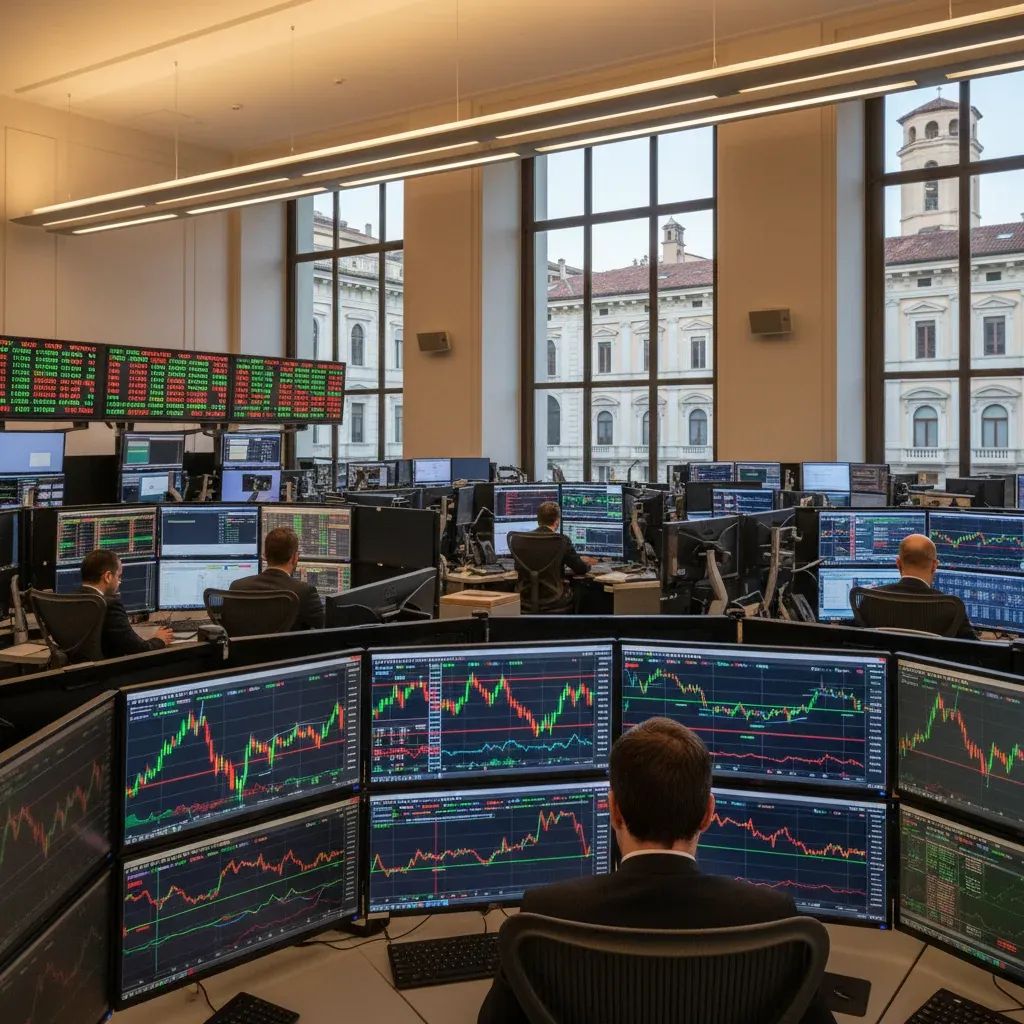
Italy's Piazza Affari closed modestly lower, with the benchmark index declining 0.15% as energy stocks weighed on the broader market amid ongoing geopolitical concerns in the Middle East. The modest downturn reflects a pattern across European equities, with traders monitoring central bank signals and international developments.
Why This Matters:
• Energy sector weakness: Saipem fell 3.4%, Eni declined 2.6%, and Tenaris dropped 1.4%, reflecting sector-wide pressure on the Italy FTSE MIB index.
• Central bank policy: Both the European Central Bank (ECB) and the US Federal Reserve are maintaining restrictive monetary policies, with the ECB having raised rates in June and markets watching for signals at the 23 July meeting.
• Geopolitical uncertainty: International tensions continue to influence energy markets and investor sentiment across Europe.
• Italian sovereign debt: The BTP-Bund spread closed at 78 basis points, with the 10-year Italian government bond yield at 3.66%, indicating relative stability in Italy's debt market.
Energy Sector Under Pressure
The Italian energy complex faced significant selling pressure. Saipem, the offshore drilling and construction company, fell 3.4% despite recent positive analyst commentary. Eni, Italy's energy major, declined 2.6%, while Tenaris, the steel pipe manufacturer serving the energy sector, dropped 1.4%, reflecting broader concerns about project costs amid energy market volatility.
Broader Market Performance
STMicroelectronics declined 3.3% as the technology sector faced headwinds from global demand concerns. Prysmian fell 2%, while Campari dropped 1.7%.
Utility stocks were broadly negative. Snam fell 2%, A2A lost 1.6%, and both Italgas and Enel slid 0.9%. The sector continues to grapple with higher wholesale electricity prices and regulatory pressures.
The financial sector showed mixed results. Generali fell 0.7%, BPER Banca dipped 0.5%, while Banco BPM and Monte dei Paschi di Siena were essentially flat. Intesa Sanpaolo edged up 0.1%, UniCredit gained 0.5%, and Unipol surged 3.9%.
On the upside, Nexi, the digital payments firm, jumped 6.4%, leading the gainers. Amplifon climbed 4%, Leonardo advanced 3.9%, Stellantis rallied 3.3%, and Telecom Italia rose 2.2%.
What This Means for Residents and Investors
For investors in Italy, today's modest market decline reflects normal volatility driven by sector-specific pressures and international developments. Energy stocks remain sensitive to geopolitical factors, and elevated interest rates continue to influence valuations across equity markets.
For households, the broader context of higher energy costs and restrictive monetary policy remains relevant. The transition away from regulated electricity pricing for non-vulnerable customers has placed additional cost considerations on many Italian families. Careful budget planning and consideration of fixed-rate energy contracts remain prudent strategies.
Central Banks Hold Steady
The European Central Bank raised rates by 25 basis points in June, bringing the deposit rate to 2.25%. The next ECB meeting is scheduled for 23 July, with markets monitoring developments closely. Across the Atlantic, the US Federal Reserve has maintained the federal funds rate at 3.50%-3.75%, with market expectations for potential adjustments later in the year.
The synchronized tightening by major central banks continues to influence capital costs for Italian firms and broader financial conditions across Europe.
European Indices Mirror Italian Pattern
Paris's CAC 40 fell 0.79%, London's FTSE 100 dropped 0.18%, Madrid's IBEX 35 shed 0.21%, while Frankfurt's DAX managed a modest 0.18% gain. The pattern reflects a continent-wide market environment where energy-dependent sectors face particular pressure.
Looking Ahead
With earnings reports from key energy companies scheduled for late July, investors will be watching for operational insights. The 23 July ECB decision will also draw close attention from market participants.
For residents of Italy, maintaining a balanced approach to personal finances—including prudent energy management and diversified savings strategies—remains advisable in an environment of elevated volatility and restrictive monetary policy.


