
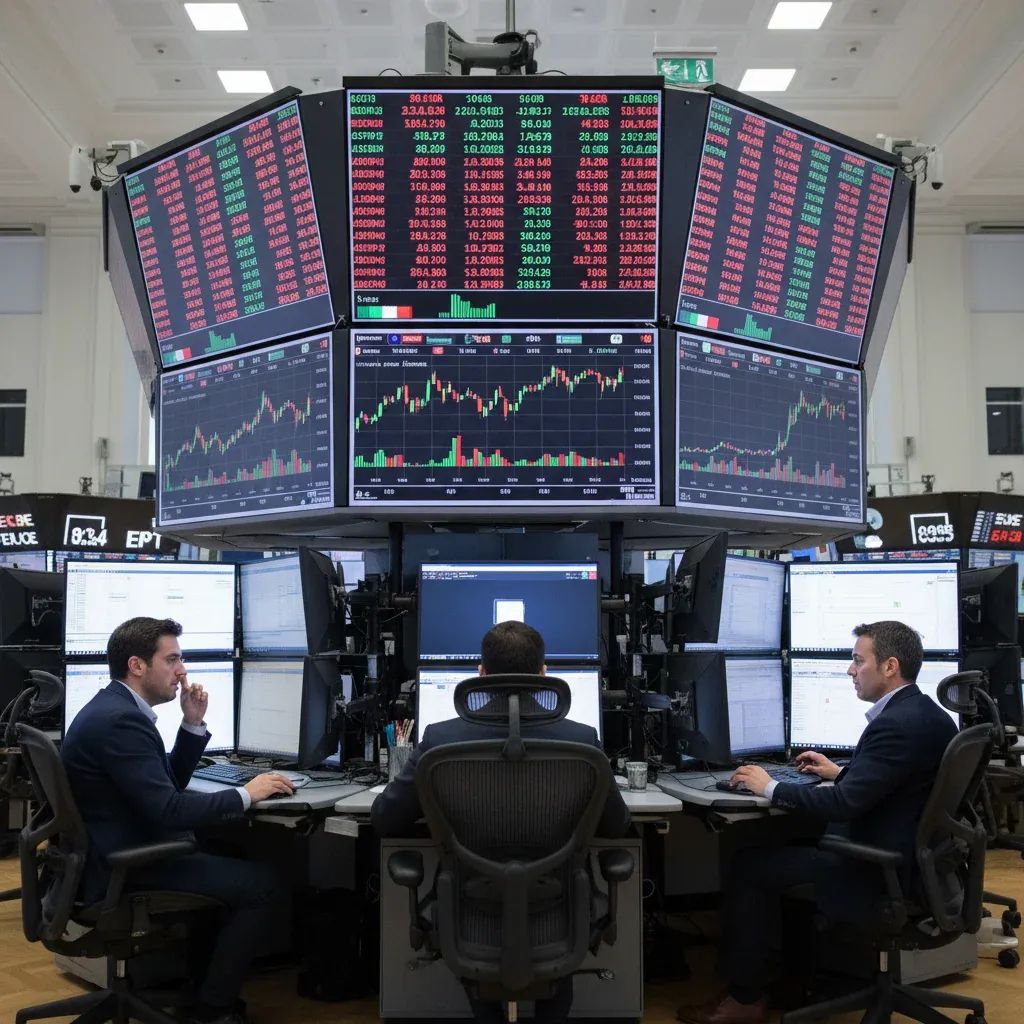
The Milan stock exchange posted a 0.6% gain, outperforming its European peers and extending a tentative recovery after weeks of steep losses driven by Middle East conflict and soaring energy costs. The resilience of Italy's FTSE MIB stood out as investors cautiously returned to risk assets following a brief reprieve in oil prices and mixed signals from Washington on the Iran standoff.
Why This Matters
• Borrowing costs ease gradually: Italy's 10-year BTP yield dropped to 3.72%, with the spread over German Bunds tightening to 77.6 basis points—a positive signal that may eventually translate to slightly lower mortgage and loan rates over time.
• Energy reprieve: Crude oil and natural gas prices fell sharply, offering temporary relief to household bills and industrial input costs across the continent.
• Market volatility persists: Contradictory statements from the Trump administration on Iran create uncertainty that could reverse gains quickly, making this a fragile rally.
Milan Leads European Recovery
Italy's benchmark equity index climbed 0.6% during the session, marking the strongest performance among major European bourses. Madrid's IBEX 35 followed with a 0.45% advance, while Frankfurt's DAX and London's FTSE 100 each added 0.45%. Paris lagged, gaining just 0.2%, reflecting continued caution among French investors.
The broader Stoxx 600 index, which tracks companies across the continent, edged up 0.15%, with energy stocks leading the advance despite the sector's exposure to volatile commodity prices. The modest gains represent a bounce from a significant decline earlier this month when the Stoxx 600 shed approximately 6%, and the FTSE MIB lost 4.16%.
Wall Street provided additional momentum. The Dow Jones Industrial Average opened 0.75% higher at 47,027 points, while the S&P 500 rose 0.45% and the tech-heavy Nasdaq Composite gained 0.25%. The positive sentiment in New York helped stabilize European markets as traders closed positions ahead of the weekend.
Oil and Gas Prices Retreat—For Now
A key catalyst for the rally was the sharp pullback in energy markets. West Texas Intermediate crude dropped 1.8% to $93.90 per barrel, while Brent crude fell 0.95% to $99.40. Both benchmarks had briefly touched $120 earlier this month as the conflict between the United States, Israel, and Iran intensified, threatening supply routes through the Strait of Hormuz—a chokepoint for one-fifth of global oil exports.
The White House granted a temporary exemption allowing purchases of Russian crude, a move designed to ease supply constraints and dampen price spikes. Yet analysts caution that the relief may be short-lived. President Trump's rhetoric has oscillated wildly: mid-week reports suggested he told G7 leaders that Tehran was "about to surrender," only for him to declare that Iran would be "hit very hard" next week. The inconsistency has amplified volatility, with traders struggling to price in the duration and scope of hostilities.
Natural gas prices also retreated, with Amsterdam TTF futures—the European benchmark that influences Italian consumer prices—falling 2.4% to €49.70 per megawatt-hour. Traders cited difficulties managing rapid swings in sentiment, with many closing speculative positions to reduce risk exposure. For Italian households and businesses—heavily reliant on imported gas—the decline offers a modest reprieve from energy bills that surged earlier this year.
What This Means for Italian Investors and Households
The decline in Italy's government bond yields signals positive sentiment for the country's creditworthiness. The 10-year BTP yield fell 2.8 basis points to 3.72%, while the spread over German Bunds narrowed to 77.6 points—down from over 80 points earlier in the week. A tighter spread reflects increased confidence in Italian sovereign debt. For consumers and businesses, this may gradually influence borrowing conditions, though changes typically occur over longer timeframes.
The euro weakened further against the dollar, trading at $1.1475 after touching its lowest level since August earlier in the session. A softer euro has mixed implications: it makes imports—including energy and raw materials—more expensive, feeding into inflation, but it also benefits Italian exporters, particularly in manufacturing and luxury goods sectors that compete globally.
For savers and pension funds exposed to equity markets, the 0.6% gain offers a brief respite after weeks of significant losses. However, the fragility of the rally means portfolio managers are advising caution. Market fundamentals remain challenging amid ongoing geopolitical tensions.
Central Bank Watch: ECB Decision Looms
Investors are now turning attention to the European Central Bank's policy meeting scheduled for March 19. The ECB is widely expected to hold its deposit rate steady at 2.00%, with the main refinancing rate at 2.15%. Analysts assign a 91% probability to no change in rates, though a minority speculate that renewed inflation pressures—fueled by energy shocks—could prompt discussion of rate hikes later in 2026.
For Italian borrowers, the outlook is mixed. While inflation has been moderating, the conflict-driven spike in energy costs threatens to reverse progress. If the ECB pivots toward tightening, mortgage rates and corporate borrowing costs could rise again, weighing on an economy already navigating weak industrial output and sluggish consumer demand.
Geopolitical Uncertainty Clouds Outlook
The trajectory of European markets hinges almost entirely on developments in the Middle East. Trump's statements have sown confusion: he has declared victory, demanded Iran's "unconditional surrender," and threatened further strikes—all within days. Meanwhile, reports suggest Israel is pressing for an extended campaign targeting Iran's oil infrastructure, despite White House reservations.
The Strait of Hormuz remains the critical flashpoint. Should the waterway be blockaded for an extended period, analysts warn that Brent crude could surge to $150–200 per barrel, triggering a global recession. Europe, with its heavy dependence on energy imports and limited fiscal room to cushion shocks, is seen as particularly vulnerable.
Gold prices have climbed as investors seek safe havens, while industrial commodities remain under pressure due to fears of slowing global growth. The Milano bourse's outperformance reflects Italy's relatively diversified export base and lower direct exposure to Middle East energy supplies compared to peers, but the advantage is marginal in a scenario of systemic disruption.
Fragile Gains, Uncertain Horizon
The session's gains represent a technical bounce rather than a shift in sentiment. Trading volumes were moderate, and many institutional investors remain positioned defensively. The Stoxx 600's 0.15% advance barely registers against the significant losses recorded earlier this month, and analysts caution that any escalation in the Iran conflict could erase recent gains within hours.
For residents of Italy, the immediate takeaway is cautious relief: energy costs have stabilized, borrowing conditions have shown modest improvement, and equity portfolios have stemmed losses. But the respite is tenuous. The coming week—with the ECB meeting and potential military escalation—will test whether this rally has legs or is merely a pause in a broader market correction driven by geopolitical turmoil that shows no sign of resolution.


