
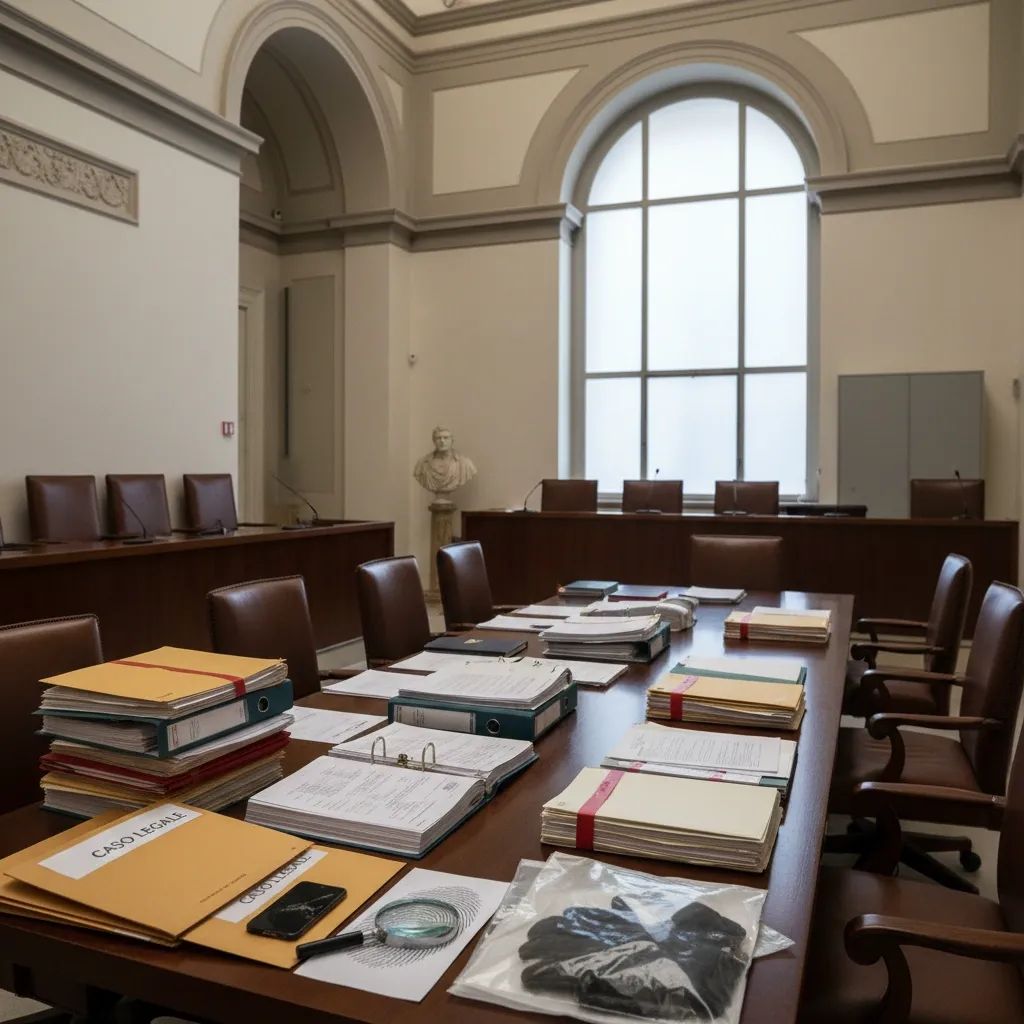
MILAN, February 23, 2026 — The Milan Public Prosecutor's Office has ordered the detention of a 42-year-old police officer accused of voluntary homicide after investigators concluded that he planted a fake weapon next to the body of a suspected drug dealer he shot dead last month. The case—which involves four additional officers under investigation for aiding and abetting—has reignited concerns about accountability, evidence tampering, and excessive force within Italy's law enforcement agencies.
Why This Matters
• Precedent for police accountability: Voluntary homicide charges against an on-duty officer are rare in Italy, where convictions for police violence have historically faced systemic resistance.
• Corruption allegations: Testimony suggests the detained officer regularly extorted money and drugs from dealers in the Rogoredo area, pointing to organized criminal behavior within the local force.
• Forensic breakthrough: DNA evidence and a 23-minute delay in calling emergency services underpin the prosecution's case, potentially setting a new standard for scrutinizing officer-involved shootings.
• Legal risk for colleagues: Four additional officers face charges that could result in prison sentences if prosecutors prove they obstructed justice and withheld aid from the dying man.
The Shooting and Initial Claims
On January 26, Carmelo Cinturrino, an assistant chief stationed at the Mecenate Police Station in Milan, shot and killed Abderrahim Mansouri, a 28-year-old Moroccan national known to authorities for narcotics offenses, in the so-called "drug forest" of Rogoredo—a notorious open-air drug market on the city's southeastern edge. Cinturrino immediately claimed self-defense, stating that Mansouri had pointed a pistol at him during an anti-drug sweep.
First responders recovered a blank-firing replica of a Beretta 92 without the requisite red safety cap beside the victim's body. For weeks, that weapon formed the centerpiece of Cinturrino's narrative: Mansouri had threatened him, he fired to protect himself, and the shooting was justified under Italian law governing legitimate defense.
Yet from the outset, inconsistencies troubled investigators. The autopsy—conducted in early February—revealed that Mansouri had been struck by a single bullet above the right temple, with a lateral trajectory suggesting he was turned sideways when shot. The ballistics report placed the officer between 20 and 30 meters away from the victim at the moment of discharge, a distance that contradicts the imminent-threat scenario typically required to invoke self-defense protections.
Forensic Evidence Unravels the Officer's Story
The breakthrough came from the Regional Forensic Science Unit of the Italy State Police, which processed the blank-firing gun and found no DNA trace of Mansouri on the weapon. Instead, genetic analyst Denise Albani identified two separate DNA profiles—one of which matched Cinturrino himself. Prosecutor Giovanni Tarzia disclosed this finding at a press conference, declaring it a decisive indication that the weapon had been "brought to the scene and placed next to the body at a later stage."
Surveillance footage from cameras outside the Mecenate Police Station captured a colleague retrieving a backpack shortly after the incident, reinforcing investigators' theory that the replica pistol was transported to Rogoredo to stage a defensive shooting. Telecommunications data and witness interviews further undermined the officers' coordinated account of events, revealing discrepancies in their reported movements and timeline.
Most damaging was the 23-minute gap between the shooting and the first emergency call. During that interval, Mansouri lay dying on the ground. Cinturrino allegedly told colleagues he had already alerted medical services—a statement phone records later disproved. Paramedics found the victim still alive when they eventually arrived, but he succumbed to his injuries shortly afterward. Prosecutors argue that the delay was deliberate, allowing officers time to construct an exculpatory narrative and position the fake weapon.
Allegations of Extortion and Personal Vendetta
Beyond the forensics, a disturbing motive has emerged from witness statements collected by the Milan Mobile Squad. Multiple sources—including Mansouri's brother—told investigators that Cinturrino had for months demanded cash and narcotics from dealers operating in Rogoredo, effectively running a protection racket within the drug market. Mansouri reportedly feared the officer and had confided to relatives that Cinturrino "had it in for him," hinting at a personal grudge.
Colleagues of the detained officer described a pattern of aggressive behavior, including what one termed "forced arrests"—detentions initiated not to enforce the law but to intimidate or punish targets. These testimonies paint a picture of an officer who wielded his badge less as a public servant and more as a territorial enforcer, extracting tribute from the very criminals he was supposed to apprehend.
The prosecution's detention order cites not only flight risk and evidence tampering but also the danger of recidivism, warning that Cinturrino could commit further acts of violence if released pending trial. Such language is unusual in Italian judicial filings and reflects the gravity prosecutors assign to the case.
Four Fellow Officers Face Complicity Charges
On February 17, the Milan Prosecutor's Office expanded the investigation to include four additional officers from the Mecenate station, formally charging them with aiding and abetting and failure to render assistance. According to the indictment, the quartet helped Cinturrino evade scrutiny by providing false statements about the sequence of events, the positions and conduct of those present, and the timing of the emergency response.
Crucially, the four allegedly omitted any mention of civilian witnesses at the scene—individuals whose accounts contradicted the officers' version. By withholding this information and synchronizing misleading testimony, prosecutors contend, the officers sought to shield their colleague from a homicide inquiry. The failure-to-assist charge stems from the 23-minute delay: as Mansouri bled out, none of the officers present took action to summon medical help or provide first aid.
Under Italian law, failure to render assistance (omissione di soccorso) carries a prison sentence of up to one year, while aiding and abetting (favoreggiamento) can result in up to four years if the underlying crime is a felony. The four officers have not been detained but remain under formal investigation; their legal status could shift as prosecutors finalize the case file.
What This Means for Residents and Legal Observers
For Italians and foreign nationals living in Milan, the Rogoredo case underscores ongoing friction between marginalized communities and police forces in high-crime areas. Rogoredo has long been a flashpoint for drug-related violence and heavy-handed enforcement, and the zone's reputation as a lawless "boschetto" has sometimes justified aggressive tactics that blur the line between policing and vigilantism.
The case also highlights gaps in police accountability mechanisms. Italy still does not require officers to wear visible identification badges during operations, a fact that has repeatedly hindered efforts to trace responsibility in abuse allegations. Although the 2017 introduction of a standalone torture statute (prompted by the European Court of Human Rights rulings on the 2001 Genoa G8 violence) provided a new prosecutorial tool, convictions remain rare, and a culture of institutional omertà often shields officers from consequence.
Legal experts note that the DNA evidence in this case—and the prosecutors' willingness to move swiftly to detention—may signal a shift in how Milan judicial authorities handle officer-involved shootings. If Cinturrino is convicted on voluntary homicide charges, it would be one of the few successful prosecutions of an on-duty Italian officer for a lethal use of force since the cases of Federico Aldrovandi (2005) and Stefano Cucchi (2009)—both of which required years of litigation and public pressure to yield convictions.
Broader Context: Police Violence and Systemic Impunity
Italy's modern history is punctuated by high-profile incidents of police brutality, from the post-war repression of labor movements to the Diaz school beatings during the Genoa G8 summit and the deaths of detainees such as Riccardo Magherini in Florence (2014). In many of these cases, initial investigations stalled or collapsed amid conflicting testimony, destroyed evidence, and a perceived reluctance by magistrates to challenge law enforcement narratives.
More recently, 25 officers at the Verona police headquarters were charged with torture and assault between July 2022 and March 2023, following reports of "routine gratuitous violence" against suspects in custody. The Rogoredo investigation arrives amid renewed public scrutiny of police conduct, particularly after incidents of baton charges against students in Pisa and Milan in early 2024 drew condemnation from President Sergio Mattarella.
Reporting Police Misconduct in Italy
Residents who witness or experience police violence have several reporting options:
• File complaints directly at Carabinieri or Polizia di Stato offices in your jurisdiction
• Report through hospital staff, who are legally required to notify authorities of suspected abuse or misconduct
• Contact legal counsel; victims may qualify for free legal aid regardless of income if charges involve torture, abuse, stalking, or evidence tampering
• Foreign nationals should also notify their consular services immediately
Documentation—including photos, videos, witness contacts, and medical reports—strengthens cases significantly. Keep copies of all complaint filings and follow up regularly with investigating authorities. Advocacy organizations like Amnesty International's Italy office and local civil rights groups also assist victims in navigating the complaint process.
Next Steps and Trial Timeline
Cinturrino is expected to appear before a Milan judge for a detention review hearing within the next 48 hours. His defense team has not yet commented publicly, but legal observers anticipate arguments centered on the chaotic nature of undercover drug operations and the split-second decisions officers face in dangerous environments.
Prosecutors, meanwhile, are preparing a comprehensive case file that will include ballistic reports, telecommunications metadata, surveillance video, and witness depositions. If the investigating magistrate upholds the detention order, Cinturrino will remain in custody pending the completion of preliminary proceedings, a process that typically takes several months in Italy's notoriously slow criminal-justice system.
The four officers charged with complicity are likely to face separate administrative proceedings within the Ministry of the Interior, which could result in suspension or dismissal even before any criminal verdict. Italian police unions have historically defended members accused of misconduct, but the DNA evidence and documented delay in this case may limit their ability to rally institutional support.
For Mansouri's family, the detention represents a rare acknowledgment of wrongdoing. His brother has called for full accountability and compensation, arguing that systemic corruption in Milan's drug-enforcement units enabled the killing. Advocacy groups are pressing for reforms, including mandatory body cameras, independent oversight boards, and stronger penalties for officers who tamper with evidence or withhold assistance.
A Test Case for Italian Policing Reform
Whether the Rogoredo prosecution heralds a broader reckoning or remains an isolated exception will depend on political will, judicial consistency, and public pressure. For now, the case stands as a stark reminder that even in a functioning democracy, the power imbalance between armed officers and vulnerable individuals—migrants, drug users, those on society's margins—can produce lethal outcomes when unchecked by rigorous oversight and swift accountability.


