
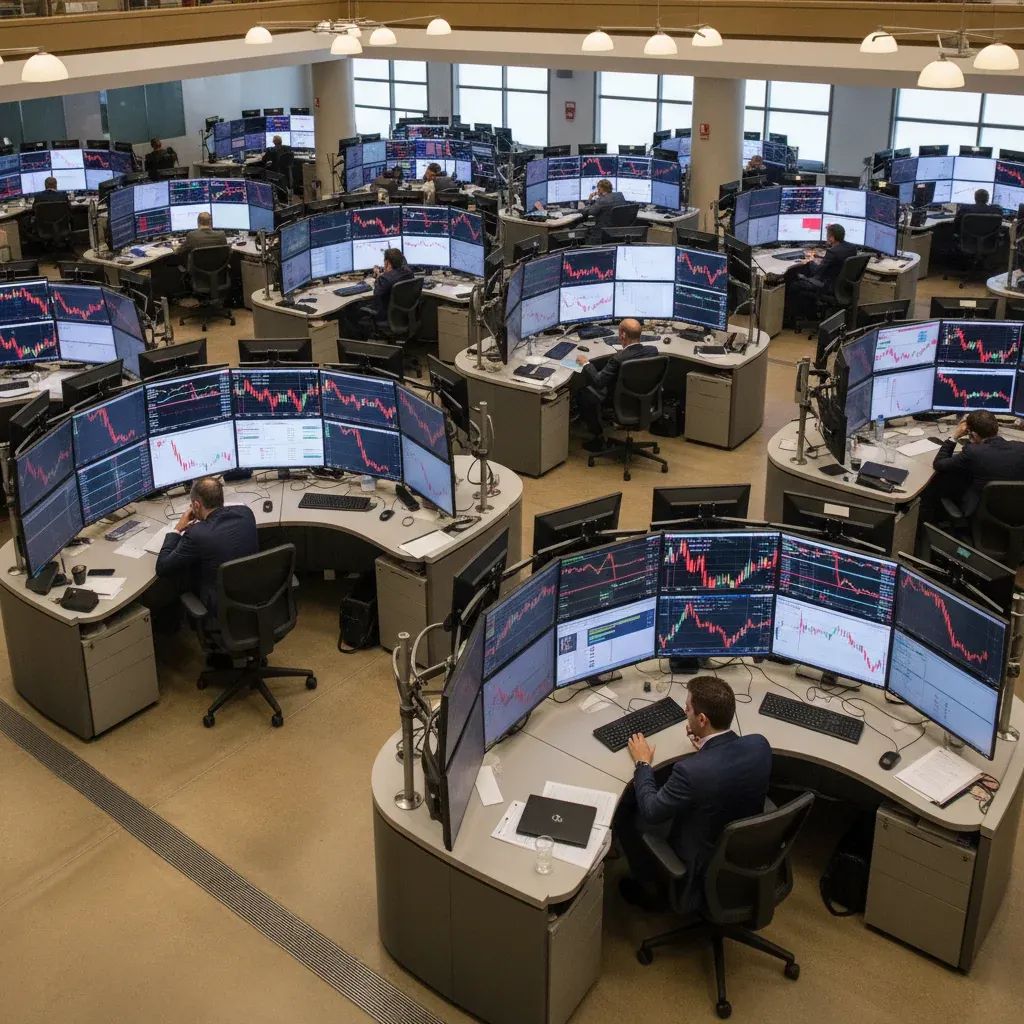
Italy's economy faces a double blow from the Middle East conflict: surging energy bills and a financial market downdraft that wiped out billions in equity value, as attacks on Persian Gulf refineries and gas infrastructure drove Brent crude above $116 per barrel and sent European stock indices into a 2% tailspin.
Why This Matters
• Energy import costs: Italy now faces an estimated €10 billion in additional energy expenses this year alone, according to Italian business groups, hitting manufacturers and consumers.
• Market exposure: Piazza Affari shed 2.4%, with the BTP-Bund spread climbing to 84 basis points and the 10-year Italian yield reaching 3.81%.
• Gas prices: European natural gas spiked 24% to €68/MWh after touching €74 intraday, reigniting fears of a 2022-style supply crunch.
• Strategic vulnerability: Italy's 74% dependence on fossil fuel imports leaves it among the most exposed economies in the eurozone to geopolitical shocks.
The Energy Shock That Europe Wasn't Ready For
The escalation began with a coordinated strike on Iran's key gas fields, followed by retaliatory attacks on refining and export terminals across the Persian Gulf. Within hours, the Strait of Hormuz—through which one-fifth of the world's seaborne oil and natural gas passes—saw tanker traffic collapse by more than 90%, removing millions of barrels from daily supply.
For Italy, which imports roughly three-quarters of its energy needs, the arithmetic is brutal. Natural gas jumped from stable levels to €68 per megawatt-hour by midday Thursday, a 24% surge that translates directly into industrial production costs and household heating bills. The Brent crude benchmark leapt 8.19% to $116, while West Texas Intermediate gained a more modest 0.9% to $97, reflecting the U.S. shale sector's relative insulation from Middle Eastern supply disruptions.
Italian business groups warned that the energy spike alone could erase nearly €10 billion in purchasing power from the industrial base over the next twelve months, compressing export margins in the machinery, automotive, and textile sectors—three pillars of the country's manufacturing economy.
What This Means for Residents
If you live in Italy, the immediate consequence is inflationary pressure on everything from groceries to gasoline. Higher energy costs ripple through supply chains: transportation becomes more expensive, refrigeration and packaging costs rise, and manufacturers pass input-cost increases to consumers. The government has not yet announced targeted subsidies, but officials acknowledge the need to revisit energy relief measures shelved after the 2022 crisis abated.
For savers and investors, the story is equally sobering. The FTSE MIB index opened down 1.17% and extended losses to 2.4% by midmorning. Telecommunications giant TIM fell 2%, fashion house Brunello Cucinelli dropped 2.4%, and infrastructure player Prysmian lost 3.3%. Tower company Inwit was the session's biggest casualty, shedding 8.87% as rate-sensitive growth stocks bore the brunt of the sell-off.
Bond investors saw the 10-year BTP yield climb to 3.81%, while the spread over German Bunds widened to 84 basis points—a level not seen since the banking turmoil earlier this year. That widening reflects both flight-to-quality flows into German debt and fresh doubts about fiscal headroom in Rome, where budget pressures are mounting amid ongoing uncertainty.
European Markets in Synchronized Retreat
Italy was not alone. Frankfurt's DAX fell 2.2%, Paris slipped 1.55%, London shed 1.68%, and Madrid lost 2.3%. The pattern was consistent: energy-importing economies with thin fiscal buffers sold off hardest, while safe-haven assets saw muted demand. Gold, typically a refuge in geopolitical turmoil, actually declined 5% to $4,700 per ounce, as liquidity squeezes and margin calls forced traders to sell profitable positions. Silver fared worse, dropping over 10% to just above $70 per ounce.
The euro held relatively steady at $1.1450, suggesting currency markets view the crisis as a symmetric shock to both the eurozone and the United States rather than a differential blow to European competitiveness.
Asian markets had telegraphed the risk overnight. Tokyo closed sharply lower after the Bank of Japan left rates unchanged, citing uncertainty over inflation trajectories. The U.S. Federal Reserve's recent hawkish message—signaling no imminent rate cuts despite cooling core inflation—added a second layer of pressure, as investors recalibrated expectations for borrowing costs in a world where energy-driven headline inflation may force central banks to stay restrictive longer than anticipated.
The ECB's Dilemma
All eyes turned to Frankfurt, where the European Central Bank convened its March policy meeting. Analysts expected no change to the 2% deposit rate, and the ECB delivered exactly that. President Christine Lagarde acknowledged the dual risks: an energy-driven inflation spike that could push headline CPI back above 3%, and a demand slowdown as higher energy costs sap consumer spending power.
In her post-meeting remarks, Lagarde emphasized a data-dependent, meeting-by-meeting approach, leaving the door open to rate adjustments if the conflict drives sustained price pressures. Analysts are monitoring whether prolonged energy disruptions could prompt policy changes in coming months.
For Italian households and businesses, the calculus is stark: if the ECB raises rates to counter inflation, borrowing costs climb further, crimping investment and mortgage affordability. If the ECB holds steady, inflation erodes real incomes. Either path poses challenges.
Sector-by-Sector Impact
The damage was uneven. Energy-intensive sectors—steel, chemicals, glass—face margin compression. Luxury goods makers, already battling softer demand from China, now confront higher logistics costs and renewed uncertainty. The automotive supply chain, heavily reliant on just-in-time delivery, risks production stoppages if fuel surcharges make trucking uneconomical on certain routes.
Conversely, renewable energy firms saw renewed policy interest. Developers of wind, solar, and battery-storage projects gained attention, as governments acknowledged the strategic importance of diversifying away from fossil-fuel dependence. Italy, with renewable energy playing an increasingly important role in the power mix, is examining accelerated deployment strategies to enhance energy independence and insulate consumers from similar shocks.
One Florence-based laser equipment manufacturer, El.En., flagged the Middle East as a critical market for medical devices, warning that prolonged instability could disrupt commercial channels. Industrial conglomerate Honeywell described the conflict's revenue impact as a "tactical problem" for the first quarter but maintained full-year guidance, underscoring the uncertainty over duration.
A 2022 Déjà Vu—With a Twist
The parallels to the 2022 energy crisis are unmistakable: sudden supply disruptions, price spikes, and stagflation fears. But this shock has distinct features. The Strait of Hormuz bottleneck is more acute than the Nord Stream pipeline closure was, given the Gulf's central role in global LNG flows. And whereas 2022 saw a slow-motion ratchet of sanctions and counter-sanctions, the current escalation involved kinetic attacks on critical infrastructure, raising the specter of prolonged outages and environmental disasters.
Already, analysts estimate that European consumers paid an additional €3 billion in energy costs in the first ten days of the crisis. Insurance premiums for tankers transiting Gulf waters have doubled, adding another layer of expense to the delivered price of oil and gas. Shipping companies are exploring longer alternative routes around Africa, a detour that adds weeks to transit times and further tightens supply.
The environmental toll is equally severe. Oil spills and refinery fires in the shallow, slow-current waters of the Persian Gulf take decades to dissipate naturally, threatening fisheries, tourism, and coastal desalination plants that supply fresh water to millions. Cleanup costs could exceed tens of billions of dollars, with knock-on effects on food security and regional stability.
What Italy Can—and Can't—Control
Italy's government has limited levers. It cannot dictate Gulf geopolitics or conjure new gas fields overnight. What it can do is accelerate renewable deployment, expand strategic petroleum reserves, and negotiate collective EU purchasing agreements to smooth price volatility. Critics note that Italy's current strategy—positioning itself as a Mediterranean gas hub via North African pipelines—has left it doubly exposed: dependent on imports and vulnerable to transit-country instability.
Energy analysts argue that measures to boost industrial efficiency and electrification could help reduce fossil-fuel consumption over time, blunting future shocks. The political will and fiscal capacity to implement such programs, however, remain uncertain amid competing budgetary pressures.
For now, Italian residents face a period of heightened uncertainty. Energy bills will rise, inflation will accelerate, and financial markets will remain volatile as long as the conflict persists. The government's next moves—whether emergency subsidies, tax relief, or accelerated green investment—will determine how much of the pain is borne by households versus absorbed by fiscal buffers.
The Gulf crisis is a reminder that in a globally interconnected energy system, geography is not destiny—but dependence is.


