
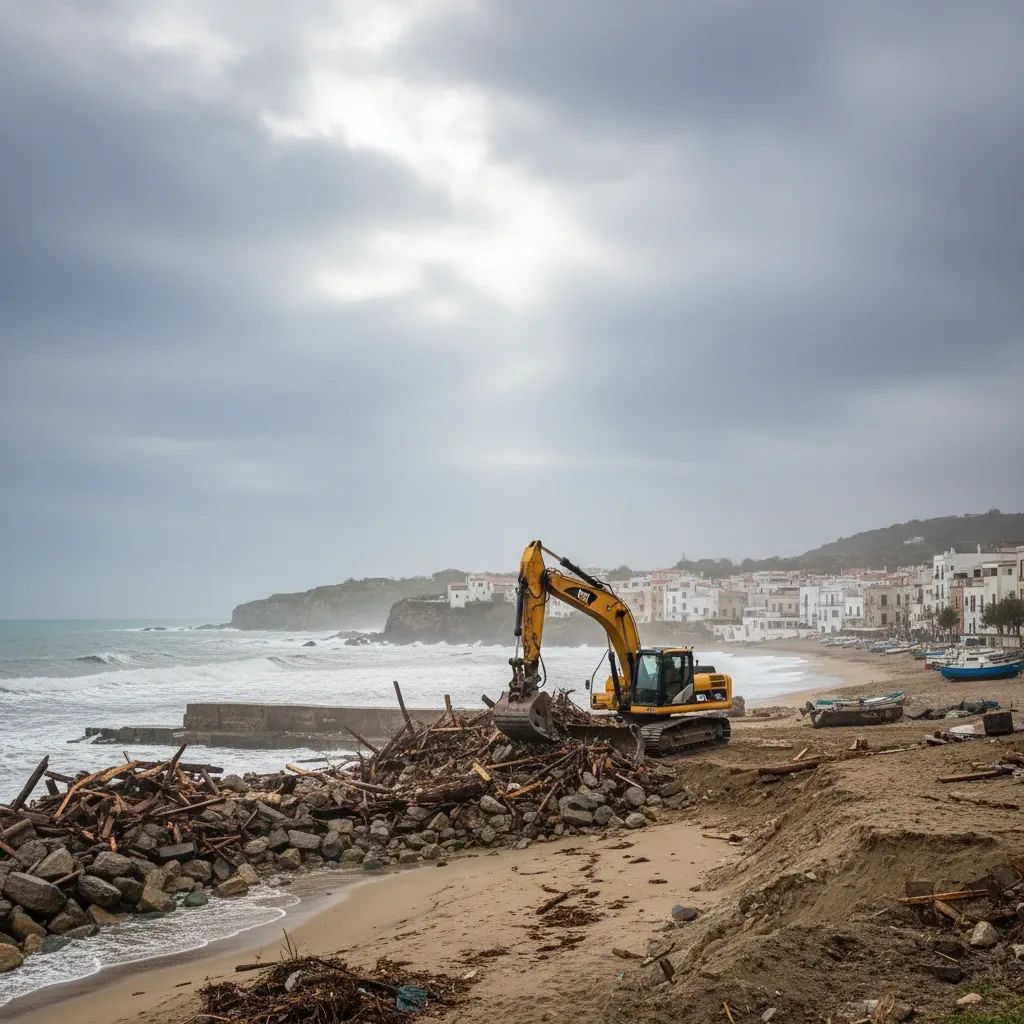
The Italian National System for Environmental Protection (SNPA) has confirmed that 2025 ranks as the second hottest year on record for Italian seas since monitoring began in 1982, with annual average temperatures reaching 20°C—a full 1.18°C above the 1991-2020 baseline. Peak summer readings soared to 26.64°C in July and 26.48°C in August, underscoring an accelerating climate trajectory that is reshaping marine ecosystems, fisheries, and coastal economies across the peninsula.
What This Means for You Right Now
For residents and businesses across Italy, the warming Mediterranean is no longer a distant environmental headline—it's reshaping daily life in immediate, tangible ways.
At your dinner table: Fish species are vanishing from Italian waters while newcomers from warmer regions are arriving. In Palermo markets, for example, 95% of fish sold as sardine is actually the look-alike species alaccia, a direct consequence of shifting populations. Restaurants from the Adriatic to Sicily are quietly experimenting with "new" Mediterranean species—some exotic only a decade ago—as traditional catches become scarcer and more expensive. Expect to see different offerings on coastal menus and potentially higher seafood prices.
If you own coastal property: Warmer seas are intensifying extreme weather events. Sudden deluges, hailstorms, and flash floods have become more frequent and severe, damaging transport networks, energy grids, and infrastructure. Property owners in coastal zones face heightened flood risk and rising insurance costs. Venice and low-lying areas along the Adriatic and Tyrrhenian coasts are particularly vulnerable to storm surge amplified by warmer water temperatures.
If you live in the South: Water is becoming scarcer. While northern Italy saw a 7% increase in precipitation in 2025, southern regions recorded a 5% decline, aggravating chronic water scarcity in Sicily, Calabria, and Puglia. For residents in these areas, this means tighter water restrictions during summer months, higher water bills, and agricultural pressures that could affect local food prices and availability.
Beach safety: Spain has already closed beaches due to Vibrio bacteria, which thrive in warmer waters and cause infections. Italian health authorities are monitoring this risk, particularly in the Adriatic and Ionian seas where temperatures have risen most dramatically. Jellyfish sightings have also increased, and harmful algae blooms are becoming more frequent—conditions you should monitor before planning beach outings.
If you work in fishing or tourism: Fishing activity in some areas has contracted by up to 40%, forcing families dependent on the sea to explore alternative livelihoods or migrate. Tourism is shifting, too: 51% of tourists now alter their destination based on weather forecasts, with a noticeable exodus from beaches to mountains during peak heat. This reshaping of the seasonal economy is already affecting employment and local business resilience in many coastal communities.
Why This Matters at the Systemic Level
• Marine biodiversity under stress: The warming trend is driving "tropicalization," with traditional Mediterranean species declining or migrating northward while invasive species proliferate. The sighting of common fin whales plummeted to just 63 individuals in 2025, down from the typical range of 150 to 200.
• Fishing industry disruption: Reproductive capacity of key commercial species—including tuna, swordfish, and sardines—has dropped by up to 30%, and some fishing zones report activity reductions of 40%. Fishing activity in some areas has contracted dramatically as species distributions shift.
• Tourism and economic risk: The European Central Bank estimates the 2025 summer heat wave alone cost the continent roughly 0.3% of economic output, with cumulative losses projected to reach 0.8% by 2029. Italy's coastal economy, worth roughly $450 billion annually when including direct and indirect tourism and fishing sectors, is under serious threat.
• Regulatory momentum: Italy's newly established National Observatory on Climate Adaptation (launched December 2025) and the finalized National Climate Adaptation Plan signal institutional readiness to confront the crisis head-on.
The Thermal Reality Behind the Numbers
The SNPA report, compiled by ISPRA and regional environmental agencies (Arpa/Appa), paints a picture of sustained atmospheric and oceanic warming. Atmospheric temperatures in Italy averaged 1.03°C above the 1991-2020 reference, with every month except October and November exceeding historical norms. June 2025 was the second-hottest June on record, trailing only the legendary 2003 heat wave, with a staggering +3.23°C anomaly.
Seasonally, summer 2025 placed fourth among the warmest since 1961 (+1.46°C), while winter (+1.21°C) and spring (+0.86°C) both ranked among the top warmest in the six-decade series. Even autumn, typically a moderating season, closed 0.16°C above average.
The marine thermal signature is even more striking. The Mediterranean basin, widely recognized as a climate change hotspot, is warming faster than the global ocean average. In June 2026, sea surface temperature anomalies of up to 8°C were recorded off southern France and around Corsica, Sardinia, and the Italian peninsula. The Ligurian and Tyrrhenian seas registered anomalies of +6°C, fueling a cascade of ecological disruptions.
Ecosystems in Flux: From "Tropicalization" to Mass Mortality
The Mediterranean, despite covering less than 1% of the world's ocean surface, harbors between 5% and 15% of known marine biodiversity. That richness is now under siege. Marine heat waves—periods of abnormally high sea temperatures—have surged in frequency and intensity, triggering mass mortality events among sessile organisms such as corals, sponges, and gorgonians.
Scientists describe the phenomenon as "tropicalisation": heat-loving species from warmer latitudes are colonizing Mediterranean waters, while native cold-water species retreat or collapse. Alien species, particularly in the eastern basin, are proliferating so rapidly that experts predict one-third of Mediterranean marine species could be non-native within five years.
Critical habitats are deteriorating. Posidonia oceanica meadows—underwater prairies that purify water, sequester carbon, and stabilize sediments—are losing resilience. Ocean acidification, driven by increased CO₂ absorption, is eroding the shells and skeletons of calcifying organisms. The reproductive viability of commercially vital fish has dropped by up to 30%, disrupting the entire food web and threatening long-term stock sustainability.
Policy Response: What's Being Done (and What's Stalling)
For individuals and businesses in Italy, the question is clear: what are institutions doing to adapt and mitigate?
The Italian Ministry of the Environment and Energy Security (MASE) has established institutional architecture designed to coordinate adaptation. The National Observatory on Climate Adaptation, established in December 2025, is tasked with steering implementation of the National Climate Adaptation Plan (PNACC), approved in late 2023. The Observatory will update the plan periodically, identify funding sources, and monitor progress across sectors.
Italy's Integrated National Energy and Climate Plan (PNIEC) sets ambitious targets: 30% of energy consumption from renewables by 2030 and 33% emission cuts in non-ETS sectors relative to 2005 levels. The Social Climate Fund, valued at over €9.3 billion, is earmarked for energy efficiency retrofits, renewable installations, and sustainable mobility.
However, there's a critical implementation gap: As of June 2026, Italy's utilization plan for the €9.3 billion Social Climate Fund remained stalled. This delay directly affects you: programs that could retrofit homes for energy efficiency, install solar panels with subsidies, or expand electric vehicle charging infrastructure are stuck in bureaucracy. For households facing higher energy bills amid climate stress, this represents lost opportunity.
Regional initiatives are adding momentum. Lombardy's Climate Law (l.r. 11/2025), passed in July 2025, mandates renewable energy systems in new buildings and accelerates electric vehicle charging infrastructure rollout. It also controversially opens the door to nuclear energy as part of the decarbonization mix.
Italy's greenhouse gas emissions fell 3.6% in 2024 compared to 2023, achieving a 30% reduction from 1990 levels, driven by renewable energy expansion. Yet projections for 2025 suggest a modest 0.3% uptick, largely due to increased natural gas use in power generation. The transport sector remains a stubborn challenge, with emissions 10% above 1990 levels and accounting for 31% of national totals.
A Turning Point, Not a Tipping Point
Maria Alessandra Gallone, president of ISPRA and SNPA, emphasized in the report that climate change "is no longer a future challenge, but a present reality." She underscored that meeting emission reduction targets is feasible, contingent on accelerating policy action grounded in scientific evidence.
The data from 2025 mark a sobering milestone, but Italy's institutional response—anchored in the PNACC, the National Observatory, and sector-specific plans—offers a framework for measured, science-driven action. The challenge is execution: translating policy ambition into tangible emissions cuts, ecosystem restoration, and economic adaptation.
For residents, the warming Mediterranean is no longer an abstract threat. It is reshaping the fish on dinner plates, the appeal of beach holidays, the risk profile of coastal homes, and the stability of regional water supplies. Whether Italy can leverage this crisis to accelerate green investment, protect biodiversity, and build climate-proof infrastructure will define not only the nation's environmental legacy but also its economic competitiveness in a rapidly warming world.


